
Overcoming Nihilism: Reflections Based on Nietzsche, Dostoevsky, and Camus
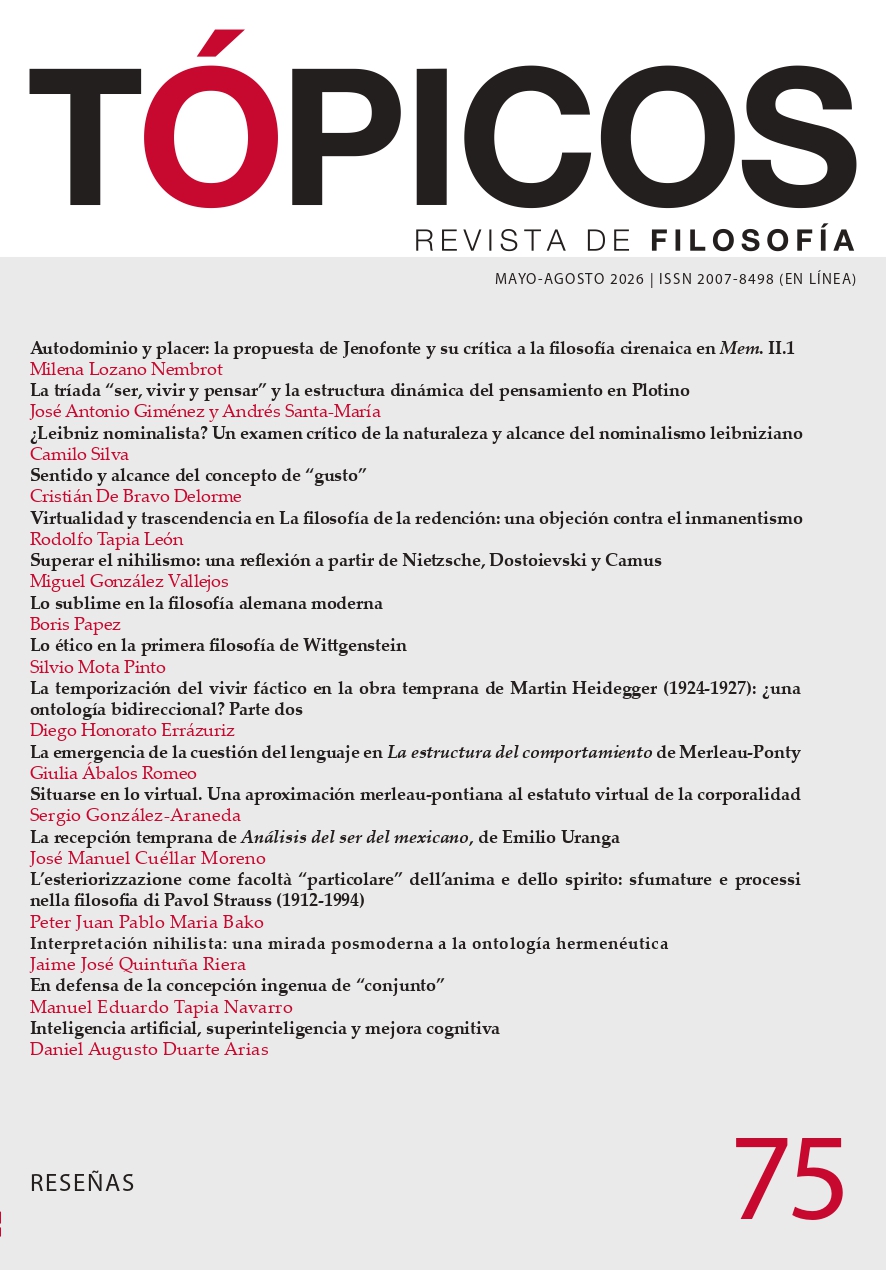
Published 2026-03-04
How to Cite
Downloads
Copyright (c) 2026 Miguel González Vallejos

This work is licensed under a Creative Commons Attribution-NonCommercial-ShareAlike 4.0 International License.
Abstract
This article raises the problem of overcoming nihilism in Nietzsche, Dostoevsky, and Camus. After analyzing the meaning of this concept, focusing on the Kirillov case raised in the novel The Demons, the responses of these authors to this phenomenon are addressed, namely, Nietzsche’s eternal return, Camus’s reconciliation with absurdity, and Dostoevsky’s return to Christianity. The central claim is that any philosophy or ideology that disregards God will fail in its attempt to overcome nihilism.
Keywords
- nihilism,
- Nietzsche,
- Dostoevsky,
- Camus,
- Kirillov
- The Demons,
- Volpi,
- Zarathustra,
- absurd,
- overcoming ...More
References
- Camus, A. (2018). El mito de Sísifo. L. Echávari (trad.). Alianza.
- De Lubac, H. (2012). El drama del humanismo ateo. C. Castro (trad.). Ediciones Encuentro.
- Dostoievski, F. (2016) Crimen y castigo. J. López-Morillas (trad.). Alianza.
- Dostoievski, F. (2017). Los demonios. J. López-Morillas (trad.). Alianza.
- Dostoievski, F. (2017). Los hermanos Karamazov. A. Vidal (trad.). Alianza.
- Frank, J. (2010). Dostoievski. Los años milagrosos. 1865-1871. Tomo IV. M. Utrilla (trad.). FCE.
- Feuerbach, L. (2013). La esencia del cristianismo. J. Iglesias (trad.). Trotta.
- Gillespie, M. (2016). Dostoevsky´s Impact on Nietzsche´s Undertasting of Nihilism. En J. Love y J. Metzger (eds.), Nietzsche and Dostoevsky: Philosophy, Morality, Tragedy (pp. 87-108). Northwestern University Press.
- González Vallejos, M. (2023). Filosofía de la cruz. Ediciones UC.
- Nietzsche, F. (2009). Digitale Kritische Gesamtausgabe. Werke und Briefe. G. Colli y M. Montinari (eds.). De Gruyter. http://www.nietzschesource.org/#eKGWB
- Nietzsche, F. (2016a). Fragmentos póstumos. Volumen IV. (1885-1889). D. Sánchez Meca (ed.). J. L. Vermal Beretta y J. Bautista Llinares Chover (trads.). Tecnos.
- Nietzsche, F. (2016b). Obras completas. Volumen IV. D. Sánchez Meca (ed.). J. Aspiunza, M. Barrios Casares, K. Lavernia Biescas, J. Bautista Llinares Chover y A. Martín Navarro (trads.). Tecnos.
- Pieper, A. (2012). Zarathustra als Verkünder des Übermenschen und als Fürsprecher des Kreises. En V. Gerhardt (ed.), Friedrich Nietzsche. Also sprach Zaratustra (pp. 69-91). Akademie Verlag. https://doi.org/10.1524/9783050057385.69
- Simon, J. (2012). Ein Text wie Nietzsches Zarathustra. En V. Gerhardt (ed.), Friedrich Nietzsche. Also sprach Zaratustra (pp. 169-192). Akademie Verlag. https://doi.org/10.1524/9783050057385.169
- Stepenberg, M. (2019). Against Nihilism: Nietzsche Meets Dostoevsky. Blake Rose Books.
- Stellino, P. (2015). Nietzsche and Dostoievski: On the Verge of Nihilism. Peter Lang. https://doi.org/10.3726/978-3-0351-0860-6
- Volpi, F. (2004). El nihilismo. A. Vigo y C. del Rosso (trads.). Biblos.