
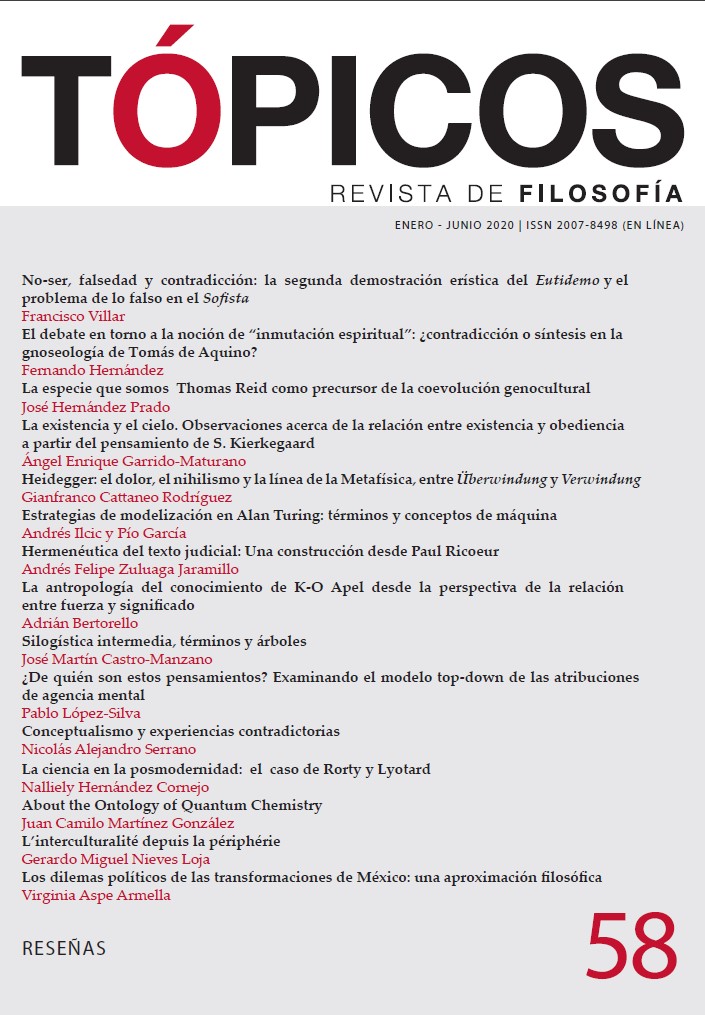
Published 2019-12-13
How to Cite
Downloads
Copyright (c) 2019 Nicolás Alejandro Serrano

This work is licensed under a Creative Commons Attribution-NonCommercial-ShareAlike 4.0 International License.
Abstract
In this paper I provide a conceptualist answer to Crane’s (1988a; 1988b) waterfall illusion argument in the representationalist debate about the type of content of perceptual experience. First, I analyze the general structure of the argument, according to which the putatively contradictory content of certain optical illusions shows that perceptual experiences have non-conceptual content. Second, I discuss some conceptualist answers to the argument in order to show why they are not satisfactory. Finally, I offer a conceptualist answer, that I call “dissociative”, according to which the content of the waterfall illusion is not actually contradictory.
Keywords
- waterfall illusion,
- perceptual experience,
- non-conceptual content,
- conceptual content
References
- Aristóteles. (1987). De Insomniis (traducido como “Acerca de los ensueños” por Pachecho, S.). En Acerca de la Generación y la Corrupción. (pp. 277-294). Madrid: Gredos.
- Braddick, O. (2010). Motion Perception. En E. B. Goldstein (ed.), Encyclopedia of Perception. (pp. 571-577). Londres: SAGE Publications Inc.
- Brewer, B. (1999). Perception and Reason. Oxford: Oxford University Press.
- Brewer, B. (2001). Précis of Perception and Reason. Philosophy and Phenomenological Research, 63(2), 405-416.
- Brewer, B. (2005). Perceptual eExperience has Conceptual Content. En E. Sosa y M. Steup (eds.), Contemporary Debates in Epistemology. (pp. 217-230). Oxford: Blackwell.
- Byrne, A. (2005). Perception and Conceptual Content. En E. Sosa y M. Steup (eds.), Contemporary Debates in Epistemology. (pp. 231-250). Oxford: Blackwell.
- Clifford, C. W. G. (2010). Afterimages. En E. B. Goldstein (ed.), Encyclopedia of Perception. (pp. 13-16). Londres: SAGE Publications Inc.
- Crane, T. (1988a). The Waterfall Ilussion. En Y. H. Gunther (ed.), Essays on Nonconceptual Content. (pp. 231-236). Cambridge: MIT Press.
- Crane, T. (1988b). Concepts in Perception. Analysis, 48(3), 150-153.
- Einhäuser, W., Martin, K. A. C. y König, P. (2004). Are Switches in Perception of the Necker Cube Related to Eye Position? European Journal of Neuroscience, 20, 2811-2818.
- Evans, G. (1982). The Varieties of Reference. Oxford: Oxford University Press.
- Fodor, J. (1983). The Modularity of Mind. Cambridge: MIT Press.
- Frege, G. (1892). Über Sinn und Bedeutung. En Zeitschrift für Philosophie und philosophische Kritik, 100, 25-50. (Traducido como “On Sense and Reference” en P. Geach y M. Black. (1980). Translations from the Philosophical Writings of Gottlob Frege. (pp. 56-78). Oxford: Blackwell).
- Frisby, J. (1979). Seeing: Illusion, Brain and Mind. Oxford: Oxford University Press.
- Goldstein, E. B. (2010). Encyclopedia of Perception. Londres: SAGE Publications Inc.
- Gunther, Y. H. (2001). Content, Illusion, Partition. Philosophical Studies: An International Journal for Philosophy in the Analytic Tradition, 102 (2), 185-202.
- Gunther, Y. H. (2003). Essays on Nonconceptual Content. Cambridge: MIT Press.
- Hamlyn, D. W. (1994). Perception, Sensation, and Nonconceptual Content. Reeditado en Y. H. Gunther (ed.), Hamlyn, D. W. (2003). Essays on Nonconceptual Content (pp. 251-262). Cambridge, Massachusetts: The MIT Press.
- Heck, R. G. (2000). Non-Conceptual Content and the ‘Space of Reasons’. The Philosophical Review, 109(4), 483-523.
- Heck, R. G. (2007). Are There Different Kinds of Content? En Brian P. McLaughlin y Jonathan D. Cohen (eds.), Contemporary Debates in Philosophy of Mind. (pp. 117-138). Oxford: Blackwell.
- Marr, D. (1982). Vision. San Francisco: Freeman and Co.
- Martinez-Conde, S. y Macknik, S. L. (2010). Visual Illusions. En E. B. Goldstein (ed.), Encyclopedia of Perception. (pp. 1077-1081). Londres: SAGE Publications Inc.
- McCauley, R. N. y Henrich, J. (2006). Susceptibility to the Müller-Lyer Illusion, Theory-Neutral Observation, and the Diachronic Penetrability of the Visual Input System. Philosophical Psychology, 19, 79-101.
- McDowell, J. (1994). Mind and World. Cambridge: Harvard University Press.
- McDowell, J. (1996). Afterword. En Mind and World. 2da. ed. (pp. 129-187). Cambridge: Harvard University Press.
- McDowell, J. (1998). Reply to Commentators. Philosophy and Phenomenological Research, 58(2), 403-431.
- McDowell, J. (2009). Having the World in View: Essays on Kant, Hegel, and Sellars. Cambridge: Harvard University Press.
- Mellor, D. H. (1988). Crane’s Waterfall Illusion. Analyisis, 48(3),147-150.
- Peacocke, C. (1992). Scenarios, Concepts, and Perception. Reeditado en Y. H. Gunther (ed.), (2003). Essays on Nonconceptual Content. (pp. 107-132). Cambridge, Massachusetts: The MIT Press.
- Russell, B. (1912). The Problems of Philosophy. Londres: Williams and Norgate; Nueva York: Henry Holt and Company.
- McDowell, J. (1940). An Inquiry into Meaning and Truth. Londres: George Allen and Unwin. Nueva York: W.W. Norton.
- Skidelsky, L. (2010). Contenido conceptual - no conceptual y vehículos representacionales. En D. Pérez, S. Español, L. Skidelsky y R. Minervino (comps.), Conceptos. Debates contemporáneos en filosofía y psicología. (pp. 65-101). Buenos Aires: Catálogos.
- Speaks, J. (2005). Is There a Problem about Nonconceptual Content? The Philosophical Review, 114(3), 359-398.