
Publiée 2016-12-27
Comment citer
Téléchargements
(c) Copyright Juan José Sanguineti 2016

Ce travail est disponible sous licence Creative Commons Attribution - Pas d’Utilisation Commerciale - Partage dans les Mêmes Conditions 4.0 International.
Résumé
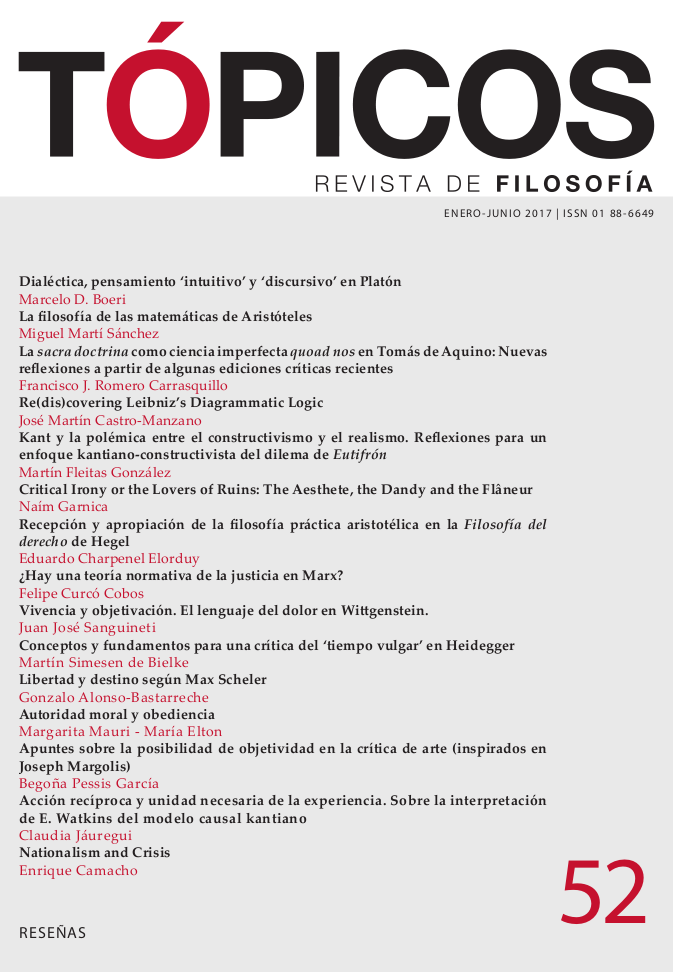
El artículo examina el pensamiento de Wittgenstein sobre el lenguaje del dolor en la primera y tercera persona. Se subrayan ciertas diferencias gramaticales importantes, según el típico método lingüístico de este filósofo, no sólo respecto a esas dos perspectivas, sino también con relación al uso de verbos cognitivos como “sentir” y “saber”. El examen de muchos textos sugiere ciertos puntos acerca de las relaciones entre las vivencias personales, la captación empática de las vivencias ajenas y su traducción conceptual. Una breve comparación con algunos textos de Tomás de Aquino completa la propuesta de la existencia de un conocimiento no intencional.
Mots-clés
- dolor,
- sensación,
- vivencia,
- saber,
- certeza
- creencia,
- duda,
- forma de vida,
- concepto,
- empatía,
- yo,
- nombres ...Plus
Références
- Wittgenstein, L. (1964). Philosophical Remarks. Oxford: Blackwell. Escrito en 1930.
- ____(1984). Werkausbage Band 5: Das Blaue Buch y Eine Philosophische Betrachtung (Das Braune Buch). Frankfurt am Main: Suhrkamp. Dictó estos cuadernos en los años 1933-35.
- ____(1993). Philosophical Occasions 1912-1951. Indianapolis and Cambridge: Hackett. Colección de algunos breves escritos de Wittgenstein. Contiene Notes for Lectures on “Private Experience” and “Sense data” (pp. 201-288), que se remiten a los años 1934-36.
- ____(1967). Zettel. Oxford: Blackwell. Preparados especialmente entre 1945 y 1948.
- ____(1953). Philosophische Untersuchungen, Philosophical Investigations. Oxford: Blackwell. Escritas entre 1945 y 1949.
- ____(1980). Remarks on the Philosophy of Psychology. vol. 1. Oxford: Blackwell, vol. 1. Escritos en los años 1947-48.
- ____(1992). Last Writings on the Philosophy of Psychology. vol. II: The Inner and the Outer. Oxford: Blackwell. Escritos en los años 1949-1951.
- ____(1969). On Certainty. Oxford: Blackwell. Escrito en los años 1949-1951.
- ____(1984). Werkausbage Band 7: Bemerkungen über die Philosophie der Psychologie y Letzte Schriften über die Philosophie der Psychologie. Frankfurt am Main: Suhrkamp. Los Le te Schriften (Ultimos escritos) se sitúan entre 1948 y 1951 (año de la muerte de Wittgenstein).
- Anscombe, E. (1981a). From Parmenides to Wittgenstein. Oxford: Blackwell.
- ____(1981b). Metaphysics and the Philosophy of Mind. Oxford: Blackwell.
- Arregui, J. V. (1984). Acción y sentido en Wittgenstein. Pamplona: Eunsa.
- Benne , M. R. y P. M. S. Hacker (2003). Philosophical Foundations of Neuroscience. Oxford: Blackwell.
- ____(2008). History of Cognitive Neuroscience. Oxford: Blackwell.
- Black, M. (1988). Lebensform e Sprachspiel nelle ultime opere di Wittgenstein. En M. Andronico, D. Marconi y C. Penco (eds.) Capire Wittgenstein. (241-251). Génova: Marietti.
- Cashell, K. (2011). New Criteria for Pain: Ordinary Language, Other Minds, and the Grammar of Sensation. «Abstracta», 6: 2, 178-215.
- Child, W. (2011).Wittgenstein. New York: Routledge.
- Dahlstrom, D. O. (2004). Wittgenstein’s intellectual virtues. En R. Pozzo (ed.). The Impact of Aristotelianism on Modern Philosophy. (266-284). Washington: The Catholic University of America Press.
- Egidi, R. (1995) (ed.). Wittgenstein: Mind and Language. Dordrecht: Kluwer.
- Feser, E. (2007). Philosophy of Mind: A Beginner’s Guide. Oxford: Oneworld.
- Finkelstein, D. (2001). Wittgenstein’s ‘Plan for the Treatment of Psychological Concepts’. En T. McCarthy y S. C. Stidd (eds.), Wittgenstein in America, (215-236). Oxford: Clarendon Press.
- Frege, G. (1977). Thoughts, en Logical Investigations. ed. P. Geach, Oxford: Blackwell.
- Friebe, C. (2014). ‘Ich habe Schmerzen’: Wittgensteins Schreien oder Reflexion? En Philosophisches Jahrbuch, 111, 343-364.
- Geach, P. (2004) (ed.) Ludwig Wittgenstein. Lecciones de filosofía de la psicología 1946-1947. Apuntes de P. T. Geach, K. J. Shah y A. C.
- Jackson, P. Geach (ed.) Madrid: Alianza Editorial.
- Hacker, P. M. (1990). Wittgenstein. Meaning and Mind. vol. 3 de An Analytical Commentary on the Philosophical Investigations. Oxford: Blackwell.
- ____(1996). Wittgenstein. Mind and Will. vol. 4 de An Analytical Commentary on the Philosophical Investigations. Oxford: Blackwell.
- ____(2001). Wittgenstein: Connections and Controversies. Oxford: Clarendon Press.
- ____(2006). Of knowledge and of knowing that someone is in pain. En Pichler, A. y Säätelä, S. (eds.) Wittgenstein: The Philosopher and his Works. (244-276). Frankfurt am Main: Ontos.
- Kenny, A. (1982). Wittgenstein. Madrid: Alianza.
- ____(1995). Wittgenstein on Mind and Metaphysics. En Egidi, R. (ed.) Wittgenstein: Mind and Language. (37-46). Dordrecht: Kluwer.
- López de Santa María Delgado, P. (1986). Introducción a Wittgenstein. Sujeto, mente y conducta. Barcelona: Herder.
- Madden, J. M. (2013). Mind, Matter, and Nature. A Thomistic Proposal for the Philosophy of Mind. Washington: The Catholic University of America Press.
- Malcolm, N. (1982). Wittgenstein and Idealism. En Vesey, G. (ed.) Idealism. Past and Present. (249-267). Cambridge: Cambridge University Press.
- ____(1986). Nothing is Hidden. Oxford: Blackwell.
- Pavlopoulos, M. (2010). Wittgenstein et la première personne. En Philosophique, 13, 73-90.
- Polo, L. (1984-1996). Curso de teoría del conocimiento. vol. 4. Pamplona: Eunsa.
- Rojo, R. (1999). Wittgenstein: Gramática y Metafísica. En Thémata. Revista de Filosofía, 21, 263-276.
- Rust, A. (1996). Wittgensteins Philosophie der Psychologie. Frankurt am Main: Klostermann.
- Sanguineti, J. J. (2007). Filosofía de la mente. Madrid: Palabra.
- ____(2011). La especie cognitiva en Tomás de Aquino, En Tópicos, 40, 81-87.
- ____(2014). Neurociencia y Filosofía del hombre. Madrid: Palabra.
- Schulte, J. (1993). Experience and Expression. Wittgenstein’s Philosophy of Psychology. Oxford: Clarendon Press.
- Sluga, H. y D. G. Stern (1996) (eds.) The Cambridge Companion to Wittgenstein. Cambridge: Cambridge University Press.
- Spinicci, P. (2000). Il mondo della vita e il problema della certeza. Milán: Cuem.
- Tejedor Palau, M. A. (1996). La crítica de Wittgenstein al escepticismo. Moore y “Sobre la certeza”. En Logos. Anales del Seminario de Metafísica, 30, 287-296.
- Thorgaard, K. (2010). The normative and epistemological status of pain experiences in modern health care. En Tidsskrift for Forskning i Sygdom og Samfund, 13, 109-130.
- Von Wright, G. H. (1982). Wittgenstein. Oxford: Blackwell, Oxford.