
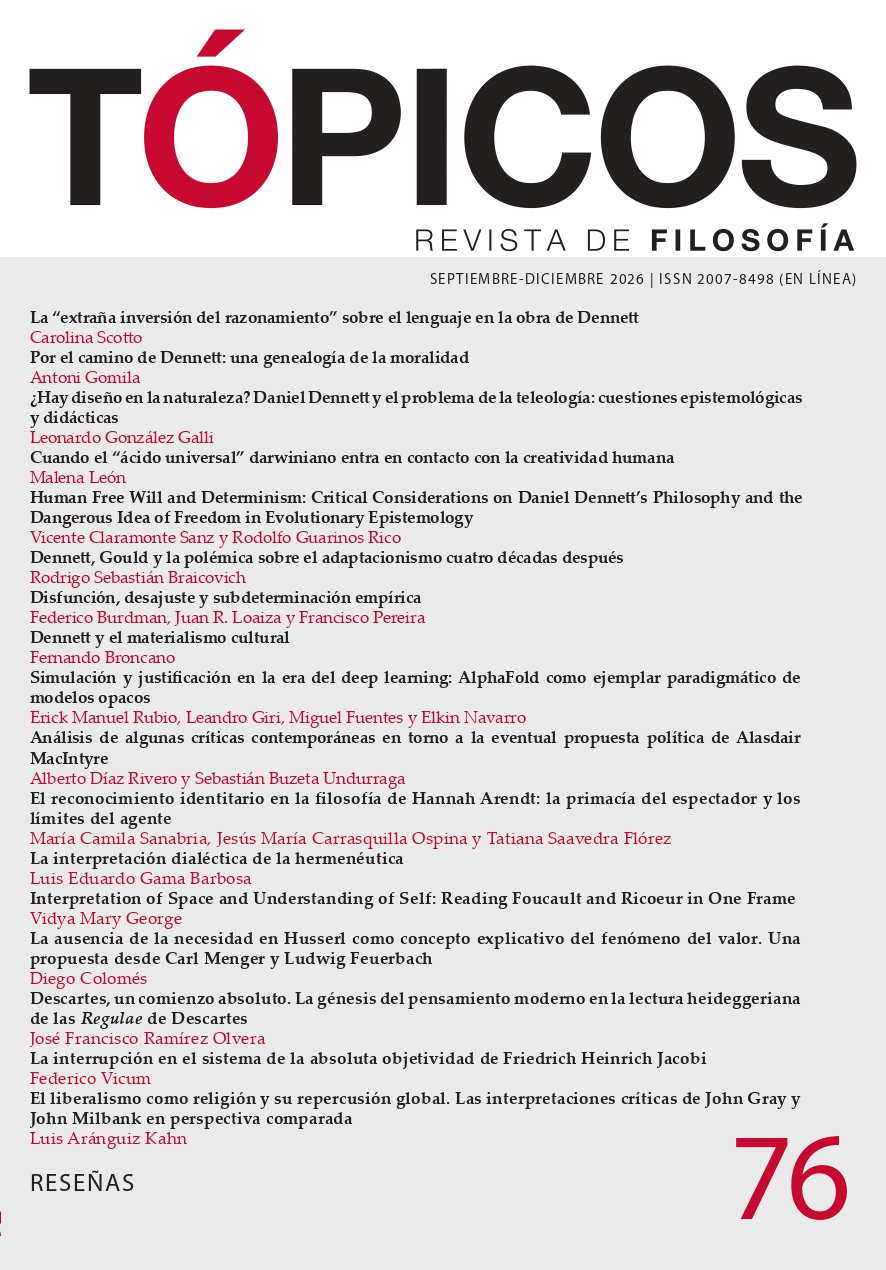
Publicado 2026-05-20
Como Citar
Downloads
Direitos de Autor (c) 2026 Carolina Scotto

Este trabalho encontra-se publicado com a Licença Internacional Creative Commons Atribuição-NãoComercial-CompartilhaIgual 4.0.
Resumo
En este trabajo me propongo mostrar de qué maneras, según Dennett, la “peligrosa idea” de Darwin alcanza también al lenguaje y a sus propiedades distintivas. Según Dennett, en virtud de una “extraña inversión del razonamiento” atribuible a la obra de Darwin, todo “diseño inteligente” obedece al principio de la competencia sin comprensión, según el cual la primera precede y está presupuesta por la segunda, por lo que, en algunos casos, es posible explicarla sin que la comprensión tenga lugar. Como se verá, la reconfiguración que resulta de aquella “inversión del razonamiento” acerca de la relación de los humanos con el lenguaje —cómo emergió, cómo es aprendido, cómo es usado, cuáles son sus efectos cognitivos y culturales— así como del lenguaje mismo como un conjunto de herramientas comunicativas y cognitivas, es de signo opuesto a la que ofrecen muchas concepciones filosóficas y lingüísticas contemporáneas, arraigadas en el principio opuesto: la primacía de la comprensión sobre la competencia.
Palavras-chave
- extraña inversión del razonamiento,
- competencia sin comprensión,
- lenguajes,
- Darwin,
- Dennett
- evolución del lenguaje,
- memes,
- palabras,
- significados,
- comunicación ...Mais
Referências
- Blackmore, S. J. (1999). The Meme Machine. OUP.
- Carroll, L. (2015). Los libros de Alicia. E. Stilman (trad.). Ediciones de la Flor.
- Clatterbuck, H. (2018). Dennett´s Canon and Major Cognitive Transitions. Teorema, 37(3), 129-143.
- Darwin, C. (1987). Charles Darwin´s Notebooks 1836-1844. P. H. Barrett, P. J. Gautrey, S. Herbert, D. Kohn y S. Smith (eds.). Cambridge University Press.
- Darwin, C. (1992). El origen de las especies. A. de Zulueta (trad.). Planeta.
- Darwin, C. (2009a). The Correspondence of Charles Darwin. Volume 20. Cambridge University Press. https://doi.org/10.1017/CBO9781139815000
- Darwin, C. (2009b). The Descent of Man, and Selection in Relation to Sex. CUP. https://doi.org/10.1017/CBO9780511703836
- Dawkins, R. (1976). The Selfish Gene. OUP.
- Dawkins, R. (1982). The Extended Phenotype. OUP.
- Dawkins, R. (1983). Universal Darwinism. En D. S. Bendall (ed.), Evolution from Molecules to Men (pp. 403-425). CUP.
- Dennett, D. C. (1980). Passing the Buck to Biology. Behavioral and Brain Sciences, 3, 19. https://doi.org/10.1017/S0140525X00001552
- Dennett, D. C. (1991a). Consciousness Explained. Little, Brown and Co.
- Dennett, D. C. (1991b). Real Patterns. Journal of Philosophy, 88(1), 27-51. https://doi.org/10.2307/2027085
- Dennett, D. C. (1993). Learning and Labelling (Comments on Clark and Karmiloff-Smith, “The Cognizer´s Innards”). Mind & Language, 8(4), 540-547. https://doi.org/10.1111/j.1468-0017.1993.tb00302.x
- Dennett, D. C. (1995). Darwin´s Dangerous Idea: Evolution and the Meanings of Life. Simon & Schuster.
- Dennett, D. C. (1996). Kinds of Minds: Towards an Understanding of Consciousness. Weidenfeld & Nicolson.
- Dennett, D. C. (1997). How to do Other Things with Words. Royal Institute of Philosophy Supplement, 42, 219-245. https://doi.org/10.1017/S1358246100010262
- Dennett, D. C. (1998). La actitud intencional. G. Ventureira (trad.). Gedisa.
- Dennett, D. C. (2000). Making Tools for Thinking. En D. Sperber (ed.), Metarepresentations: A Multidisciplinary Perspective (pp. 17-29). OUP. https://doi.org/10.1093/oso/9780195141146.003.0002
- Dennett, D. C. (2009a). Darwin´s “Strange Inversion of Reasoning”. PNAS, 106(suppl. 1), 10061-10065. https://doi.org/10.1073/pnas.0904433106
- Dennett, D. C. (2009b). The Cultural Evolution of Words and Other Thinking Tools. Cold Spring Harbor Symposia on Quantitative Biology, 74, 435-441. https://doi.org/10.1101/sqb.2009.74.008
- Dennett, D. C. (2013). Foreword. En D. Ryder, J. Kingsbury y K. Williford (eds.), Millikan and Her Critics (pp. ix-xii). John Wiley & Sons.
- Dennett, D. C. (2014a, 2 de agosto). Perspectives on Cultural Evolution. International Cognition & Culture Institute. https://cognitionandculture.net/webinars/sfi-cultural-evolution-workshop/perspectives-on-cultural-evolution-by-daniel-c-dennett/
- Dennett, D. C. (2014b). The Evolution of Reasons. En B. Bashour, B. y H. D. Muller (eds.), Contemporary Philosophical Naturalism and Its Implications (pp. 47-62). Routledge.
- Dennett, D. C. (2017a). From Bacteria to Bach and Back: The Evolution of Mind. W. W. Norton & Co.
- Dennett, D. C. (2017b). Haig´s ´Strange Inversion of Reasoning´ [Manuscrito]. Center for Cognitive Studies, Tufts University.
- Dennett, D. C. (2018a). Reflections on Clatterbuck. Teorema, 37(3), 145-150.
- Dennett, D. C. (2018b). Reflections on Tadeusz Zadwidzki. En B. Huebner (ed.), The Philosophy of Daniel Dennett (pp. 57-61). OUP.
- Dennett, D. C. (2018c). Resumen de From Bacteria to Bach and Back: The Evolution of Minds. Teorema, 37(3), 103-106.
- Dennett, D. C. (2020). Comment on “Can Memes Explain the Birth of Comprehension?”. Avant, 11(2), 1-4. https://doi.org/10.26913/avant.2020.02.13
- Dennett, D. C. (2023). I´ve Been Thinking. Norton & Co.
- Dennett, D. C. (2024). Commentary on Mark Richard, Meanings as Species. Inquiry, 67(2), 626-632. https://doi.org/10.1080/0020174X.2022.2039852
- Gibson, J. J (2015). The Ecological Approach of Visual Perception. Psychology Press. https://doi.org/10.4324/9781315740218
- Godfrey-Smith, P. (2018). Between Towers and Trees in Cognitive Evolution. En B. Huebner (ed.), The Philosophy of Daniel Dennett (pp. 225-249). OUP. https://doi.org/10.1093/oso/9780199367511.003.0015
- Hauser, M. D., Chomsky, N. y Fitch, T. (2002). The Faculty of Language: What Is It, Who Has It, and How Did It Evolve? Science, 298(5598), 1569-1579. https://doi.org/10.1126/science.298.5598.1569
- Keiser, J. (2023). Non-Ideal Foundations of Language. Routledge. https://doi.org/10.4324/9781003188537
- Locke, J. (2005). Ensayo sobre el entendimiento humano. E. O´Gorman (trad.). FCE.
- Mesoudi, A. (2021). Blind and Incremental or Directed and Disruptive? On the Nature of Novel Variation in Human Cultural Evolution. American Philosophical Quarterly, 58(1), 7-20. https://doi.org/10.2307/48600682
- Miguens, S. (2022). Animal Brains and the Work of Words: Daniel Dennett on Natural Language and the Human Mind. Topoi, 41(3), 599-607. https://doi.org/10.1007/s11245-021-09745-2
- Morgan, C. L. (2007). An Introduction to Comparative Psychology. Kessinger Publishing.
- Planer, R. J. (2023). Going Dennettian about Gricean Communication. Philosophical Psychology, 1271-1294. https://doi.org/10.1080/09515089.2023.2204887
- Planer, R. J. (2024). Memetics and the Parallel Architecture. Topics in Cognitive Science, 17, 898-908. https://doi.org/10.1111/tops.12735
- Rathkopf, C. (2017). Mental Evolution: A Review of Daniel Dennett´s From Bacteria to Bach and Back. Biology & Philosophy, 32, 1355-1368. https://doi.org/10.1007/s10539-017-9586-y
- Quine, W. O. (1968). Palabra y objeto. Manuel Sacristán (trad.). Editorial Labor.
- Scotto, C. (2022). A Pragmatics-First Approach to Faces. Topoi, 41(3), 641-657. https://doi.org/10.1007/s11245-022-09821-1
- Scotto, C. (2024). Signos liminares en el corazón de la comunicación: un enfoque interactivo. En I. Audisio y F. G. Rodríguez (eds.), Pensamiento cuerpo a cuerpo. Intersubjetividad, cuerpo y lenguaje (pp. 101-144). Ed. Universidad Nacional de Córdoba.
- Sellars, W. (1992). Philosophy and the Scientific Image of Man. En Science, Perception and Reality, Routledge & Kegan Paul.
- Sellars, W. (1997). Empiricism and the Philosophy of Mind. En R. Brandom (ed.), Harvard University Press.
- Schliesser, E. (2019). Synthetic Philosophy. Biology & Philosophy, 34. https://doi.org/10.1007/s10539-019-9673-3
- Sterelny K. (2006). Memes Revisited. British Journal of Philosophy of Science, 57, 145-165. https://doi.org/10.1093/bjps/axi157
- Zawidzki, T. W. (2007). Dennett. Oneworld Pub.
- Wittgenstein, L. (1997). Observaciones sobre la filosofía de la psicología. 2. L. F. Segura (trad.). UNAM.
- Wittgenstein, L. (2003). Investigaciones filosóficas. A. García Suárez y C. U. Moulines (trads.). UNAM.