
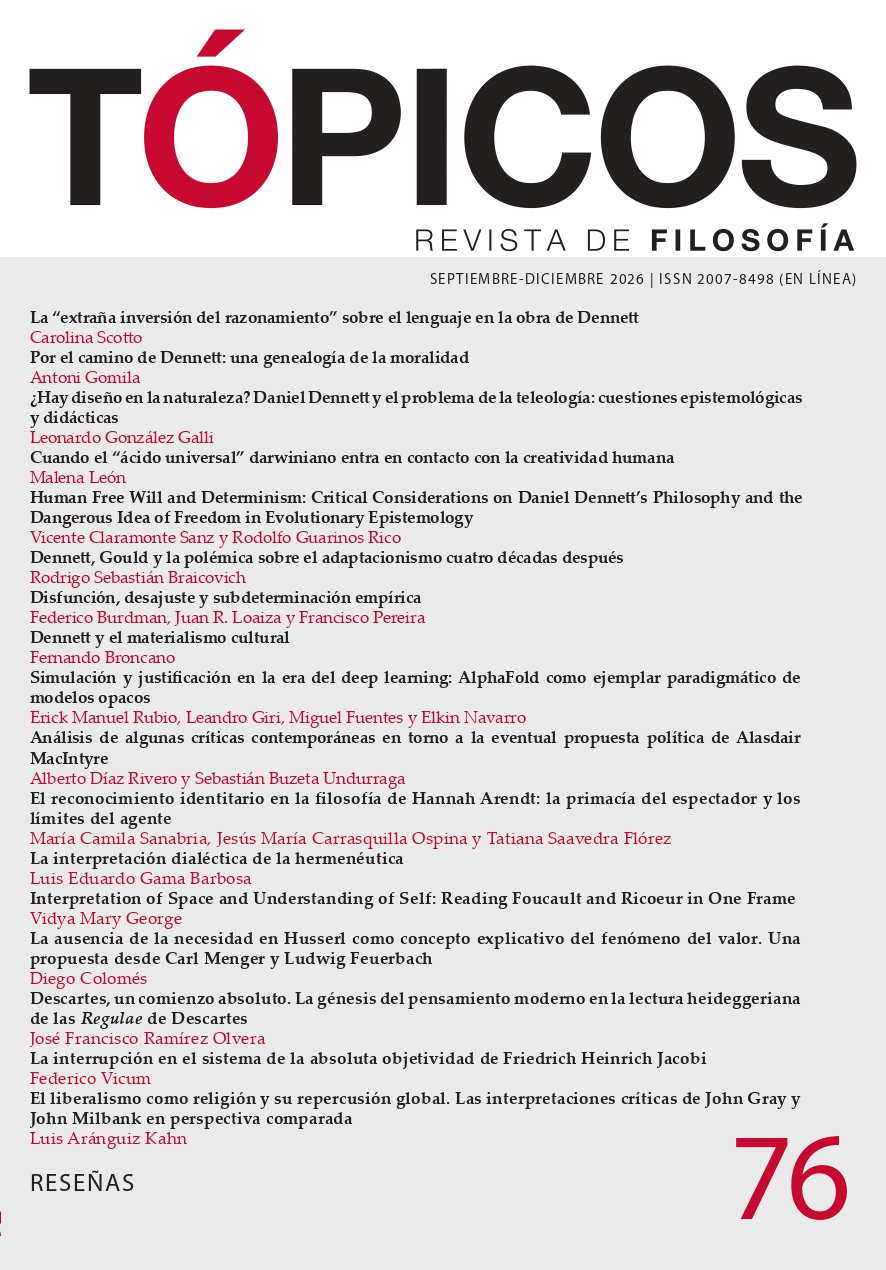
Human Free Will and Determinism: Critical Considerations on Daniel Dennett’s Philosophy and the Dangerous Idea of Freedom in Evolutionary Epistemology
Publicado 2026-06-01
Como Citar
Downloads
Direitos de Autor (c) 2026 Vicente Claramonte Sanz, Rodolfo Guarinos Rico

Este trabalho encontra-se publicado com a Licença Internacional Creative Commons Atribuição-NãoComercial-CompartilhaIgual 4.0.
Resumo
This paper proposes some critical considerations on Daniel Dennett’s philosophy, particularly on his notion of human free will in relation to determinism. To this effect, it analyses the four types of possibility studied by Dennett and their relationship with causality and chance in the context of the philosophy of biology. In addition, it also critically evaluates the distinction made by Dennett between deterministic, indeterministic, and nihilistic universes, with special attention to the treatment conferred in physics to the idea of causality in classical, relativistic, and quantum mechanics. Finally, it explains how the compatibility between human free will and deterministic natural laws defended by Dennett could be developed and explained in evolutionary epistemology.
Palavras-chave
- free will,
- determinism,
- indeterminism,
- causality,
- philosophy of biology
- evolutionary epistemology,
- Daniel Dennett’s philosophy,
- philosophy of science,
- materialism,
- libertarianism ...Mais
Referências
- Álvarez Toledo, S. (1999). Notas sobre la causalidad probabilística. In E. Abalde Paz & J. M. Muñoz Cantero (eds.), Metodología educativa I (pp. 21-28). Universidad de La Coruña.
- Aristóteles. (1988). Tratados de lógica. (Órganon). II. Sobre la interpretación, Analíticos primeros, Analíticos segundos. M. Candel Sanmartín (trans.). Gredos.
- Batterman, R. (1993). Defining Chaos. Philosophy of Science, 60, 43-66. https://doi.org/10.1086/289717
- Curie, P. (1894). Sur la symétrie des phénomènes physiques : symétrie d’un champ électrique et d’un champ magnétique. Journal de Physique, 3, 393-415. https://doi.org/10.1051/jphystap:018940030039300
- Dennett, D. C. (1984). Elbow Room: The Varieties of Free Will Worth Wanting. The MIT Press-Oxford University Press.
- Dennett, D. C. (1991). Consciousness Explained. Little, Brown and Company.
- Dennett, D. C. (1995). Darwin’s Dangerous Idea. Simon & Schuster. https://doi.org/10.1002/j.2326-1951.1995.tb03633.x
- Dennett, D. C. (1999). La peligrosa idea de Darwin. Evolución y significados de la vida. C. Pera Blanco-Morales (trans.). Galaxia Gutenberg.
- Dennett, D. C. (2003). Freedom Evolves. Viking Penguin.
- Dennett, D. C. (2004). La evolución de la libertad. R. Vila Vernis (trans.). Paidós.
- Dennett, D. C. (2005). Natural Freedom. Metaphilosophy, 36(4), 449-459. https://doi.org/10.1111/j.1467-9973.2005.00383.x
- Eddington, A. (1928). The Nature of the Physical World. Cambridge University Press. https://doi.org/10.5962/bhl.title.5859
- Heisenberg, W. (1927). Über den anschaulichen Inhalt der quantentheoretischen Kinematik und Mechanik. Zeitschrift für Physik, 43(3), 172-198. https://doi.org/10.1007/BF01397280
- Hempel, C. (1942). The Function of General Laws in History. The Journal of Philosophy, 39, 35-48. https://doi.org/10.2307/2017635
- Hoefer, C. (2024). Causal Determinism. The Stanford Encyclopedia of Philosophy (Summer 2024 Edition). E. N. Zalta & U. Nodelman (eds.). https://plato.stanford.edu/archives/sum2024/entries/determinism-causal/
- Hume, D. (1994). Investigación sobre el conocimiento humano. J. de Salas Ortueta (trans.). Alianza.
- Laplace, P. (1985). Ensayo filosófico sobre las probabilidades. P. Castrillo (trans.). Alianza.
- López Cuétara, J. (2005). El aristotelismo en el pensamiento de Robert Grosseteste. Verdad y vida, 63(242), 49-92.
- Monod, J. (1993). El azar y la necesidad. Ensayo sobre la filosofía natural de la biología moderna. F. Ferrer Lerín (trans.). Tusquets Editores.
- Nichols, S. (2011). Experimental Philosophy and the Problem of Free Will. Science, 331(6023), 1401-1403. https://doi.org/10.1126/science.1192931
- O’Connor, T. (2005). Pastoral Counsel for the Anxious Naturalist: Daniel Dennett’s Freedom Evolves. Metaphilosopy, 34(4), 436-448. https://doi.org/10.1111/j.1467-9973.2005.00382.x
- Ostalé, J. y Pradier, A. (2010). Los futuros contingentes en Roberto Grosseteste, con una traducción inédita de su De veritate propositionis. Daimon. Revista Internacional de Filosofía, suplemento 3, 29-38.
- Poincaré, H. (1892). Les méthodes nouvelles de la mécanique céleste. Éditions Gauthiers-Villars.
- Quine, W. V. O. (1974). Relatividad ontológica y otros ensayos. M. Garrido y J. L. Blasco (trans.). Tecnos.
- Sarkissian, H., Chatterjee, A., De Brigard, F., Knobe, J., Nichols, S., & Sirker, S. (2010). Is Belief in Free Will a Cultural Universal? Mind & Language, 25(3), 346-358. https://doi.org/10.1111/j.1468-0017.2010.01393.x
- Suppes, P. (1970). A Probabilistic Theory of Causality. North-Holland.
- Suppes, P. (1993). The Transcendental Character of Determinism. Midwest Studies in Philosophy, 18, 242-257. https://doi.org/10.1111/j.1475-4975.1993.tb00266.x
- Swartz, N. (2004). Foreknowledge and Free Will. Internet Encyclopedia of Philosophy. https://iep.utm.edu/foreknow/
- Van Fraassen, B. (1989). Laws and Symmetry. Clarendon Press. https://doi.org/10.1093/0198248601.001.0001
- Van Inwagen, P. (1983). An Essay on Free Will. Clarendon Press.