
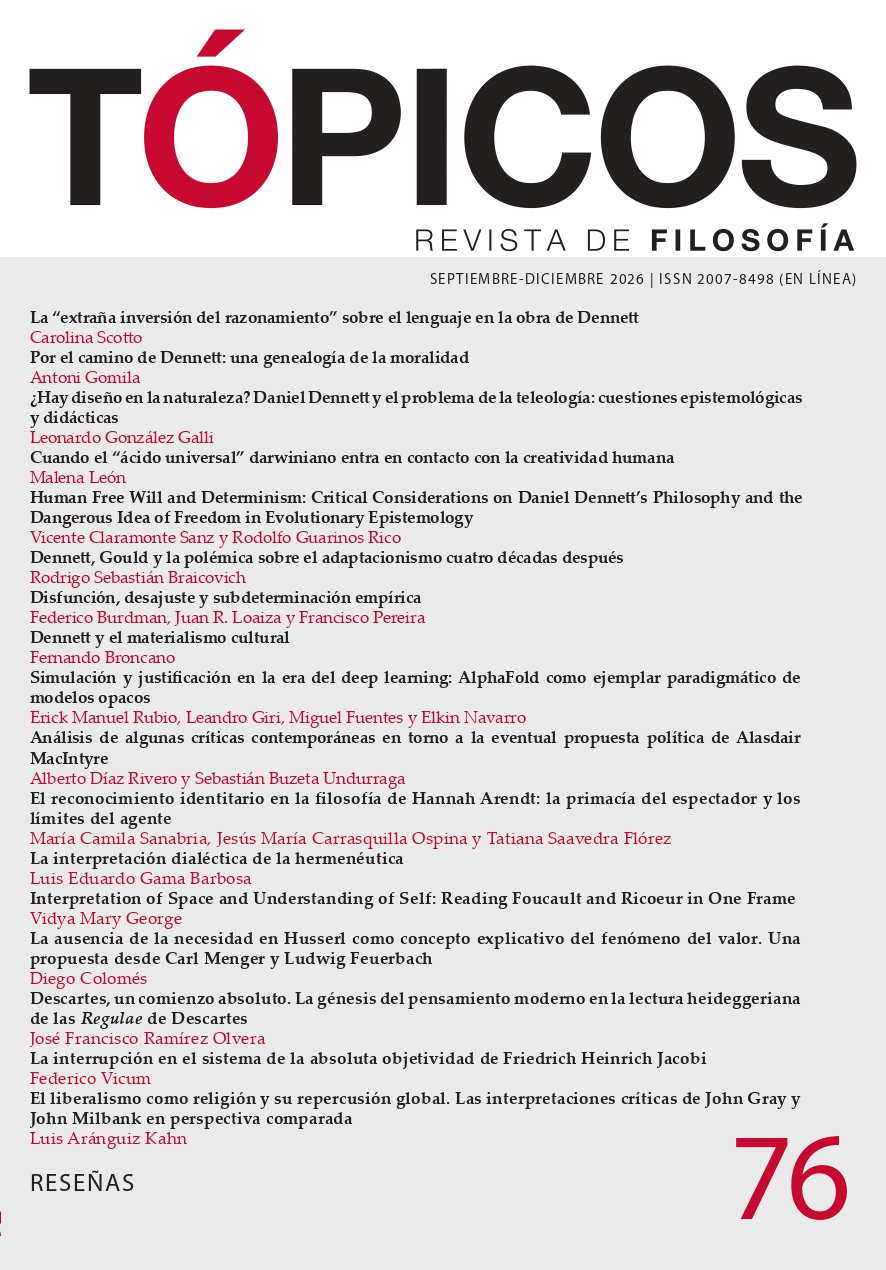
Publicado 2026-06-01
Como Citar
Downloads
Direitos de Autor (c) 2026 Malena León

Este trabalho encontra-se publicado com a Licença Internacional Creative Commons Atribuição-NãoComercial-CompartilhaIgual 4.0.
Resumo
Dennett ha sostenido que una recepción cabal de la teoría evolutiva darwiniana debe modificar nuestra concepción de los fenómenos mentales, dentro de los cuales se ha incluido tradicionalmente la creatividad humana. En este artículo sistematizo y desarrollo algunos lineamientos que debería adoptar un enfoque darwinista de la creatividad humana siguiendo las ideas de Dennett. Defiendo que el enfoque darwinista dennettiano de la creatividad es de carácter pluralista —dado que incorpora procesos de distinto tipo y que operan en distintos niveles—, incluye explicaciones que tienen en cuenta el carácter acumulativo del diseño y contempla que los procesos creativos son, en gran medida, colaborativos y que no necesariamente involucran comprensión. Así, es un enfoque que sostiene que la mente humana, actuando de manera individual, no detenta la potencia que le asignaron los enfoques predarwinianos de la creatividad.
Palavras-chave
- Daniel Dennett,
- creatividad,
- darwinismo,
- evolución cultural,
- diseño sin diseñador
- competencia sin comprensión,
- genio creativo,
- nivel comunitario,
- ácido universal,
- procesos de abajo arriba,
- intencionalidad derivada ...Mais
Referências
- Acerbi, A. y Mesoudi, A. (2015). If We Are All Cultural Darwinians What’s the Fuss About? Clarifying Recent Disagreements in the Field of Cultural Evolution. Biology and Philosophy, 30(4), 481-503. https://doi.org/10.1007/s10539-015-9490-2
- Amabile, T. (1983). The Social Psychology of Creativity. Springer. https://doi.org/10.1007/978-1-4612-5533-8
- Baravalle, L. (2017). El papel del pensamiento poblacional en la teoría de la doble herencia. Scientiae Studia, 15(2), 283-305. https://doi.org/10.11606/51678-31662017000200005
- Barron, F. (1955). The Disposition toward Originality. Journal of Abnormal and Social Psychology, 51, 478-485. https://doi.org/10.1037/h0048073
- Boden, M. (2002). The Creative Mind: Myths and Mechanisms. Routledge.
- Brentano, F. (2012). Psychology from an Empirical Standpoint. A. C. Rancurello, D. B. Terrell y L. L. McAlister (trads.). Routledge. https://doi.org/10.4324/9780203202883
- Briskman, L. (2009). Creative Product and Creative Process in Science and Art. En M. Krausz, D. Dutton y K. Bardsley (eds.), The Idea of Creativity (pp. 17-42). Brill. https://doi.org/10.1163/ej.9789004174443.i-348.12
- Campbell, D. T. (1960). Blind Variation and Selective Retention in Creative Thought as in Other Knowledge Processes. Psychological review, 67(6), 380-400. https://doi.org/10.1037/h0040373
- Csikszentmihalyi, M. (2014). The Systems Model of Creativity: The Collected Works of Mihaly Csikszentmihalyi. Springer. https://doi.org/10.1007/978-94-017-9085-7
- Darwin, C. (1964). The Origin of Species. Harvard University Press. https://doi.org/10.2307/j.ctvjf9xp5
- Dawkins, R. (1976). The Selfish Gene. Oxford University Press.
- De Sousa, R. (2018). [Reseña de From Bacteria to Bach and Back: The Evolution of Minds, de D. C. Dennett]. Evolutionary Studies in Imaginative Culture, 2(1), 113-116. https://doi.org/10.26613/esic.2.1.80
- Dennett, D. C. (1990a). The Interpretation of Texts, People and Other Artifacts. Philosophy and Phenomenological Research, 50, 177-194. https://doi.org/10.2307/2108038
- Dennett, D. C. (1990b). The Myth of Original Intentionality. En K. A. Mohyeldin Said, W. H. Newton-Smith, R. Viale y K. V. Wilkes (eds.) Modelling the Mind (pp. 43-62). Clarendon Press. https://doi.org/10.1093/oso/9780198249733.003.0004
- Dennett, D. C. (1991). Real Patterns. The Journal of Philosophy, 88(1), 27-51. https://doi.org/10.2307/2027085
- Dennett, D. C. (1995a). La conciencia explicada. S. Balari Ravera (trad.). Paidós.
- Dennett, D. C. (1995b). Darwin’s Dangerous Idea: Evolution and the Meanings of Life. Penguin Books.
- Dennett, D. C. (1998). La actitud intencional. D. Zadunaisky (trad.). Gedisa.
- Dennett, D. C. (2001). In Darwin’s Wake, Where Am I? Proceedings and Addresses of the American Philosophical Association, 75(2), 11-30. https://doi.org/10.2307/3218710
- Dennett, D. C. (2002). Content and Consciousness. Routledge. https://doi.org/10.4324/9780203005729
- Dennett, D. C. (2006). From Typo to Thinko: When Evolution Graduated to Semantic Norms. En S. Levinson (ed.) Evolution and Culture: A Fyssen Foundation Symposium (pp. 133-145). The MIT Press.
- Dennett, D. C. (2013). Intuition Pumps and Other Tools for Thinking. W. W. Norton & Company.
- Dennett, D. C. (2017). De las bacterias a Bach: la evolución de la mente. M. Figueras (trad.). Pasado & Presente.
- Fogarty, L., Creanza, N., Feldman, M. W. (2015). Cultural Evolutionary Perspectives on Creativity and Human Innovation. Trends in Ecology & Evolution, 30(12), 736-754. https://doi.org/10.1016/j.tree.2015.10.004
- Gaut, B. y Livingston, P. (2003). The Creation of Art: New Essays in Philosophical Aesthetics. Cambridge University Press. https://doi.org/10.1111/j.1747-9991.2010.00351.x
- Gaut, B. (2010). The Philosophy of Creativity. Philosophy Compass, 5(12), 1034-1046.
- Ginnobili, S. (2022). Darwinian Functional Biology. Theoria. An International Journal for Theory, History and Foundations of Science, 37(2), 233-255. https://doi.org/10.1387/theoria.22645
- Glăveanu, V. (2011). How Are We Creative Together? Comparing Sociocognitive and Sociocultural Answers. Theory and Psychology, 21, 473-492. https://doi.org/10.1177/0959354310372152
- Glăveanu, V. (2015). Creativity as a Sociocultural Act. The Journal of Creative Behavior, 49(3), 165-180. https://doi.org/10.1002/jocb.94
- Godfrey-Smith, P. (2009). Darwinian Populations and Natural Selection. Oxford University Press.
- Kaufman, J. C. y Glăveanu, V. (2019). A Review of Creative Theories: What Questions Are We Trying to Answer? En J. Kaufman y R. Sternberg (eds.), The Cambridge Handbook of Creativity (pp. 27-43). Cambridge University Press. https://doi.org/10.1017/9781316979839.004
- Kronfeldner, M. E. (2009). Creativity Naturalized. The Philosophical Quarterly, 59(237), 577-592. https://doi.org/10.1111/j.1467-9213.2009.637.x
- León, M. (2023). Is Cultural Selection Creative?. En J. M. Viejo y M. Sanjuán (eds.), Life and Mind: New Directions in the Philosophy of Biology and Cognitive Sciences (pp. 133-164). Springer. https://doi.org/10.1007/978-3-031-30304-3_7
- Locke, J. (1847). An Essay Concerning Human Understanding. Kay & Troutman.
- Miłkowski, M. (2009). Is Evolution Algorithmic? Minds and Machines, 19(4), 465-475. https://doi.org/10.1007/s11023-009-9170-6
- Mesoudi, A. (2011). Cultural Evolution: How Darwinian Theory Can Explain Human Culture and Synthesize the Social Sciences. University of Chicago Press. https://doi.org/10.7208/chicago/9780226520452.001.0001
- Richerson, P. y Boyd, R. (2005). Not by Genes Alone: How Culture Transformed Human Evolution. The University of Chicago Press. https://doi.org/10.7208/chicago/9780226712130.001.0001
- Ross, D. (2000). Introduction: The Dennettian Stance. En D. Ross, A. Brook y D. Thompson (eds.), Dennett’s Philosophy: A Comprehensive Assessment (pp. 1-26). The MIT Press. https://doi.org/10.7551/mitpress/2335.003.0003
- Runco, M. A. y Jaeger, G. J. (2012). The Standard Definition of Creativity. Creativity Research Journal, 24(1), 92-96. https://doi.org/10.1080/10400419.2012.650092
- Schliesser, E. (2018). A Genealogy of Modernity and Dennett’s Strange Inversion of Reasoning. Teorema: Revista Internacional de Filosofía, 37(3), 171-180.
- Searle, J. (1982). The Myth of the Computer. The New York Review of Books, 29(7), 3-6.
- Searle, J. (1983). Intentionality: An Essay in the Philosophy of Mind. Cambridge University Press. https://doi.org/10.1017/CBO9781139173452
- Searle, J. (2004). La mente: una breve introducción. H. Pons (trad.). Grupo Editorial Norma.
- Simonton, D. K. (1999). Origins of Genius: Darwinian Perspectives on Creativity. Oxford University Press.
- Sober, E. (2004). The Design Argument. Blackwell.
- Sober, E. (2006). Evolution, Population Thinking, and Essentialism. En E. Sober (ed.), Conceptual Issues in Evolutionary Biology (pp. 329-359). The MIT Press.
- Sperber, D. (1996). Explaining Culture: A Naturalistic Approach. Blackwell.
- Sterelny, K. (2006). Memes Revisited. British Journal for the Philosophy Science, 57(1), 145-165. https://doi.org/10.1093/bjps/axi157