
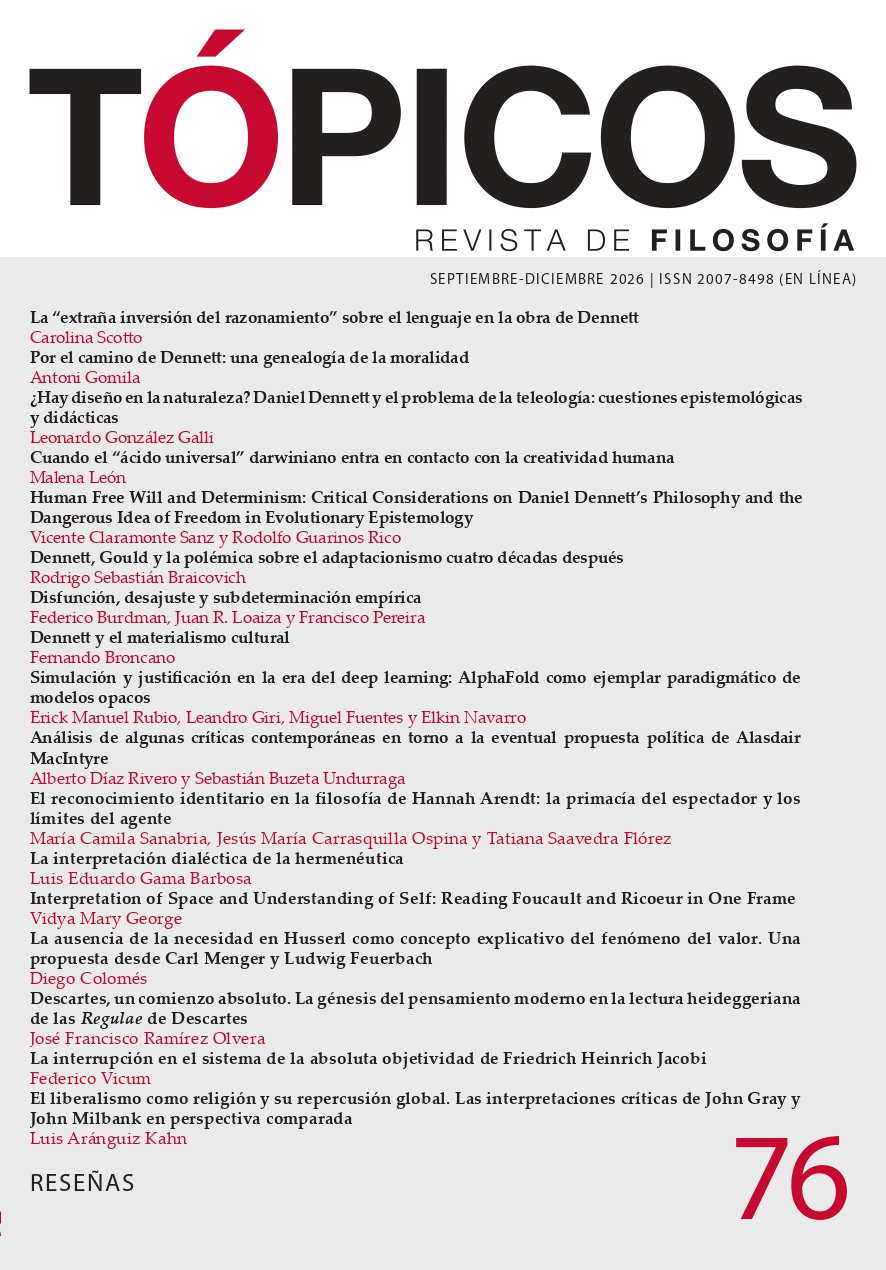
Publicado 2026-05-20
Como Citar
Downloads
Direitos de Autor (c) 2026 Antoni Gomila

Este trabalho encontra-se publicado com a Licença Internacional Creative Commons Atribuição-NãoComercial-CompartilhaIgual 4.0.
Resumo
En este artículo discuto los dos capítulos finales de Darwin’s Dangerous Idea dedicados a la evolución de la moralidad y ofrezco una versión resumida de la genealogía de la moral que he desarrollado en trabajos recientes, como respuesta en parte a las limitaciones señaladas en la propuesta de Dennett. Respecto al capítulo 16 del libro, argumento que se puede ir más allá de su planteamiento y ofrecer una explicación evolutiva del origen y evolución de la moralidad. Respecto al capítulo 17, señalo la inespecificidad moral de su propuesta de un “manual de primeros auxilios morales”, lo cual lleva a la necesaria caracterización del ámbito de la moralidad. En la tercera sección se argumenta que la genealogía de la moral que he propuesto permite avanzar en la línea pretendida por Dennett al ofrecer una explicación evolucionista de la moralidad. Esta propuesta no separa la evolución biológica y la evolución cultural como dos procesos alternativos, al modo de Dennett y de la memética, sino que los integra a través del proceso de desarrollo individual, por el cual cada nuevo individuo biológico humano se constituye culturalmente.
Palavras-chave
- moralidad,
- evolución cultural,
- Dennett,
- genealogía de la moral,
- memética
- motivación moral,
- moralización,
- perspectiva de segunda persona ...Mais
Referências
- Acedo-Carmona, C. y Gomila, A. (2014). Personal Trust Increases Cooperation beyond General Trust. PLoS One, 9(8), e105559. https://doi.org/10.1371/journal.pone.0105559
- Acedo-Carmona, C. y Gomila, A. (2019). Personal Trust Extends Cooperation beyond Trustees: A Mexican Study. International Journal of Psychology, 54(5), 687-704. https://doi.org/10.1002/ijop.12500
- Axelrod, R. (1984). The Evolution of Cooperation. Basic Books.
- Barkow, J., Tooby, J. y Cosmides, L. (1993). The Adapted Mind: Evolutionary Psychology and the Generation of Culture. Oxford University Press. https://doi.org/10.1093/oso/9780195060232.001.0001
- Barone P. y Gomila A. (2020). Infants’ Performance in the Indirect False Belief Tasks: A Second-Person Interpretation. WIRE Cognitive Science, 12(3), e1551. https://doi.org/10.1002/wcs.1551
- Bernstein, A. y Gomila, A. (2024). The Truth in Social Media. Topoi, 44, 127-138. https://doi.org/10.1007/s11245-024-10039-6
- Bicchieri, C. (2006). The Grammar of Society: The Nature and Dynamics of Social Norms. Cambridge University Press. https://doi.org/10.1017/CBO9780511616037
- Bicchieri, C. (2016). Norms in the Wild: How to Diagnose, Measure, and Change Social Norms. Oxford University Press. https://doi.org/10.1093/acprof:oso/9780190622046.001.0001
- Christensen, J. F. y Gomila, A. (2012). Moral Dilemmas in Cognitive Neuroscience: A Principled Review. Neuroscience and Biobehavioral Reviews, 36, 1249-1264. https://doi.org/10.1016/j.neubiorev.2012.02.008
- Darwall, S. (2006). The Second-Person Standpoint. Harvard University Press.
- Darwin, C. (1872a). The Descent of Man, and Selection in Relation to Sex. John Murray.
- Darwin, C. (1872b). The Expression of Emotions in Man and Animals. John Murray.
- Dennett, D. C. (1988). The Moral First Aid Manual. En S. M. McMurrin (ed.), Tanner Lectures on Human Values. VIII (pp. 120-147). University of Utah Press.
- Dennett , D. C. (1992). Consciousness Explained. Little, Brown & Co.
- Dennett, D. C. (1995). Darwin’s Dangerous Idea: Evolution and the Meanings of Life. Simon & Schuster.
- Dennett, D. C. (2017). Fron Bacteria to Bach and Back. Penguin.
- Frank, R. H. (1988). Passions within Reason: The Strategic Role of the Emotions. Norton.
- Gomila, A. (1991). Interpretation in Biology and Psychology. Epistemologia, 14, 275-292.
- Gomila, A. (2014). Sobre la relación entre ontogenia y filogenia: una crítica de la Psicología Evolucionista. En S. Español (ed.), Psicología de la música y del desarrollo. Una exploración interdisciplinaria sobre la musicalidad humana (pp. 261-283). Paidós.
- Haidt, J. y Joseph, C. (2007). The Moral Mind: How 5 Sets of Innate Moral Intuitions Guide the Development of Many Culture-Specific Virtues, and Perhaps Even Modules. En P. Carruthers, S. Laurence y S. Stich (eds.), The Innate Mind. 3 (pp. 367-392). Oxford University Press. https://doi.org/10.1093/acprof:oso/9780195332834.003.0019
- Isern-Mas, C. y Gomila, A. (2022a). A Second-Personal Approach to the Evolution of Moral Motivation and the Feeling of Obligation. Biological Theory, 17(3), 199-209. https://doi.org/10.1007/s13752-022-00397-y
- Isern-Mas, C. y Gomila, A. (2022b). Love, Friendship, and Moral Motivation. Journal of Theoretical and Philosophical Psychology, 42(2), 93-107. https://doi.org/10.1037/teo0000166
- Kitcher, P. (1993). The Evolution of Human Altruism. Journal of Philosophy, 90, 497-516. https://doi.org/10.2307/2941024
- Pérez, D. y Gomila, A. (2021). Social Cognition and the Second Person in Human Interaction. Routledge. https://doi.org/10.4324/9781003133155
- Pérez-Manrique, A. y Gomila, A. (2022). Emotional Contagion in Non-Human Animals: A Review. WIRE Cognitive Science, 13(1), e1560. https://doi.org/10.1002/wcs.1560
- Pinker, S. (1997). How the Mind Works. Norton.
- Quine, W. V. O. (1969). Epistemology Naturalized. En W. V. O. Quine, Ontological Relativity and Other Essays (pp. 69-90). Columbia University Press. https://doi.org/10.7312/quin92204-004
- Rozin, P. (1999). The Process of Moralization. Psychological Science, 10(3), 218-221. https://doi.org/10.1111/1467-9280.00139
- Simon, H. (1969). The Sciences of the Artificial. MIT Press.
- Stanford, P. K. (2018). The Difference between Ice Cream and Nazis: Moral Externalization and the Evolution of Human Cooperation. Behavioral and Brain Sciences, 41, e95. https://doi.org/10.1017/S0140525X17001911
- Strawson, P. F. (1962). Freedom and Resentment. Proceedings of the British Academy, 48, 1-25.
- Suhler, C. y Churchland, P. (2011). Can Innate, Modular “Foundations” Explain Morality? Challenges for Haidt’s Moral Foundations Theory. Journal of Cognitive Neuroscience, 23(9), 2103-2116. https://doi.org/10.1162/jocn.2011.21637
- Sznycer, D., Tooby, J., Cosmides, L., Porat, R., Shalvi, S. y Halperin, E. (2016). Shame Closely Tracks the Threat of Devaluation by Others, Even Across Cultures. Proceedings of the National Academy of Sciences, 113(10), 2625-2630. https://doi.org/10.1073/pnas.1514699113
- Tomasello, M. (1999). The Cultural Origins of Human Cognition. Harvard University Press. https://doi.org/10.4159/9780674044371
- Wilson, E. O. (1975). Sociobiology: The New Synthesis. Harvard University Press.
- Wilson, E. O. (1978). On Human Nature. Harvard University Press.