
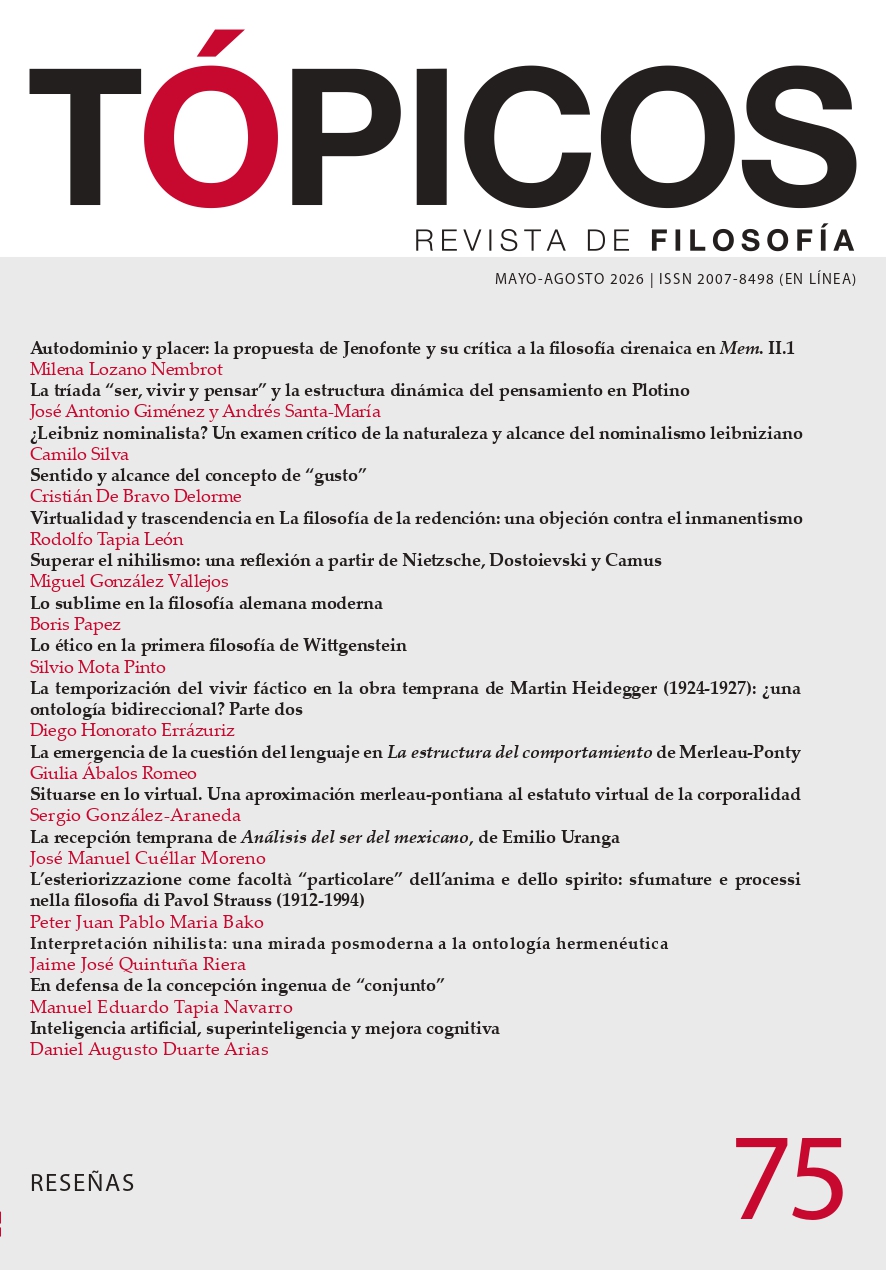
Pubblicato 2026-04-01
Come citare
Download
Copyright (c) 2026 Daniel Augusto Duarte Arias

Questo volume è pubblicato con la licenza Creative Commons Attribuzione - Non commerciale - Condividi allo stesso modo 4.0 Internazionale.
Abstract
El transhumanismo es un movimiento que considera posible la consecución de un estadio evolutivo superior por la viabilidad de la “singularidad”. Algunas posturas consideran que esto no es posible debido a los límites intrínsecos de la inteligencia artificial (IA). La tesis que defiendo es que, a pesar de la imposibilidad de lograr estadios sobrehumanos, la IA satisface los criterios de mejora cognitiva (en cierto nivel restaurativo y dentro de ciertos límites). Esta mejora se manifiesta en capacidades específicas que resultan en un incremento que trasciende los límites humanos, pero no conducen a un estadio evolutivo superior. Para defender esto, examino qué es la IA, la superinteligencia artificial (SIA) y la singularidad; posteriormente muestro algunas objeciones a la posibilidad de alcanzar una inteligencia artificial general (IAG) a partir de John Searle, Roger Penrose y Hubert Dreyfus; finalmente, argumento mediante una taxonomía en qué niveles puede decirse que la IA representa una mejora cognitiva.
Parole chiave
- inteligencia artificial,
- IA débil,
- IA fuerte,
- mejora cognitiva,
- singularidad
- superinteligencia,
- transhumanismo,
- sobrehumano,
- experiencia cualitativa,
- mente extendida ...Più
Riferimenti bibliografici
- Asla, M. (2021). Mental Transference (Mind Up-loading): Metaphysical Controversies around the Preservation of Personal Identity. Forum. Supplement to Acta Philosophica, 3, 169-183. https://doi.org/10.17421/2498-9746-03-09
- Bostrom, N. (2014). Superintelligence: Paths, Dangers, Strategies. Oxford University Press.
- Bostrom, N. y Sandberg, A. (2009). Cognitive Enhancement: Methods, Ethics, Regulatory Challenges. Science and Engineering Ethics, 15(3), 311-341. https://doi.org/10.1007/s11948-009-9142-5
- Chalmers, D. (1995). Facing Up to the Problem of Consciousness. Journal of Consciousness Studies, 2(3), 200-219.
- Chalmers, D. (1996). The Conscious Mind: In Search of a Fundamental Theory. Oxford University Press.
- Chalmers, D. (2010). The Singularity: A Philosophical Analysis. Journal of Consciousness Studies, 17(9-10), 7-65.
- Clark, A. y Chalmers, D. (1998). The Extended Mind. Analysis, 58(1), 7-19. https://doi.org/10.1093/analys/58.1.7
- Coeckelbergh, M. (2021). Ética de la inteligencia artificial. L. Álvarez Canga (trad.). Cátedra.
- Diéguez, A. (2016). La singularidad tecnológica y el desafío posthumano. Pasajes: Revista de Pensamiento Contemporáneo, 50, 154-164.
- Diéguez, A. (2020). La función ideológica del transhumanismo y algunos de sus presupuestos. Isegoría, 63, 367-386. https://doi.org/10.3989/isegoria.2020.063.05
- Diéguez, A. (2021). Cuerpos inadecuados el desafio transhumanista a la filosofia. Herder.
- Dobre, C. E. y García Pavón, R. (2024). Singularidad individual versus “singularity”. Una crítica al transhumanismo desde el pensamiento de Søren Kierkegaard. Tópicos, Revista de Filosofía, 69, 389-420. https://doi.org/10.21555/top.v690.2503
- Dretske, F. I. (1981). Knowledge & the Flow of Information. MIT Press.
- Dreyfus, H. L. (1967). Why Computers Must Have Bodies in Order to Be Intelligent. The Review of Metaphysics, 21(1), 13-32.
- Ferry, L. (2018). La revolución transhumanista. A. Martorell (trad.). Alianza.
- Good, I. J. (1966). Speculations Concerning the First Ultraintelligent Machine. En F. L. Alt y M. Rubinoff (eds.), Advances in Computers. 6 (pp. 31-88). Elsevier. https://doi.org/10.1016/s0065-2458(08)60418-0
- Google DeepMind. (s. f.). Google DeepMind. https://www.deepmind.com/
- Google DeepMind. (2022, 5 de octubre). Discovering Novel Algorithms with AlphaTensor. https://www.deepmind.com/blog/discovering-novel-algorithms-with-alphatensor
- Google DeepMind. (2023a, 7 de junio). AlphaDev Discovers Faster Sorting Algorithms. https://www.deepmind.com/blog/alphadev-discovers-faster-sorting-algorithms
- Google DeepMind. (2023b, 28 de julio). RT-2: New Model Translates Vision and Language into Action. https://www.deepmind.com/blog/rt-2-new-model-translates-vision-and-language-into-action
- Google DeepMind. (2023c, 19 de septiembre). A Catalogue of Genetic Mutations to Help Pinpoint the Cause of Diseases. https://www.deepmind.com/blog/alphamissense-catalogue-of-genetic-mutations-to-help-pinpoint-the-cause-of-diseases
- Hoffmann, C. H. (2023). The Quest for a Universal Theory of Intelligence: The Mind, the Machine, and Singularity Hypotheses. De Gruyter. https://doi.org/10.1515/9783110756166
- Jackson, F. (1982). Epiphenomenal Qualia. The Philosophical Quarterly, 32(127), 127-136. https://doi.org/10.2307/2960077
- Jackson, F. (1986). What Mary Didn’t Know. The Journal of Philosophy, 83(5), 291-295. https://doi.org/10.2307/2026143
- Kurzweil, R. (2005). The Singularity Is Near: When Humans Transcend Biology. Viking.
- Larson, E. J. (2021). The Myth of Artificial Intelligence: Why Computers Can’t Think the Way We Do. The Belknap Press of Harvard University Press. https://doi.org/10.4159/9780674259935
- McCarthy, J. (1978). History of LISP. ACM SIGPLAN Notices, 13(8), 217-223. https://doi.org/10.1145/960118.808387
- Minsky, M. (1988). The society of mind. Simon & Schuster.
- Mnih, V., Kavukcuoglu, K., Silver, D., Rusu, A. A., Veness, J., Bellemare, M. G., Graves, A., Riedmiller, M., Fidjeland, A. K., Ostrovski, G., Petersen, S., Beattie, C., Sadik, A., Antonoglou, I., King, H., Kumaran, D., Wierstra, D., Legg, S. y Hassabis, D. (2015). Human-level Control through Deep Reinforcement Learning. Nature, 518(7540), 529-533. https://doi.org/10.1038/nature14236
- Moravec, H. P. (2000). Robot: Mere Machine to Transcendent Mind. Oxford University Press.
- Nagel, T. (1974). What Is It Like to Be a Bat? Philosophical Review, 83(4), 435-450.
- Newell, A. y Simon, H. A. (1972). Human Problem Solving. Prentice Hall.
- OpenAI. (s. f.). ChatGPT. https://openai.com/chatgpt
- Parens, E. (1998). Special Supplement: Is Better Always Good? The Enhancement Project. The Hastings Center Report, 28(1), S1-S17. https://doi.org/10.2307/3527981
- Penrose, R. (1995). Beyond the Doubting of a Shadow: A Reply to Commentaries on Shadows of the Mind. PSYCHE: An Interdisciplinary Journal of Research on Consciousness, 2, 1-40.
- Preston, J. (2002). Introducción. En M. Bishop y J. Preston (eds.), Views into the Chinese Room: New Essays on Searle and Artificial Intelligence (pp. 1-50). Clarendon Press. https://doi.org/10.1093/oso/9780198250579.003.0001
- Rivera-Novoa, Á. (2020). Mente extendida y transhumanismo. ¿Qué tan humana es la mente de un cyborg? En O. M. Donato Rodríguez, D. M. Muñoz González y Á. Rivera Novoa (eds.), Redefinir lo humano en la era técnica: perspectivas filosóficas (pp. 75-89). Universidad Libre. https://repository.unilibre.edu.co/handle/10901/19869
- Rivera-Novoa, Á. (2024). La tesis de la mente extendida y el ideal transhumanista de mejoramiento cognitivo. Trilogía. Ciencia Tecnología Sociedad, 16(33), e3142. https://doi.org/10.22430/21457778.3142
- Rivera-Novoa, Á. y Duarte Arias, D. A. (2025). Generative Artificial Intelligence and Extended Cognition in Science Learning Contexts. Science & Education. https://doi.org/10.1007/s11191-025-00660-1
- Rowlands, M. (2010). The New Science of the Mind: From Extended Mind to Embodied Phenomenology. MIT Press. https://doi.org/10.7551/mitpress/9780262014557.001.0001
- Russell, S. J. y Norvig, P. (2021). Artificial Intelligence: A Modern Approach. Pearson.
- Sandberg, A. (2011). Cognition Enhancement: Upgrading the Brain. En J. Savulescu, R. ter Meulen y G. Kahane (eds.), Enhancing Human Capacities (pp. 71-91). Wiley-Blackwell. https://doi.org/10.1002/9781444393552.ch5
- Sarne, D. y Grosz, B. J. (2007). Sharing Experiences to Learn User Characteristics in Dynamic Environments with Sparse Data. En E. H. Durfee, M. Yokoo, M. N. Huhns y O. Shehory (eds.), Proceedings of the 6th International Joint Conference on Autonomous Agents and Multiagent Systems (pp. 202-209). Association for Computing Machinery. https://doi.org/10.1145/1329125.1329176
- Searle, J. R. (1980). Minds, Brains, and Programs. Behavioral and Brain Sciences, 3(3), 417-424. https://doi.org/10.1017/S0140525X00005756
- Sincrolab. (s. f.). Sincrolab. Recuperación cognitiva y neuropsicología digital. https://sincrolab.es/
- Turing, A. M. (1950). Computing Machinery and Intelligence. Mind, 59(236), 433-460. https://doi.org/10.1093/mind/LIX.236.433
- Vinge, V. (1993). The Coming Technological Singularity: How to Survive in the Post-Human Era. https://api.semanticscholar.org/CorpusID:5750614