
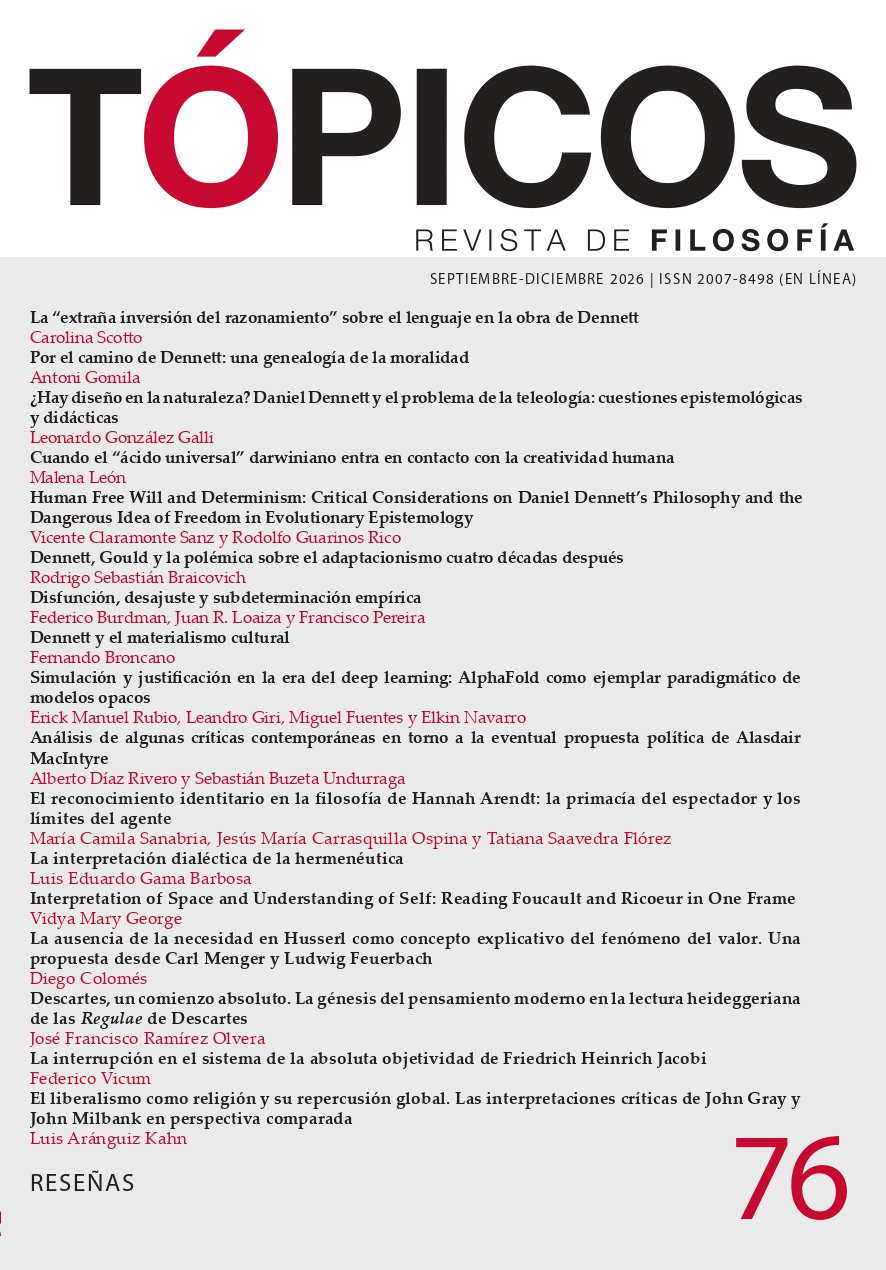
El liberalismo como religión y su repercusión global. Las interpretaciones críticas de John Gray y John Milbank en perspectiva comparada
Publiée 2026-08-09
Comment citer
Téléchargements
(c) Copyright Luis Aránguiz Kahn 2026

Ce travail est disponible sous licence Creative Commons Attribution - Pas d’Utilisation Commerciale - Partage dans les Mêmes Conditions 4.0 International.
Résumé
Este artículo analiza de manera comparada el pensamiento del filósofo John Gray y el teólogo socialista cristiano John Milbank —ambos ingleses contemporáneos— en torno a la relación entre liberalismo, religión y orden internacional. Aunque son de procedencias intelectuales distintas, ambos coinciden en sostener que dicha relación no consiste simplemente en la interacción de actores políticos y religiosos, sino sobre todo en una conjugación en la que ideología y religión se funden para dar origen a una religión y teología políticas precisas que delimitan las formas en que se conduce la vida humana a escala planetaria. Pese a esta semejanza, el artículo finaliza evidenciando las diferencias que existen entre Gray y Milbank sobre sus concepciones del mundo postliberal, desprendidas de sus valoraciones sobre liberalismo y religión.
Mots-clés
- John Gray,
- John Milbank,
- postliberalismo,
- teología política,
- religión política
- liberalismo,
- pluralismo de valores,
- política de la virtud,
- Eric Voegelin,
- Carl Schmitt ...Plus
Références
- Anderson, P. (2014). Imperium et consilium. Akal.
- Asad, T. (2003). Formations of the Secular. Stanford University Press.
- Berlin, I. (1990). The Crooked Timber of Humanity. John Murray.
- Casanova, J. (1994). Public Religions in the Modern World. The University of Chicago Press. https://doi.org/10.7208/chicago/9780226190204.001.0001
- Cohn, N. (2004). The Pursuit of the Millenium. Pimlico.
- Critchley, S. (2017). La fe de los que no tienen fe. B. Thoilliez (trad.). Trotta.
- Crowder, G. (2007). Gray and the Politics of Pluralism. En J. Horton y G. Newey (eds.), The Political Theory of John Gray (pp. 59-76). Routledge.
- Del Palacio, J. (2012). Conservadurismo británico contemporáneo: John Gray y la teoría política del modus vivendi. Isegoría, 47, 601-614. https://doi.org/10.3989/isegoria.2012.047.12
- Forde, J. (2020). Anglican Socialism and Welfare: John Milbank’s “Blue Socialist” Thinking and the Church of England’s Approach to Welfare since 2008. [Tesis de doctorado, Universidad de Manchester]. Research Explorer. https://research.manchester.ac.uk/en/studentTheses/anglican-socialism-and-welfare-john-milbanks-blue-socialist-think/
- Fukuyama, F. (1989). The End of History? The National Interest, 16, 3-18. https://doi.org/10.1080/07366988909450540
- Gray, J. (1989). Liberalisms. Routledge.
- Gray, J. (1996). What Is Dead and What Is Living in Liberalism? En J. Gray, Post-Liberalism (pp. 283-328). Routledge.
- Gray, J. (2001). Las dos caras del liberalismo. M. Salomon (trad.). Paidós.
- Gray, J. (2011a). El fin de la historia, ¿otra vez? En J. Gray, Anatomía de Gray (pp. 271-278). A. Santos Mosquera (trad.). Paidós. 271-278.
- Gray, J. (2011b). El homo rapiens y la extinción en masa. En J. Gray, Anatomía de Gray (pp. 487-494). A. Santos Mosquera (trad.). Paidós.
- Gray, J. (2011c). Orígenes culturales del comunismo soviético. En J. Gray, Anatomía de Gray (pp. 257-260). A. Santos Mosquera (trad.). Paidós.
- Gray, J. (2017). Misa negra. La religión apocalíptica y la muerte de la utopía. A. Santos Mosquera (trad.). Sexto Piso.
- Habermas, J. (2006). Entre naturalismo y religión. P. Fabra, D. Gamper, F. J. Gil Martín, J. L. López de Lizaga, P. Madrigal y J. C. Velasco (trads.). Paidós.
- Hardt, M. y Negri, A. (2000). Imperio. A. Bixio (trad.). Paidós.
- Hazony, Y. (2018). The Virtue of Nationalism. Basic Books.
- Huntington, S. (1997). El choque de civilizaciones. J. P. Tosaus Abadía (trad.). Paidós.
- Kelly, P. (2007). The Social Theory of Anti-Liberalism. En J. Horton y G. Newey (eds.), The Political Theory of John Gray (pp. 25-42). Routledge.
- Milbank, J. y Pabst, A. (2014). The Anglican Polity and the Politics of the Common Good. Crucible: The Christian Journal of Social Ethics, 1, 7-15.
- Milbank, J. y Pabst, A. (2016). The Politics of Virtue. Rowman & Littlefield. https://doi.org/10.5040/9798881817411
- Milbank, J. (1997). The Word Made Strange. Blackwell.
- Milbank, J. (2002). Sovereignty, Empire, Capital and Terror. South Atlantic Quarterly, 101(2), 304-324. https://doi.org/10.1215/00382876-101-2-305
- Milbank, J. (2006). Theology and Social Theory: Beyond Secular Reason. Blackwell. https://doi.org/10.1002/9780470694121
- Milbank, J. (2009a). Geopolitical Theology: Economy, Religion and Empire after 9/11. En M. Morgan (ed.), The Impact of 9/11 on Religion and Philosophy (pp. 85-112). Palgrave Macmillan. https://doi.org/10.1057/9780230101609_7
- Milbank, J. (2009b). Liberalidad contra liberalismo. En J. Milbank y A. Pabst, El pensamiento de John Milbank (pp. 67-94). S. Montiel Gómez (trad.). Editorial Nuevo Inicio.
- Milbank, J. (2009c). The Future of Love. Cascade Books.
- Milbank, J. (2015). The Politics of the Soul. Open Insight, 6(9), 91-108. https://doi.org/10.23924/oi.v6n9a2015.pp91-108.127
- Nye, J. (2004). Soft Power. Public Affairs.
- Oakeshott, M. (1962). Rationalism in Politics. Basic Books.
- Pabst, A. (2017). Postliberalism: The New Centre Ground of British Politics. The Political Quarterly, 88(3), 500-509.
- Pabst, A. (2020). The Post-liberal Moment. Telos, 190, 177-180. https://doi.org/10.1111/1467-923X.12363
- Portillo, A. (2013). Una aproximación a la comprensión de la geopolítica de las religiones. Fermentum. Revista Venezolana de Sociología y Antropología, 23(67), 135-148.
- Rawls, J. (1995). Liberalismo político. S. R. Madero Báez (trad.). FCE.
- Scattola, M. (2008). Teología política. H. Cardoso (trad.). Ediciones Nueva Visión.
- Schmitt, C. (2009). Teología Política. F. J. Conde y J. Navarro Pérez (trads.). Trotta.
- Simpson, P. (2018). Political Illiberalism. Routledge.
- Sleat, M. (2013). Liberal Realism. Manchester University Press. https://doi.org/10.7228/manchester/9780719088902.001.0001
- Stout, J. (2004). Democracy and Tradition. Princeton University Press. https://doi.org/10.1515/9781400825868
- Strauss, L. (2011). Leo Strauss. El filósofo en la ciudad. C. Hilb (ed.). Prometeo Libros.
- Voegelin, E. (2014). Religiones políticas. M. Abella Martínez y P. García Guirao (trads.). Trotta.
- Wolterstorff, N. (1997). The Role of Religion in Decision and Discussion of Political Issues. En R. Audi y N. Wolterstorff (eds.), Religion in the Public Square: The Place of Religious Convictions in Political Debate (pp. 67-120). Rowman and Littlefield.