
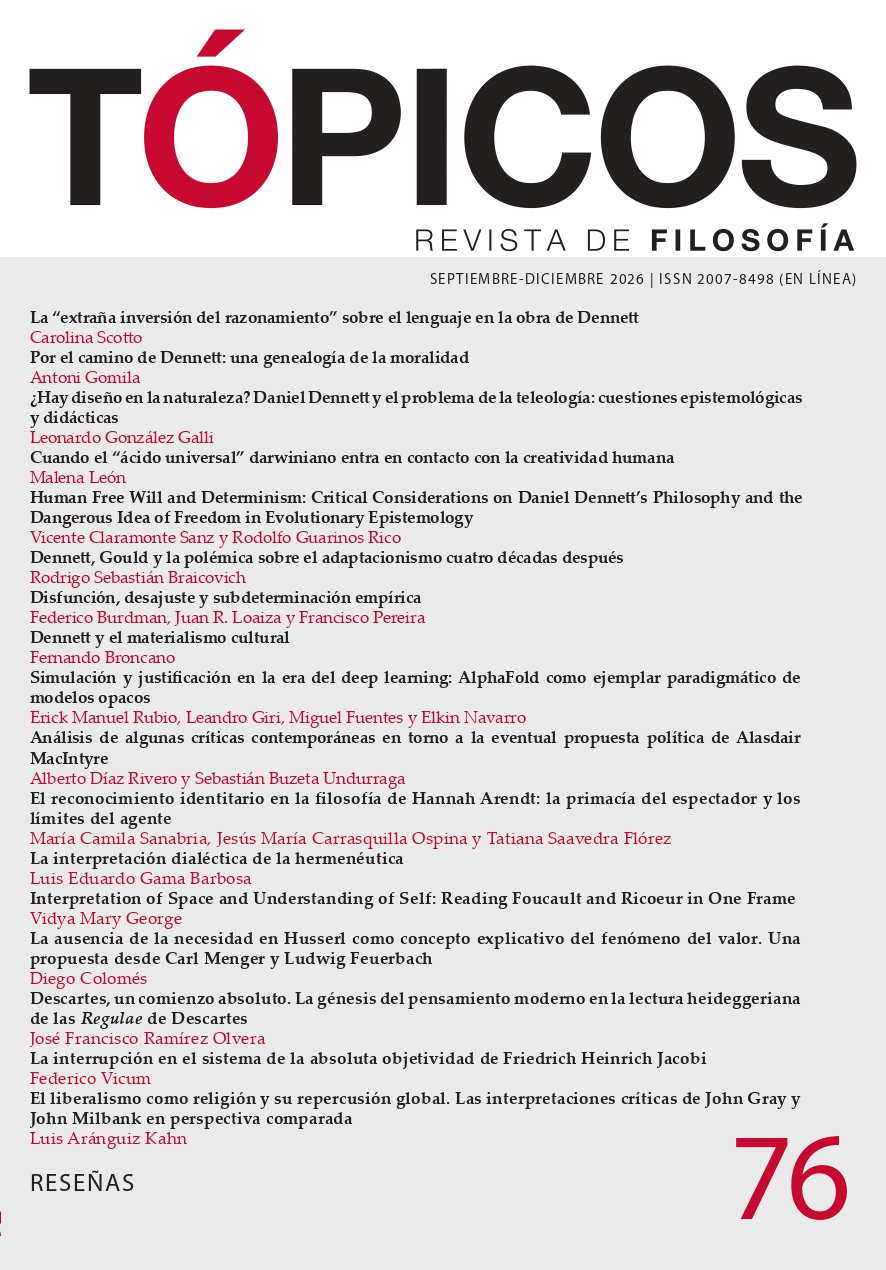
Publicado 2026-06-14
Cómo citar
Descargas
Derechos de autor 2026 Federico Burdman, Juan R. Loaiza, Francisco Pereira

Esta obra está bajo una licencia internacional Creative Commons Atribución-NoComercial-CompartirIgual 4.0.
Resumen
¿Son los trastornos psiquiátricos causados por el funcionamiento incorrecto de la maquinaria de la mente? ¿O pueden explicarse como el resultado de la falta de ajuste entre nuestros mecanismos psicológicos y un ambiente diferente a aquel en el cual estos sistemas evolucionaron? En este artículo, adoptamos elementos centrales de la concepción de la función propia desarrollada por Daniel Dennett para abordar una versión particular del debate entre teorías de la disfunción y teorías del desajuste, enfocándonos en casos de adicción a sustancias. Siguiendo la idea de Dennett según la cual no hay un hecho decisivo que determine la función propia de los sistemas biológicos, sostenemos que la decisión sobre la disfunción del sistema de recompensa en la adicción está subdeterminada por la evidencia. Nuestro argumento invita a reorientar la discusión, sugiriendo un nuevo foco en las consideraciones pragmáticas que pueden esgrimirse para elegir entre dos teorías empíricamente equivalentes.
Palabras clave
- adicción,
- disfunción,
- desajuste,
- función propia,
- sistema de recompensa
- subdeterminación,
- evolución,
- mecanismo,
- actitud de diseño,
- enfermedad ...Más
Referencias
- Ahn, S. (2020). How Non-Epistemic Values Can Be Epistemically Beneficial in Scientific Classification. Studies in History and Philosophy of Science Part A, 84, 57-65. https://doi.org/10.1016/j.shpsa.2020.08.002
- APA DSM Team. (2021). Guide to Submitting Proposals for Changes to DSM-5. American Psychiatric Association. Consultado el 13 de enero de 2025 de https://www.psychiatry.org/File%20Library/Psychiatrists/Practice/DSM/DSM5-Proposal-Submissions-General-Guidance.pdf
- Berridge, K. C. (2009). Wanting and Liking: Observations from the Neuroscience and Psychology Laboratory. Inquiry, 52(4), 378-398. https://doi.org/10.1080/00201740903087359
- Boorse, C. (2014). A Second Rebuttal on Health. Journal of Medicine and Philosophy, 39(6), 683-724. https://doi.org/10.1093/jmp/jhu035
- Burdman, F. (2024). Recalcitrant Desires in Addiction. En S. Amaya, D. Shoemaker y M. Vargas (eds.), Oxford Studies in Agency and Responsibility: Volume 8. Non-Ideal Agency and Responsibility (pp. 58-80). Oxford University Press. https://doi.org/https://doi.org/10.1093/oso/9780198910114.003.0004
- Burdman, F. (2025). On the Grounds for Calling Addiction a Disease. Análisis Filosófico, 45(1), 203-231. https://doi.org/10.36446/af.e1048
- Butlin, P. y Papineau, D. (2017). Normal and Addictive Desires. En N. Heather y G. Segal (eds.), Addiction and Choice: Rethinking the Relationship (pp. 99-115). Oxford University Press. https://doi.org/10.1093/acprof:oso/9780198727224.003.0006
- Carrier, M. (2011). Underdetermination as an Epistemological Test Tube: Expounding Hidden Values of the Scientific Community. Synthese, 180(2), 189-204. https://doi.org/10.1007/s11229-009-9597-6
- Colombo, M. (2014). Deep and Beautiful: The Reward Prediction Error Hypothesis of Dopamine. Studies in History and Philosophy of Science Part C: Studies in History and Philosophy of Biological and Biomedical Sciences, 45, 57-67. https://doi.org/10.1016/j.shpsc.2013.10.006
- Cooper, R. (2004). What is Wrong with the DSM? History of Psychiatry, 15(1), 5-25. https://doi.org/10.1177/0957154X04039343
- Cosmides, L. y Tooby, J. (1999). Toward an Evolutionary Taxonomy of Treatable Conditions. Journal of Abnormal Psychology, 108(3), 453-464. https://doi.org/10.1037/0021-843X.108.3.453
- Cummins, R. (1975). Functional Analysis. The Journal of Philosophy, 72(20), 741-765. https://doi.org/10.2307/2024640
- De Haro, S. (2023). The Empirical Under-Determination Argument Against Scientific Realism for Dual Theories. Erkenntnis, 88, 117-145. https://doi.org/10.1007/s10670-020-00342-0
- Dennett, D. C. (1978). Brainstorms: Philosophical Essays on Mind and Psychology. Bradford Books.
- Dennett, D. C. (1987). The Intentional Stance. The MIT Press.
- Dennett, D. C. (1991). Real Patterns. The Journal of Philosophy, 88(1), 27-51. https://doi.org/10.2307/2027085
- Dennett, D. C. (1995). Darwin’s Dangerous Idea: Evolution and the Meanings of Life. Simon & Schuster.
- Dennett, D. C. (2017). Darwin and the Overdue Demise of Essentialism. En D. L. Smith (ed.), How Biology Shapes Philosophy: New Foundations for Naturalism (pp. 9-22). Cambridge University Press. https://doi.org/10.1017/9781107295490.002
- Dill, B. y Holton, R. (2014). The Addict in Us all. Frontiers in Psychiatry, 5. https://doi.org/10.3389/fpsyt.2014.00139
- Durrant, R., Adamson, S., Todd, F. y Sellman, D. (2009). Drug Use and Addiction: An Evolutionary Perspective. Australian and New Zealand Journal of Psychiatry, 43(11), 1049-1056. https://doi.org/10.3109/00048670903270449
- Flanagan, O. (2025). What Is It Like to Be an Addict? Oxford University Press. https://doi.org/10.1093/oso/9780199388929.001.0001
- Fodor, J. A. (2000). The Mind Doesn’t Work that Way: The Scope and Limits of Computational Psychology. The MIT press. https://doi.org/10.7551/mitpress/4627.001.0001
- Garson, J. (2019). What Biological Functions Are and Why They Matter. Cambridge University Press. https://doi.org/10.1017/9781108560764
- Ginnobili, S. y Roffé, A. (2017). Dos usos de los modelos de optimalidad en las explicaciones por selección natural. Metatheoria, 8(1), 43-55. https://doi.org/10.48160/18532330me8.161
- Gorelick, D. A., Zangen, A. y George, M. S. (2014). Transcranial Magnetic Stimulation in the Treatment of Substance Addiction. Annals of the New York Academy of Sciences, 1327(1), 79-93. https://doi.org/10.1111/nyas.12479
- Grace, A. A., Floresco, S. B., Goto, Y. y Lodge, D. J. (2007). Regulation of Firing of Dopaminergic Neurons and Control of Goal-Directed Behaviors. Trends in Neurosciences, 30(5), 220-227. https://doi.org/10.1016/j.tins.2007.03.003
- Harding, S. (1986). The Science Question in Feminism. Cornell University Press.
- Heilig, M., MacKillop, J., Martinez, D., Rehm, J., Leggio, L. y Vanderschuren, L. J. M. J. (2021). Addiction as a Brain Disease Revised: Why It Still Matters, and the Need for Consilience. Neuropsychopharmacology, 46(10), 1715-1723. https://doi.org/10.1038/s41386-020-00950-y
- Holton, R. y Berridge, K. (2013). Addiction between Compulsion and Choice. En N. Levy (ed.), Addiction and Self-Control: Perspectives from Philosophy, Psychology, and Neuroscience (pp. 239-268). Oxford University Press. https://doi.org/10.1093/acprof:oso/9780199862580.003.0012
- Kostko, A. (2019). Inductive Risks and Psychiatric Classification. En R. Bluhm y Ş. Tekin (eds.), The Bloomsbury Companion to Philosophy of Psychiatry (pp. 197-215). Bloomsbury Academic. https://doi.org/10.5040/9781350024090.ch-010
- Loaiza, J. R. (2024). Functionalism and the Emotions. The British Journal for the Philosophy of Science, 75(1), 233-251. https://doi.org/10.1086/715207
- Longino, H. E. (1990). Science as Social Knowledge: Values and Objectivity in Scientific Inquiry. Princeton University Press. https://doi.org/10.1515/9780691209753
- Millikan, R. (1984). Language, Thought and Other Biological Categories. The MIT Press. https://doi.org/10.7551/mitpress/4124.001.0001
- Montague, P. R., Dayan, P. y Sejnowski, T. J. (1996). A Framework for Mesencephalic Dopamine Systems Based on Predictive Hebbian Learning. Journal of Neuroscience, 16(5), 1936-1947. https://doi.org/10.1523/JNEUROSCI.16-05-01936.1996
- Murphy, D. (2009). Psychiatry and the Concept of Disease as Pathology. En M. Broome y L. Bortolotti (eds.), Psychiatry as Cognitive Neuroscience: Philosophical perspectives (pp. 103-118). Oxford University Press. https://doi.org/10.1093/med/9780199238033.003.0006
- Murphy, D. y Stich, S. (2000). Darwin in the Madhouse: Evolutionary Psychology and the Classification of Mental Disorders. En P. Carruthers y A. Chamberlain (eds.), Evolution and the Human Mind: Modularity, Language and Meta-Cognition (pp. 62-92). Cambridge University Press. https://doi.org/10.1017/CBO9780511611926.005
- Nesse, R. M. y Berridge, K. C. (1997). Psychoactive Drug Use in Evolutionary Perspective. Science, 278(5335), 63-66. https://doi.org/10.1126/science.278.5335.63
- Nestler, E. J. (2005). Is There a Common Molecular Pathway for Addiction? Nature Neuroscience, 8(11). https://doi.org/10.1038/nn1578
- Papineau, D. (2017). Teleosemantics. En D. L. Smith (ed.), How Biology Shapes Philosophy: New Foundations for Naturalism (pp. 95-120). Cambridge University Press. https://doi.org/10.1017/9781107295490.006
- Quine, W. V. O. (1951). Two Dogmas of Empiricism. The Philosophical Review, 60(1), 20-43. https://doi.org/10.2307/2181906
- Quine, W. V. O. (1975). On Empirically Equivalent Systems of the World. Erkenntnis, 9(3), 313-328. https://doi.org/10.1007/BF00178004
- Richters, J. E. y Hinshaw, S. P. (1999). The Abduction of Disorder in Psychiatry. Journal of Abnormal Psychology, 108(3), 438-445. https://doi.org/10.1037/0021-843X.108.3.438
- Robinson, T. y Berridge, K. (2008). The Incentive Sensitization Theory of Addiction: Some Current Issues. Philosophical Transactions of the Royal Society B: Biological Sciences, 363(1507), 3137-3146. https://doi.org/10.1098/rstb.2008.0093
- Ross, D. (2020). Addiction Is Socially Engineered Exploitation of Natural Biological Vulnerability. Behavioural Brain Research, 386, 112598. https://doi.org/10.1016/j.bbr.2020.112598
- Schroeder, T. (2004). Three Faces of Desire. Oxford University Press. https://doi.org/10.1093/acprof:oso/9780195172379.001.0001
- Schultz, W. (2016). Dopamine Reward Prediction Error Coding. Dialogues in Clinical Neuroscience, 18(1), 23-32. https://doi.org/10.31887/DCNS.2016.18.1/wschultz
- Tooby, J. y Cosmides, L. (1990). The Past Explains the Present. Ethology and Sociobiology, 11(4-5), 375-424. https://doi.org/10.1016/0162-3095(90)90017-Z
- Verhulst, B., Neale, M. C. y Kendler, K. S. (2015). The Heritability of Alcohol Use Disorders: A Meta-Analysis of Twin and Adoption Studies. Psychological Medicine, 45(5), 1061-1072. https://doi.org/10.1017/S0033291714002165
- Volkow, N. D., Koob, G. F. y McLellan, A. T. (2016). Neurobiologic Advances from the Brain Disease Model of Addiction. New England Journal of Medicine, 374(4), 363-371. https://doi.org/10.1056/nejmra1511480
- Wakefield, J. C. (1992). The Concept of Mental Disorder: On the Boundary between Biological Facts and Social Values. American Psychologist, 47(3), 373-388. https://doi.org/10.1037/0003-066X.47.3.373
- Wakefield, J. C. (2017a). Addiction and the Concept of Disorder, Part 1: Why Addiction is a Medical Disorder. Neuroethics, 10(1), 39-53. https://doi.org/10.1007/s12152-016-9300-9
- Wakefield, J. C. (2017b). Addiction and the Concept of Disorder, Part 2: Is Every Mental Disorder a Brain Disorder? Neuroethics, 10(1), 55-67. https://doi.org/10.1007/s12152-016-9301-8
- Wakefield, J. C. (2020). Addiction from the Harmful Dysfunction Perspective: How There Can Be a Mental Disorder in a Normal Brain. Behavioural Brain Research, 389, 112665. https://doi.org/10.1016/j.bbr.2020.112665
- Zawidzki, T. (2007). Dennett. Oneworld Publications.