
Published 2026-06-14
How to Cite
Downloads
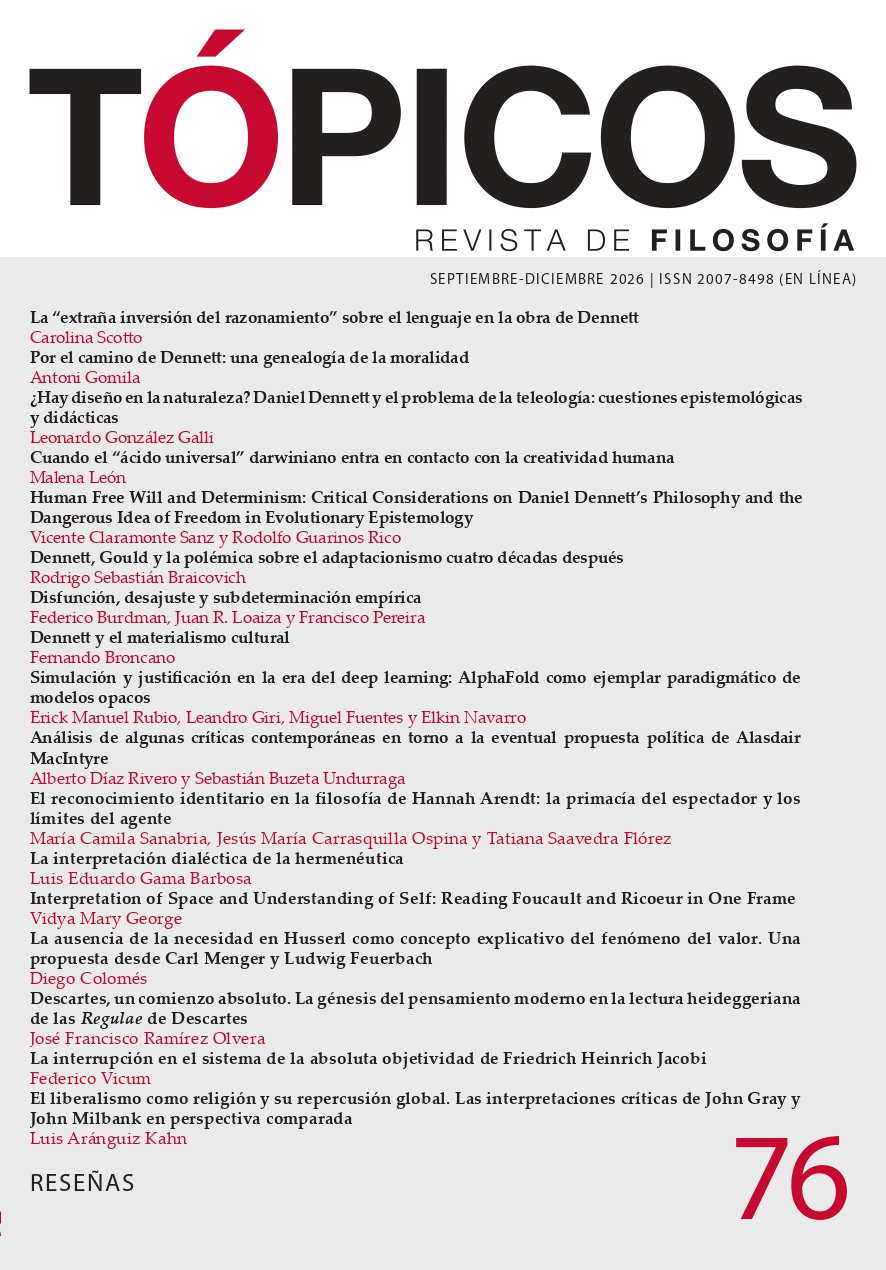
Copyright (c) 2026 Fernando Broncano

This work is licensed under a Creative Commons Attribution-NonCommercial-ShareAlike 4.0 International License.
Abstract
In this paper, I contrast Dennett’s materialism with post-cognitive enactivism. Although both are naturalist and eliminativist approaches concerning the Cartesian Theater, Dennett’s functionalism remains limited by its adherence to representationalism regarding the mind’s internal workings. The main difference observed between these two forms of materialism concerns the place of experience and phenomenology, a central position accepted by enactivism as a hallmark of life, at the cost of abandoning the idea of representation and content.
Keywords
- cognitivism,
- materialism,
- enactivism,
- representationalism,
- material culture
- heterophenomenology,
- intentional stance,
- cellular automata,
- eliminativism,
- Daniel Dennett ...More
References
- Ayala, F. J. y Arp, R. (2010). Contemporary Debates in Philosophy of Biology. Wiley-Blackwell. https://doi.org/10.1002/9781444314922
- Broncano, F. (2025, 20 de octubre). Materialismos. El laberinto de la identidad. Reflexiones en las fronteras de la cultura y la ciencia, la filosofía y la literatura, la melancolía y la esperanza. https://laberintodelaidentidad.blogspot.com/2025/10/?m=0
- Brooks, R. A. (1991). Intelligence without Representation. Artificial Intelligence, 47(1-3), 139-59. https://doi.org/10.1016/0004-3702(91)90053-M
- Chemero, A. (2009). Radical Embodied Cognitive Science. The MIT Press. https://doi.org/10.7551/mitpress/8367.001.0001
- Dennett, D. (1995). Darwin’s Dangerous Idea: Evolution and the Meanings of Life. Simon & Schuster.
- Dennett, D. (1997). Kinds of Minds: Towards an Understanding of Consciousness. Basic Books.
- Dennett, D. (2017). From Bacteria to Bach and Back: The Evolution of Minds. W. W. Norton & Company.
- Di Paolo, E., Buhrmann, T. y Barandiaran, X. E. (2017). Sensory Motor Life: An Enactive Proposal. Oxford University Press.
- Donald, M. (1991). Origins of the Modern Mind. Harvard University Press.
- Dawkins, R. (1976). The Selfish Gene. Oxford University Press.
- Godfrey-Smith, P. (2001). Three Kinds of Adaptationism. En S. H. Orzack y E. Sober (eds.), Adaptationism and Optimality (pp. 335-357). Cambridge University Press. https://doi.org/10.1017/CBO9780511609084.012
- Godfrey-Smith, P. (2016). Other Minds: The Octopus, the Sea, and the Deep Origins of Consciousness. Farrar, Straus and Giroux.
- Godfrey-Smith, P. (2018). Towers ant Trees in Cognitive Evolution. En B. Huebner (ed.), The Philosophy of Daniel Dennett (pp. 225-249). Oxford University Press. https://doi.org/10.1093/oso/9780199367511.003.0015
- Hutchins, E. (1995). Cognition in the Wild. The MIT Press. https://doi.org/10.7551/mitpress/1881.001.0001
- Ihde, D. (1993). Postphenomenology: Essays in the Postmodern Context. Northwestern University Press.
- Malafouris, L. (2013). How Things Shape the Mind: A Theory of Material Engagement. The MIT Press. https://doi.org/10.7551/mitpress/9476.001.0001
- Malafouris, L. (2019). Mind and Material Engagement. Phenomenology and the Cognitive Sciences, 18(1), 1-17. https://doi.org/10.1007/s11097-018-9606-7
- Maturana, H. R. y Varela, F. J. (1972). Autopoiesis and Cognition: The Realization of the Living. Reidel.
- Maynard Smith, J. (1958). The Theory of Evolution. Penguin Books.
- Newell, A. y H. A. Simon. (1972). Human Problem Solving. Prentice-Hall.
- Physarum polycephalum. (2026, 30 de abril). En Wikipedia. https://en.wikipedia.org/w/index.php?title=Physarum_polycephalum&oldid=1351818378
- Putnam, H. (1975). Philosophy and Our Mental Life. En H. Putnam, Mind, Language and Reality: Philosophical Papers. Volume 2. (pp. 291-303). Cambridge University Press. https://doi.org/10.1017/CBO9780511625251.016
- Rosenblueth, A., Wiener, N. y Bigelow, J. (1943). Behavior, Purpose and Teleology. Philosophy of Science, 10(1), 18-24. https://doi.org/10.1086/286788
- Searle, J. (2010). Consciousness and Language. Cambridge University Press
- Sterelny, K. (2003). Thought in a Hostile World: The Evolution of Human Cognition. Cambridge University Press.
- Wiener, N. (1948). Cybernetics: Or Control and Communication in the Animal and the Machine. The MIT Press.