
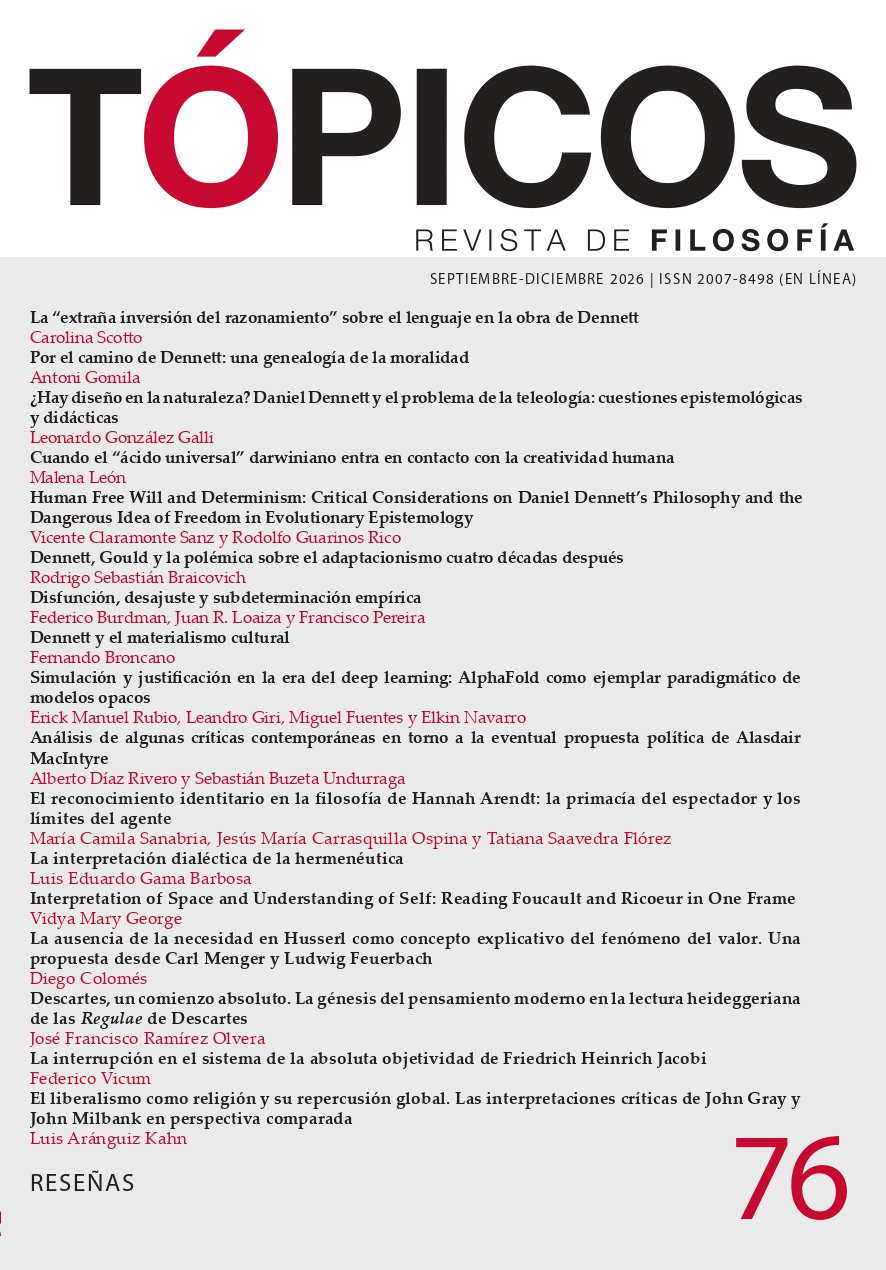
Simulation and Justification in the Age of Deep Learning: AlphaFold as a Paradigmatic Case of Opaque Models
Published 2026-07-09
How to Cite
Downloads
Copyright (c) 2026 Erick Manuel Rubio, Leandro Giri, Miguel Fuentes, Elkin Navarro

This work is licensed under a Creative Commons Attribution-NonCommercial-ShareAlike 4.0 International License.
Abstract
This paper examines the epistemic status of contemporary computational models based on deep learning through the case of AlphaFold, with the aim of assessing to what extent such systems can be understood within the traditional framework of computational simulations or whether they require distinct epistemic categories. Drawing on Paul Humphreys’ analytical framework—particularly the notions of computational templates and computational models—the paper explores the possibility of a formal and epistemic continuity between classical simulations and deep learning systems, while critically addressing issues of opacity, pragmatic validation, and the constitutive role of visual representation. The analysis shows that, although classical representationalist accounts are insufficient to capture the internal functioning of models such as AlphaFold, these systems cannot be straightforwardly reduced to mere algorithmic devices. In this sense, it is argued that AlphaFold confronts philosophy of science with the need to rethink both the criteria of epistemic justification and the scope of the notion of simulation in the era of deep learning.
Keywords
- deep learning,
- epistemically opaque deep-learning simulations,
- epistemic opacity,
- scientific representation,
- validation
- verification,
- justification,
- computer simulation,
- computational model,
- computational template ...More
References
- Barak, O. (2017). Recurrent Neural Networks as Versatile Tools of Neuroscience Research. Curr Opin Neurobiol, 46, 1-6. https://doi.org/10.1016/j.conb.2017.06.003
- Barberousse, A., Franceschelli, S. y Imbert, C. (2009). Computer Simulations as Experiments. Synthese, 169(3), 557-574. https://doi.org/10.1007/s11229-008-9430-7
- Chirimuuta, M. (2021). Prediction Versus Understanding in Computationally Enhanced Neuroscience. Synthesis, 199, 767-790. https://doi.org/10.1007/s11229-020-02713-0
- Daston, L. y Galison, P. (2007). Objectivity. Zone Books.
- Durán, J. M. (2017). Simulaciones computacionales. Principia, 21(1), 125-140. https://doi.org/10.5007/1808-1711.2017v21n1p125
- Frigg, R. y Reiss, J. (2009). The Philosophy of Simulation: Hot New Issues or Same Old Stew? Synthese, 169, 593-613. https://doi.org/10.1007/s11229-008-9438-z
- Galison, P. (1996). Computer Simulations and the Trading Zone. En P. Galison y D. J. Stump (eds.), The Disunity of Science: Boundaries, Context and Power (pp. 118-157). Stanford University Press.
- Gilmer, J., Schoenholz, S. S., Riley, P. F., Vinyals, O. y Dahl, G. E. (2017). Neural Message Passing for Quantum Chemistry. Proceedings of the 34th International Conference on Machine Learning, 70, 1263-1272. https://proceedings.mlr.press/v70/gilmer17a.html
- Gao, P. y Ganguli, S. (2015). On Simplicity and Complexity in the Brave New World of Large-Scale Neuroscience. Curr Opin Neurobiol, 32, 148-155. https://doi.org/10.1016/j.conb.2015.04.003
- Goh, G. B., Hodas, N. O., & Vishnu, A. (2017). Deep Learning for Computational Chemistry. Journal of Computational Chemistry, 38(16), 1291-1307 . https://doi.org/10.1002/jcc.24764
- Hughes, R. I. G. (1999). The Ising Model, Computer Simulation, and Universal Physics. En M. Morgan y M. Morrison (eds.), Models as Mediators: Perspectives on Natural and Social Science (pp. 97-145). Cambridge University Press. https://doi.org/10.1017/CBO9780511660108.006
- Humphreys, P. (2004). Extending Ourselves: Computational Science, Empiricism, and Scientific Method. Oxford University Press. https://doi.org/10.1093/0195158709.001.0001
- Humphreys, P. (2009). The Philosophical Novelty of Computer Simulation Methods. Synthese, 169, 615-626. https://doi.org/10.1007/s11229-008-9435-2
- Jensen, F. (2017). Introduction to Computational Chemistry. Wiley. https://doi.org/10.14293/S2199-1006.1.SOR-CHEM.CLYWQK5.v1
- Jumper, J., Evans, R., Pritzel, A., Green, T., Figurnov, M., Ronneberger, O., … y Hassabis, D. (2021). Highly Accurate Protein Structure Prediction with Alphafold. Nature, 596, 583-589. https://doi.org/10.1038/s41586-021-03819-2
- Lenhard, J. (2016). Computer Simulation. En P. Humphreys (ed.), The Oxford Handbook of Philosophy of Science (pp. 710-736). Oxford University Press. https://doi.org/10.1093/oxfordhb/9780199368815.013.42
- Morrison, M., (2012). Models, Measurement and Computer Simulation: The Changing Face of Experimentation. Philosophical Studies, 143, 33-57. https://doi.org/10.1007/s11098-008-9317-y
- Morrison, M. (2015a). Legitimating Simulation: Methodological Issues of Verification and Validation. En M. Morrison, Reconstructing Reality: Models, Mathematics, and Simulations (pp. 248- 286). Oxford University Press. https://doi.org/10.1093/acprof:oso/9780199380275.003.0008
- Morrison, M. (2015b). Without It There’s Nothing: The Necessity of Simulation in the Higgs Search. En M. Morrison, Reconstructing Reality: Models, Mathematics, and Simulations (pp. 287-316). Oxford University Press. https://doi.org/10.1093/acprof:oso/9780199380275.003.0009
- Norton, S. y Suppe, F. (2001). Why Atmospheric Modeling Is Good Science. En P. Edwards y C. Miller (eds.), Changing the Atmosphere (pp. 67-106). The MIT Press. https://doi.org/10.7551/mitpress/1789.003.0006
- Particle Physics & Astronomy Research Council (2005, 4 de junio). Millennium Simulation—The Largest Ever Model of the Universe.ScienceDaily. www.sciencedaily.com/releases/2005/06/050604061156.htm
- Rohrlich, F. (1990). Computer Simulation in the Physical Sciences. PSA: Proceedings of the Biennial Meeting of the Philosophy of Science Association, 2, 507-518. https://doi.org/10.1086/psaprocbienmeetp.1990.2.193094
- Rubio, E., Giri, L. y Ilcic, A. (2023). Desafíos epistemológicos en la era de las redes neuronales artificiales: abordando sistemas complejos desde una perspectiva computacional. Argumentos de Razón Técnica, 26, 145-178. https://doi.org/10.12795/Argumentos/2023.i26.06
- Sjölin Wirling, Y. y Grüne-Yanoff, T. (2021). The Epistemology of Modal Modeling Philosophy Compass, 16(10), e12775. https://doi.org/10.1111/phc3.12775
- Stokes, J. M., Yang, K., Swanson, K., Jin, W., Cubillos-Ruiz, A., Donghia, N. M., … y Collins, J. J. (2020). A Deep Learning Approach to Antibiotic Discovery. Cell, 180(4), 688-702.e13. https://doi.org/10.1016/j.cell.2020.01.021
- Vaswani, A., Shazeer, N., Parmar, N., Uszkoreit, J., Jones, L., Gomez, A. N., Kaiser, L. y Polosukhin, I. (2017). Attention Is All You Need. En U. von Luxburg, I. Guyon, S. Bengio, H. Wallach, R. Fergus (eds.), NIPS’17: Proceedings of the 31st International Conference on Neural Information Processing Systems (pp. 6000-6010). Curran Associates Inc. https://doi.org/10.48550/arXiv.1706.03762
- Vicsek, T. (2002). The Bigger Picture. Nature, 418(6894), 131. https://doi.org/10.1038/418131a
- Winsberg, E. (2001). Simulations, Models, and Theories: Complex Physical Systems and their Representations. Philosophy of Science, 68, S442-S454. https://doi.org/10.1086/392927
- Winsberg, E. (2010). Science in the Age of Computer Simulation. The University of Chicago Press. https://doi.org/10.7208/chicago/9780226902050.001.0001
- Winsberg, E. y Alvarado, R. (2022). Computer Simulations in Science. The Stanford Encyclopedia of Philosophy. E. N. Zalta y U. Nodelman (eds.). https://plato.stanford.edu/archives/spr2026/entries/simulations-science/
- Yang, K., Swanson, K., Jin, W., Coley, C., Eiden, P., Gao, H. Guzman-Perez, A., Hopper, T., Kelley, B., Mathea, M., Palmer, A., Settels, V., Jaakkola, T., Jensen, K. y Barzilay, R. (2019). Analyzing Learned Molecular Representations for Property Prediction. Journal of Chemical Information and Modeling, 59(8), 3370-3388. https://doi.org/10.1021/acs.jcim.9b00237