
Analysis of Some Contemporary Criticisms of Alasdair Macintyre’s Eventual Political Proposal
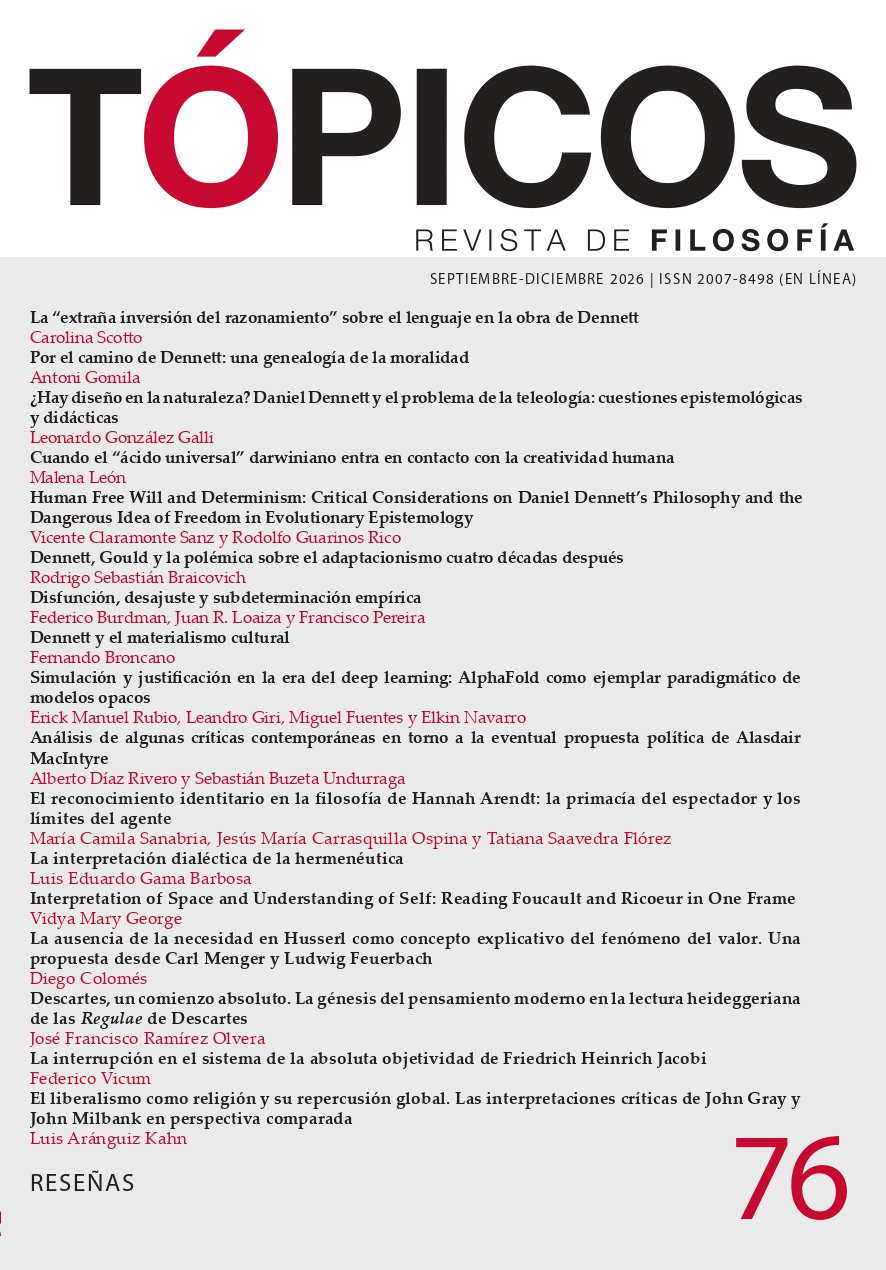
Published 2026-07-09
How to Cite
Downloads
Copyright (c) 2026 Alberto Díaz Rivero, Sebastián Buzeta Undurraga

This work is licensed under a Creative Commons Attribution-NonCommercial-ShareAlike 4.0 International License.
Abstract
Alasdair MacIntyre’s political philosophy has proven to be highly influential in current debates concerning modern political institutions and their relationship to ethics. However, it has also been the focus of numerous criticisms from various schools of thought. Of these, the most documented ones point to a lack of explicitness, clarity, and viability throughout his political proposal. This paper analyzes three of these criticisms, expressed by Perreau-Saussine, Pierre Manent, Keith Breen, Ronald Beiner, and Daniel Edward Young. Firstly, it presents and briefly highlights the main aspects of MacIntyrean political theory. It then analyzes the criticisms of these authors. Finally, it explores the possible existence of a viable political proposal based on MacIntyre’s political theory while also incorporating into the analysis those criticisms that seem to be well-founded.
Keywords
- Alasdair MacIntyre,
- political proposal,
- liberalism,
- modern state,
- state neutrality
- political theory,
- local communities,
- modernity,
- communitarianism,
- Aristotelianism ...More
References
- Anscombe, G. E. M. (1958). Modern Moral Philosophy. Philosophy, 33(124), 1-19. https://doi.org/10.1017/S0031819100037943
- Beadle, R. y Moore, G. (2011). MacIntyre, Neo-Aristotelianism and Organization Theory. Research in the Sociology of Organizations, 32, 85-121. https://doi.org/10.1108/s0733-558x%282011%290000032006
- Beadle, R. y Moore, G. (2020). Learning from MacIntyre. Pickwick Publications.
- Beiner, R. (2000). Community versus Citizenship: MacIntyre’s Revolt against the Modern State. Critical Review, 14(4), 459-479. https://doi.org/10.1080/08913810008443569
- Blackledge, P. y Davidson, N. (2008). Alasdair MacIntyre’s Engagement with Marxism: Selected Writings 1953-1974. Brill. https://doi.org/10.1163/ej.9789004166219.i-443
- Borradori, G. (1994). Nietzsche or Aristotle? Alasdair MacIntyre. En G. Borradori, The American Philosopher: Conversations with Quine, Davidson, Putnam, Nozick, Danto, Rorty, Cavell, MacIntyre, and Kuhn (pp. 137-152). R. Crocitto (trad.). University of Chicago Press. https://doi.org/10.7208/chicago/9780226066493.001.0001
- Breen, K. (2005). The State, Compartmentalization and the Turn to Local Community: A Critique of the Political Thought of Alasdair MacIntyre. The European Legacy, 10(5), 485-501. https://doi.org/10.1080/10848770500173722
- Buzeta, S. (2013). Sobre el conocimiento por connaturalidad. Servicio de Publicaciones de la Universidad de Navarra. https://hdl.handle.net/10171/37680
- Descombes, V. (2013). Alasdair MacIntyre en France. Revue Internationale de Philosophie, 264(2), 135-156. https://doi.org/10.3917/rip.264.0135
- Frazer, E. y Lacey, N. (1994). MacIntyre, Feminism and the Concept of Practice. En J. Horton y S. Mendus (eds.), After MacIntyre: Critical Perspectives on the Work of Alasdair MacIntyre (pp. 265-282). University of Notre Dame Press.
- González, A. M. (2006). Moral, razón y naturaleza: una investigación sobre Tomás de Aquino. EUNSA.
- Gregson, J. (2019). Marxism, Ethics and Politics—The Work of Alasdair MacIntyre. Palgrave Macmillan. https://doi.org/10.1007/978-3-030-03371-2
- Jones, P. (2006). Toleration, Value‐pluralism, and the Fact of Pluralism. Critical Review of International Social and Political Philosophy, 9(2), 189-210. https://doi.org/10.1080/13698230600655016
- Knight, K. (1998). Editor’s Introduction. En K. Knight (ed.), The MacIntyre Reader (pp. 1-30). University of Notre Dame Press. https://doi.org/10.2307/j.ctv19m62gb.4
- Knight, K. (2007). Aristotelian Philosophy: Ethics and Politics from Aristotle to MacIntyre. Polity.
- MacIntyre, A. (1959). Hume on “Is” and “Ought”. The Philosophical Review, 68(4), 451-468. https://doi.org/10.2307/2182491
- MacIntyre, A. (1981). After Virtue: A Study in Moral Theory. Duckworth.
- MacIntyre, A. (1988). Whose Justice? Which Rationality? University of Notre Dame Press.
- MacIntyre, A. (1990a). The Privatization of Good: An Inaugural Lecture. The Review of Politics, 52(3), 344-377. https://doi.org/10.1017/S0034670500016922
- MacIntyre, A. (1990b). Three Rival Versions of Moral Enquiry: Encyclopaedia, Genealogy, and Tradition. Duckworth.
- MacIntyre, A. (1991). An Interview with Alasdair MacIntyre. Cogito, 5(2), 67-73. https://doi.org/10.5840/cogito19915230
- MacIntyre, A. (1994). The Theses on Feuerbach: A Road Not Taken. En C. C. Gould y R. S. Cohen (eds.), Artifacts, Representations and Social Practice (pp. 277-290). Springer. https://doi.org/10.1007/978-94-011-0902-4_16
- MacIntyre, A. (1998). Politics, Philosophy and the Common Good. En K. Knight (ed.), The MacIntyre Reader (pp. 235-254). University of Notre Dame Press.
- MacIntyre, A. (2006a). Poetry as Political Philosophy: Notes on Burke and Yeats. En A. MacIntyre, Ethics and Politics: Selected Essays, Volume 2 (pp. 159-171). Cambridge University Press. https://doi.org/10.1017/CBO9780511606670.010
- MacIntyre, A. (2006b). Social Structures and Their Threats to Moral Agency. En A. MacIntyre, Ethics and Politics: Selected Essays, Volume 2 (pp. 186-204). Cambridge University Press. https://doi.org/10.1017/CBO9780511606670.012
- MacIntyre, A. (2006c). Three Perspectives on Marxism: 1953, 1968, 1995. En A. MacIntyre, Ethics and Politics: Selected Essays, Volume 2 (pp. 145-158). Cambridge University Press. https://doi.org/10.1017/CBO9780511606670.009
- MacIntyre, A. (2006d). Toleration and the Goods of Conflict. En A. MacIntyre, Ethics and Politics: Selected Essays, Volume 2 (pp. 205-223). Cambridge University Press. https://doi.org/10.1017/CBO9780511606670.013
- MacIntyre, A. (2013). Replies. Revue Internationale de Philosophie, 67(264)(2), 201-220. https://doi.org/10.3917/e.rip.264.0201
- MacIntyre, A. (2016). Ethics in the Conflicts of Modernity: An Essay on Desire, Practical Reasoning, and Narrative. Cambridge University Press. https://doi.org/10.1017/9781316816967
- Manent, P. (2022). Foreword. En É. Perrau-Saussine, Alasdair MacIntyre: An Intellectual Biography (pp. xi-xvii). N. J. Pinkoski (trad.). University of Notre Dame Press. https://doi.org/10.2307/jj.21995673.4
- Mulhall, S. y Swift, A. (1996). Liberals and Communitarians. Blackwell.
- Perreau-Saussine, É. (2022). Alasdair MacIntyre: An Intellectual Biography. N. J. Pinkoski (trad.). University of Notre Dame Press. https://doi.org/10.2307/jj.21995673
- Perreau-Saussine, É. (1999). Alasdair MacIntyre between Aristotle and Marx. [Manuscrito sin publicar]. Committee on Social Thought, University of Chicago.
- Petersen C., M. (2020). El aristotelismo revolucionario de Alasdair Macintyre. En F. J. de la Torre y J. M. Loria (eds.), Alasdair MacIntyre: relecturas iberoamericanas: recepción y proyecciones (pp. 267-286). Dykinson. https://doi.org/10.2307/j.ctv17hm9hm.19
- Pinkard, T. (2003). MacIntyre’s Critique of Modernity. En M. C. Murphy (ed.), Alasdair MacIntyre (pp. 176-200). Cambridge University Press. https://doi.org/10.1017/CBO9780511609961.008
- Pinkoski, N. J. (2019). Manent and Perreau-Saussine on MacIntyre’s Aristotelianism. Perspectives on Political Science, 48(2), 125-135. https://doi.org/10.1080/10457097.2018.1563402.
- Spaemann, R. (1989). Lo natural y lo racional: ensayos de antropología. J. Olmo (trad.). Rialp.
- Thompson, C. M. (2021). The Original Benedict Option Guidebook: Benedict of Nursia’s Own Rules for Living Christian Community in a Post-Christian Society. Marchese di Carabas.
- Widow, J. A. (1984). El hombre, animal político: el orden social: principios e ideologías. Academia Superior de Ciencias Pedagógicas de Santiago.
- Young, D. E. (2022). A Dead End in Alasdair MacIntyre’s Political Thought? Reconsidering Social Institutions, Pluralism, and the Liberal Tradition. Journal of Religion, Culture & Democracy, 9, 1-16.