
Published 2026-08-09
How to Cite
Downloads
Copyright (c) 2026 Federico Vicum

This work is licensed under a Creative Commons Attribution-NonCommercial-ShareAlike 4.0 International License.
Abstract
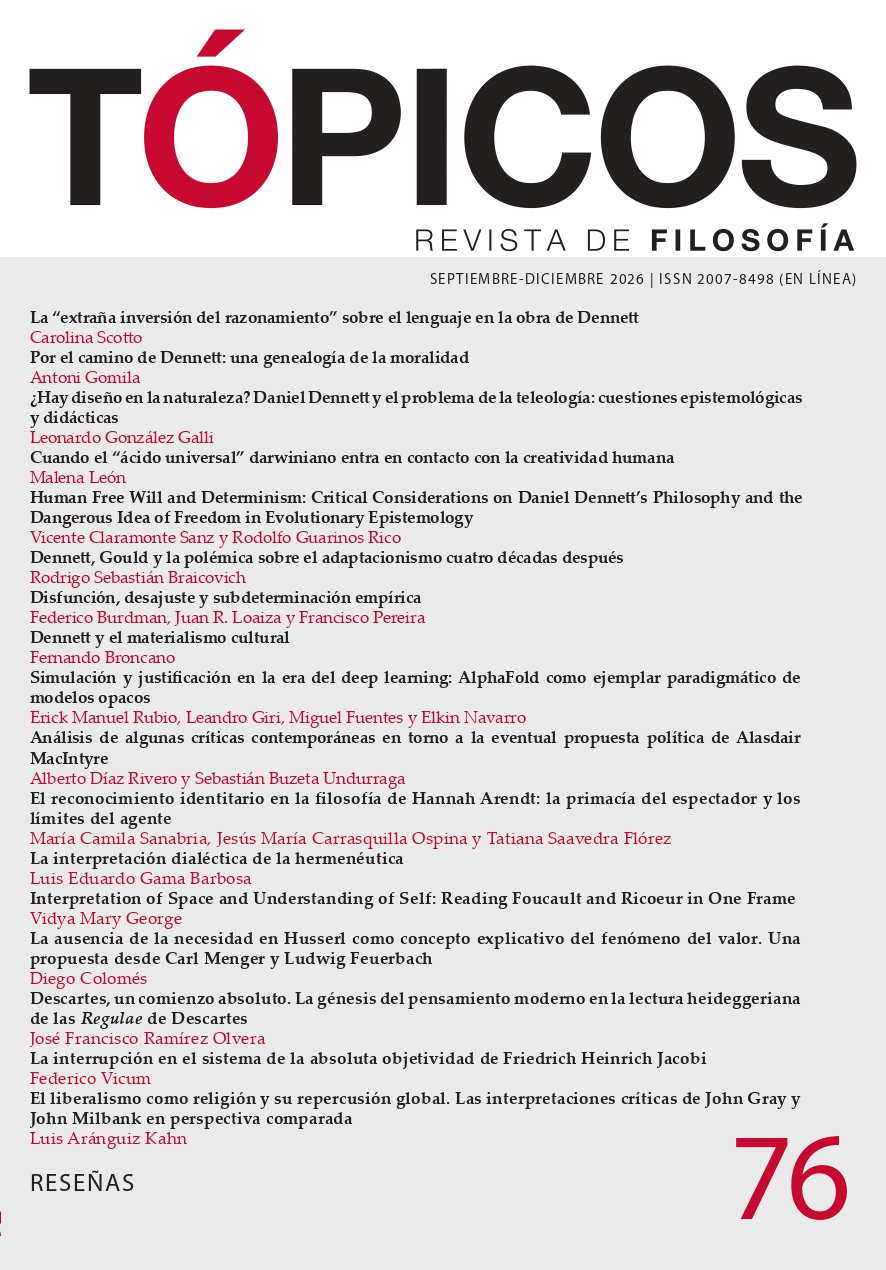
Friedrich Heinrich Jacobi’s realism is inseparable from the philosophical controversies in which he was involved. The most famous of them involves the Kantian “thing-in-itself”. However, Jacobi’s realism has to be interpreted also according to its relation to Spinoza’s philosophy. Starting from a passage of the novel Allwill, rarely studied and yet highly valued by Jacobi himself, we propose to explore Jacobi’s realism (the system of absolute objectivity) using the notion of “interruption” as a reference point. This notion allows us not only to decipher conceptual aspects of Jacobi’s thought, but also to understand the way in which he works concretely with written culture. The interruption of the pure emptiness of thought is, for Jacobi, the beginning of life (as free acting) expressed from the conditions of conceptual discourse, which are not really appropriate for such expressions.
Keywords
- interruption,
- system of absolute objectivity,
- realism,
- written culture,
- idealism
- sensation,
- Spinozism ...More
References
- Bloch, O. (1985). Le matérialisme. Presses Universitaires de France.
- Bollnow, O. (1933). Die Lebensphilosophie F. H. Jacobis. W. Kohlhammer Verlag.
- Bowman, B. (2004). Notiones Communes und Common Sense. Zu den Spinozanischen Voraussetzungen von Jacobis Rezeption der Philosophie Thomas Reids. En W. Jaeschke y B. Sandkaulen (eds.), Friedrich Heinrich Jacobi. Ein Wendepunkt der geistigen Bildung der Zeit (pp. 159-176). Felix Meiner.
- Bowman, B. (2023). Jacobi on the Nature of Mind and Intuitive Certainty. En A. J. B. Hampton (ed.), Friedrich Heinrich Jacobi and the Ends of the Enlightenment: Religion, Philosophy, and Reason at the Crux of Modernity (pp. 49-65). Cambridge University Press. https://doi.org/10.1017/9781009244978.006
- Brunel, P.-J. (2008). De Protée à Polyphème. La crise de la rationalité chez F. H. Jacobi. Études Germaniques, 63(3), 571-600. https://doi.org/10.3917/eger.251.0571
- Erasmo de Róterdam. (1677). Colloquia: nunc emendatiora. Cum omnium Notis. Typis Danielis Elzevirii. https://books.google.com.ar/books?id=H-c1n7MK7X4C&printsec=frontcover&hl=es#v=onepage&q&f=false
- Götz, C. (2008). Friedrich Heinrich Jacobi im Kontext der Aufklärung. Diskurse zwischen Philosophie, Medizin und Literatur. Felix Meiner.
- Gregori, F. (2013). Homunculus ab ovo: Beginning as Continuity and Discontinuity in Tristram Shandy. Études Anglaises, 66(2), 214-233. https://doi.org/10.3917/etan.662.0214
- Guzmán Grez, N. (2024). F. H. Jacobi y el problema de la afección en Kant: una solución metodológica. Tópicos, Revista de Filosofía, 69, 31-53. https://doi.org/10.21555/top.v690.2521
- Hammacher, K. (1969). Kritik und Leben II: Die Philosophie Friedrich Heinrich Jacobis. Wilhelm Fink.
- Jacobi, F. H. (1825). [AB I]. Auserlesener Briefwechsel. Erster Band. Gerhard Fleischer. https://www.digitale-sammlungen.de/view/bsb10403083?page=%2C1
- Jacobi, F. H. (1827). [AB II]. Auserlesener Briefwechsel. Zweyter Band. Gerhard Fleischer. https://www.digitale-sammlungen.de/view/bsb11415034?page=%2C1
- Jacobi, F. H. (1869). [NA I]. Aus F. H. Jacobis Nachlaß. Erster Band. Ungedruckte Briefe von und an Jacobi. Nebst ungedruckten Gedichten von Goethe und Lenz. R. Zoeppritz (ed.). Wilhelm Engelmann. https://www.digitale-sammlungen.de/view/bsb11415035?page=%2C1
- Jacobi, F. H. (1998). [JWA 1,1]. Werke. Gesamtausgabe. Band 1,1. Schriften zum Spinozastreit. K. Hammacher e I.-M. Piske (eds.). Felix Meiner.
- Jacobi, F. H. (2000). [JWA 3]. Werke. Gesamtausgabe. Band 3. Schriften zum Streit um die göttlichen Dinge und ihre Offenbarung. W. Jaeschke (ed.). Felix Meiner.
- Jacobi, F. H. (2004a). [JWA 2,1]. Werke. Gesamtausgabe. Band 2,1. Schriften zum transzendentalen Idealismus. W. Jaeschke e I.-M. Piske (eds). Felix Meiner.
- Jacobi, F.H. (2004b). [JWA 2,2]. Werke. Gesamtausgabe. Band 2,2. Schriften zum transzendentalen Idealismus. Anhang. W. Jaeschke e I.-M. Piske (eds.). Felix Meiner.
- Jacobi, F. H. (2006). [JWA 6,1]. Werke. Gesamtausgabe. Band 6,1. Romane I. Eduard Allwill. C. Götz y W. Jaeschke (eds.). Felix Meiner.
- Jacobi, F. H. (2007). [JWA 5,1]. Werke. Gesamtausgabe. Band 5,1. Kleine Schriften II (1787-1817). C. Goretzki y W. Jaeschke (eds.). Felix Meiner.
- Kant, I. (2009). Crítica de la razón pura. M. Caimi (trad.). Colihue.
- Knode, F. (2024). Literarische Anthropologie und empfindsame Idyllik. Zum Verhältnis von Literatur und Philosophie im Erzählwerk Friedrich Heinrich Jacobis. Transcript Verlag. https://doi.org/10.1515/9783839468586
- Olivetti, M. M. (1971). Der Einfluß Hamanns auf die Religionsphilosophie Jacobis. En K. Hammacher (ed.), Friedrich Heinrich Jacobi. Philosoph und Literat der Goethezeit (pp. 85-117). Vittorio Klostermann.
- Olivetti, M. M. (2013). L’esito teologico della filosofia del linguaggio di Jacobi. En M. M. Olivetti, Opere II. Fabrizio Serra Editore.
- Ortlieb, C. (2010). Friedrich Heinrich Jacobi und die Philosophie als Schreibart. Brill-Wilhelm Fink. https://doi.org/10.30965/9783846749388
- Sandkaulen, B. (2000). Grund und Ursache. Die Vernunftkritik Jacobis. Wilhelm Fink.
- Sandkaulen, B. (2019). Jacobis Philosophie. Über den Widerspruch zwischen System und Freiheit. Felix Meiner. https://doi.org/10.28937/978-3-7873-3629-6
- Sandkaulen, B. (2023). Jacobi and Spinoza. En A. J. B. Hampton (ed.), Friedrich Heinrich Jacobi and the Ends of the Enlightenment: Religion, Philosophy, and Reason at the Crux of Modernity (pp. 34-48). Cambridge University Press. https://doi.org/10.1017/9781009244978.005
- Sandkaulen, B. (2024). Sein in allem Dasein. En B. Sandkaulen, S. Schick y O. Koch (eds.), Jacobi-Wörterbuch Online [Versión v6]. https://jwo.saw-leipzig.de/articles/v6/bacb2871
- Schmid, C. C. E. (1788). Critik der reinen Vernunft im Grundrisse zu Vorlesungen nebst einem Wörterbuche zum leichtern Gebrauch der Kantischen Schriften. Crökerschen Buchhandlung. https://www.digitale-sammlungen.de/de/view/bsb10044342?page=1
- Spinoza, B. (2009). Ética demostrada según el orden geométrico. V. Peña (trad.). Alianza.
- Sterne, L. (1770). Das Leben und die Meynungen des Herrn Tristram Shandy. Dritter Theil. Gottlieb August Langen. https://www.digitale-sammlungen.de/view/bsb10750311?page=%2C1
- Sterne, L. (1774). Tristram Shandis Leben und Meynungen. Dritter Theil. J. J. C. Bode (trad.). Hamburgo. https://www.digitale-sammlungen.de/view/bsb10753449?page=%2C1
- Sterne, L. (1978). La vida y las opiniones del caballero Tristram Shandy. Los sermones de Mr. Yorick. J. Marías (trad.). Alfaguara.
- Sterne, L. (1980). Tristram Shandy. H. Anderson (ed.). Norton & Company.
- Stiening, G. (2021). »Der geheime Handgriff des Schöpfers«. Jacobis theonome Epistemologie. En C. Ortlieb y F. Vollhardt (eds.), Friedrich Heinrich Jacobi (1743–1819). Romancier – Philosoph – Politiker (pp. 171-190). De Gruyter. https://doi.org/10.1515/9783110727340
- Timm, H. (1971). Die Bedeutung der Spinozabriefe Jacobis für die Entwicklung der idealistischen Religionsphilosophie. En K. Hammacher (ed.), Friedrich Heinrich Jacobi. Philosoph und Literat der Goethezeit (pp. 35-84). Vittorio Klostermann.
- Timm, H. (1974). Gott und die Freiheit. Studien zur Religionsphilosophie der Goethezeit. Band I: Der Spinozarenaissance. Vittorio Klostermann.
- Verra, V. (1963). F. H. Jacobi. Dall’Illuminismo all’Idealismo. Edizioni di ‘Filosofia’.
- Villacañas, J. L. (1989). Nihilismo, especulación y cristianismo en F. H. Jacobi. Un ensayo sobre los orígenes del irracionalismo contemporáneo. Anthropos-Universidad de Murcia.
- Wilde, N. (1894). Friedrich Heinrich Jacobi. A Study in the Origin of German Realism. [Tesis doctoral, Columbia College]. Library of Congress. https://www.loc.gov/resource/gdcmassbookdig.friedrichheinric00wild/?st=gallery