
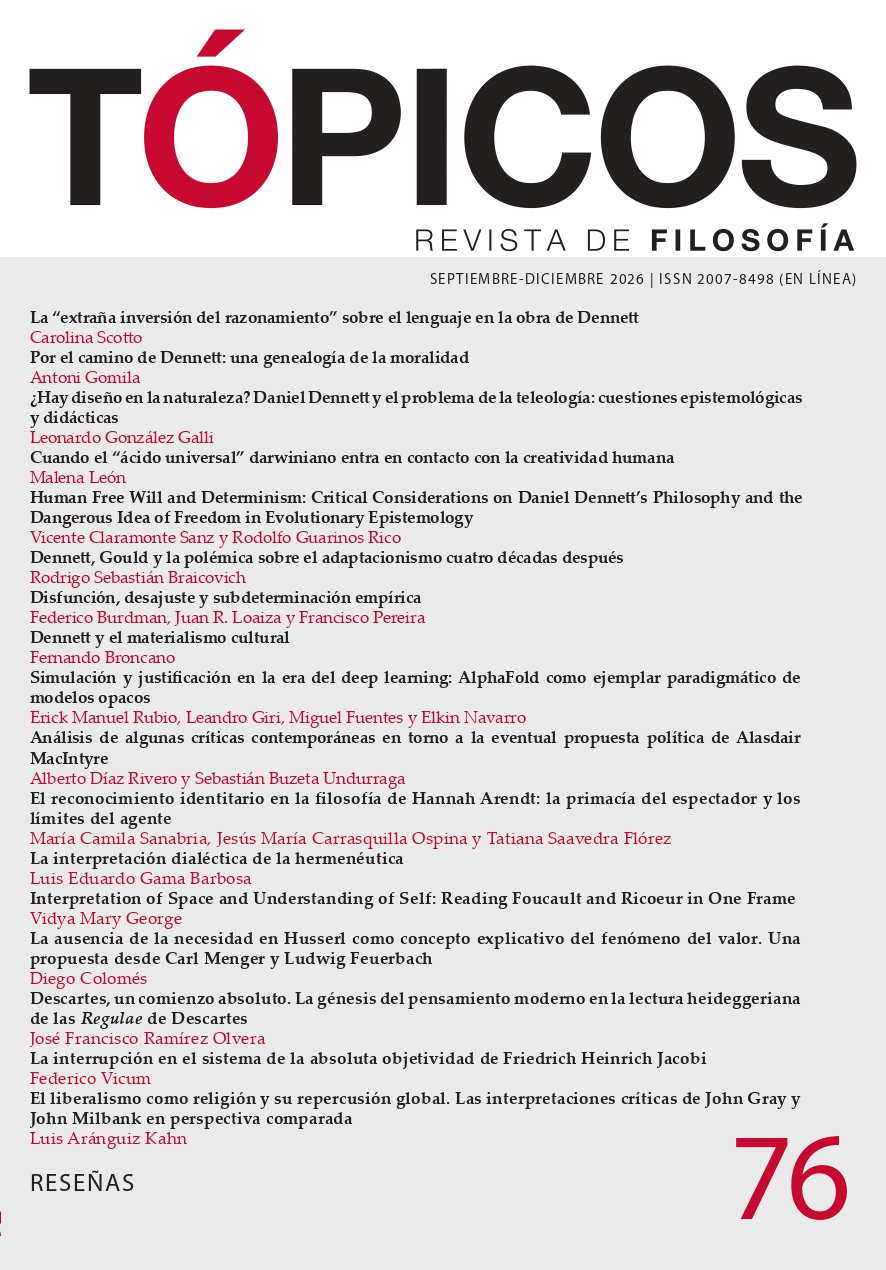
Liberalism as Religion and Its Global Repercussion: A Comparative Perspective on the Critical Interpretations of John Gray and John Milbank
Published 2026-08-09
How to Cite
Downloads
Copyright (c) 2026 Luis Aránguiz Kahn

This work is licensed under a Creative Commons Attribution-NonCommercial-ShareAlike 4.0 International License.
Abstract
This paper makes a comparative analysis of the thought of the philosopher John Gray and the Christian socialist theologian John Milbank—both contemporary English authors—on the relationship between liberalism, religion, and international order. Although they come from different intellectual backgrounds, both agree that this relationship does not consist simply of the interaction between political and religious actors, but above all of a convergence in which ideology and religion merge to give rise to specific forms of political religion and theology that define the ways in which human life is conducted on a global scale. Despite this similarity, this paper ends by highlighting the differences that exist between Gray and Milbank regarding their conceptions of the post-liberal world derived from their assessments of liberalism and religion.
Keywords
- John Gray,
- John Milbank,
- post-liberalism,
- political theology,
- political religion
- liberalism,
- geopolitical theology,
- value pluralism,
- politics of virtue,
- Eric Voegelin,
- Carl Schmitt ...More
References
- Anderson, P. (2014). Imperium et consilium. Akal.
- Asad, T. (2003). Formations of the Secular. Stanford University Press.
- Berlin, I. (1990). The Crooked Timber of Humanity. John Murray.
- Casanova, J. (1994). Public Religions in the Modern World. The University of Chicago Press. https://doi.org/10.7208/chicago/9780226190204.001.0001
- Cohn, N. (2004). The Pursuit of the Millenium. Pimlico.
- Critchley, S. (2017). La fe de los que no tienen fe. B. Thoilliez (trad.). Trotta.
- Crowder, G. (2007). Gray and the Politics of Pluralism. En J. Horton y G. Newey (eds.), The Political Theory of John Gray (pp. 59-76). Routledge.
- Del Palacio, J. (2012). Conservadurismo británico contemporáneo: John Gray y la teoría política del modus vivendi. Isegoría, 47, 601-614. https://doi.org/10.3989/isegoria.2012.047.12
- Forde, J. (2020). Anglican Socialism and Welfare: John Milbank’s “Blue Socialist” Thinking and the Church of England’s Approach to Welfare since 2008. [Tesis de doctorado, Universidad de Manchester]. Research Explorer. https://research.manchester.ac.uk/en/studentTheses/anglican-socialism-and-welfare-john-milbanks-blue-socialist-think/
- Fukuyama, F. (1989). The End of History? The National Interest, 16, 3-18. https://doi.org/10.1080/07366988909450540
- Gray, J. (1989). Liberalisms. Routledge.
- Gray, J. (1996). What Is Dead and What Is Living in Liberalism? En J. Gray, Post-Liberalism (pp. 283-328). Routledge.
- Gray, J. (2001). Las dos caras del liberalismo. M. Salomon (trad.). Paidós.
- Gray, J. (2011a). El fin de la historia, ¿otra vez? En J. Gray, Anatomía de Gray (pp. 271-278). A. Santos Mosquera (trad.). Paidós. 271-278.
- Gray, J. (2011b). El homo rapiens y la extinción en masa. En J. Gray, Anatomía de Gray (pp. 487-494). A. Santos Mosquera (trad.). Paidós.
- Gray, J. (2011c). Orígenes culturales del comunismo soviético. En J. Gray, Anatomía de Gray (pp. 257-260). A. Santos Mosquera (trad.). Paidós.
- Gray, J. (2017). Misa negra. La religión apocalíptica y la muerte de la utopía. A. Santos Mosquera (trad.). Sexto Piso.
- Habermas, J. (2006). Entre naturalismo y religión. P. Fabra, D. Gamper, F. J. Gil Martín, J. L. López de Lizaga, P. Madrigal y J. C. Velasco (trads.). Paidós.
- Hardt, M. y Negri, A. (2000). Imperio. A. Bixio (trad.). Paidós.
- Hazony, Y. (2018). The Virtue of Nationalism. Basic Books.
- Huntington, S. (1997). El choque de civilizaciones. J. P. Tosaus Abadía (trad.). Paidós.
- Kelly, P. (2007). The Social Theory of Anti-Liberalism. En J. Horton y G. Newey (eds.), The Political Theory of John Gray (pp. 25-42). Routledge.
- Milbank, J. y Pabst, A. (2014). The Anglican Polity and the Politics of the Common Good. Crucible: The Christian Journal of Social Ethics, 1, 7-15.
- Milbank, J. y Pabst, A. (2016). The Politics of Virtue. Rowman & Littlefield. https://doi.org/10.5040/9798881817411
- Milbank, J. (1997). The Word Made Strange. Blackwell.
- Milbank, J. (2002). Sovereignty, Empire, Capital and Terror. South Atlantic Quarterly, 101(2), 304-324. https://doi.org/10.1215/00382876-101-2-305
- Milbank, J. (2006). Theology and Social Theory: Beyond Secular Reason. Blackwell. https://doi.org/10.1002/9780470694121
- Milbank, J. (2009a). Geopolitical Theology: Economy, Religion and Empire after 9/11. En M. Morgan (ed.), The Impact of 9/11 on Religion and Philosophy (pp. 85-112). Palgrave Macmillan. https://doi.org/10.1057/9780230101609_7
- Milbank, J. (2009b). Liberalidad contra liberalismo. En J. Milbank y A. Pabst, El pensamiento de John Milbank (pp. 67-94). S. Montiel Gómez (trad.). Editorial Nuevo Inicio.
- Milbank, J. (2009c). The Future of Love. Cascade Books.
- Milbank, J. (2015). The Politics of the Soul. Open Insight, 6(9), 91-108. https://doi.org/10.23924/oi.v6n9a2015.pp91-108.127
- Nye, J. (2004). Soft Power. Public Affairs.
- Oakeshott, M. (1962). Rationalism in Politics. Basic Books.
- Pabst, A. (2017). Postliberalism: The New Centre Ground of British Politics. The Political Quarterly, 88(3), 500-509.
- Pabst, A. (2020). The Post-liberal Moment. Telos, 190, 177-180. https://doi.org/10.1111/1467-923X.12363
- Portillo, A. (2013). Una aproximación a la comprensión de la geopolítica de las religiones. Fermentum. Revista Venezolana de Sociología y Antropología, 23(67), 135-148.
- Rawls, J. (1995). Liberalismo político. S. R. Madero Báez (trad.). FCE.
- Scattola, M. (2008). Teología política. H. Cardoso (trad.). Ediciones Nueva Visión.
- Schmitt, C. (2009). Teología Política. F. J. Conde y J. Navarro Pérez (trads.). Trotta.
- Simpson, P. (2018). Political Illiberalism. Routledge.
- Sleat, M. (2013). Liberal Realism. Manchester University Press. https://doi.org/10.7228/manchester/9780719088902.001.0001
- Stout, J. (2004). Democracy and Tradition. Princeton University Press. https://doi.org/10.1515/9781400825868
- Strauss, L. (2011). Leo Strauss. El filósofo en la ciudad. C. Hilb (ed.). Prometeo Libros.
- Voegelin, E. (2014). Religiones políticas. M. Abella Martínez y P. García Guirao (trads.). Trotta.
- Wolterstorff, N. (1997). The Role of Religion in Decision and Discussion of Political Issues. En R. Audi y N. Wolterstorff (eds.), Religion in the Public Square: The Place of Religious Convictions in Political Debate (pp. 67-120). Rowman and Littlefield.