
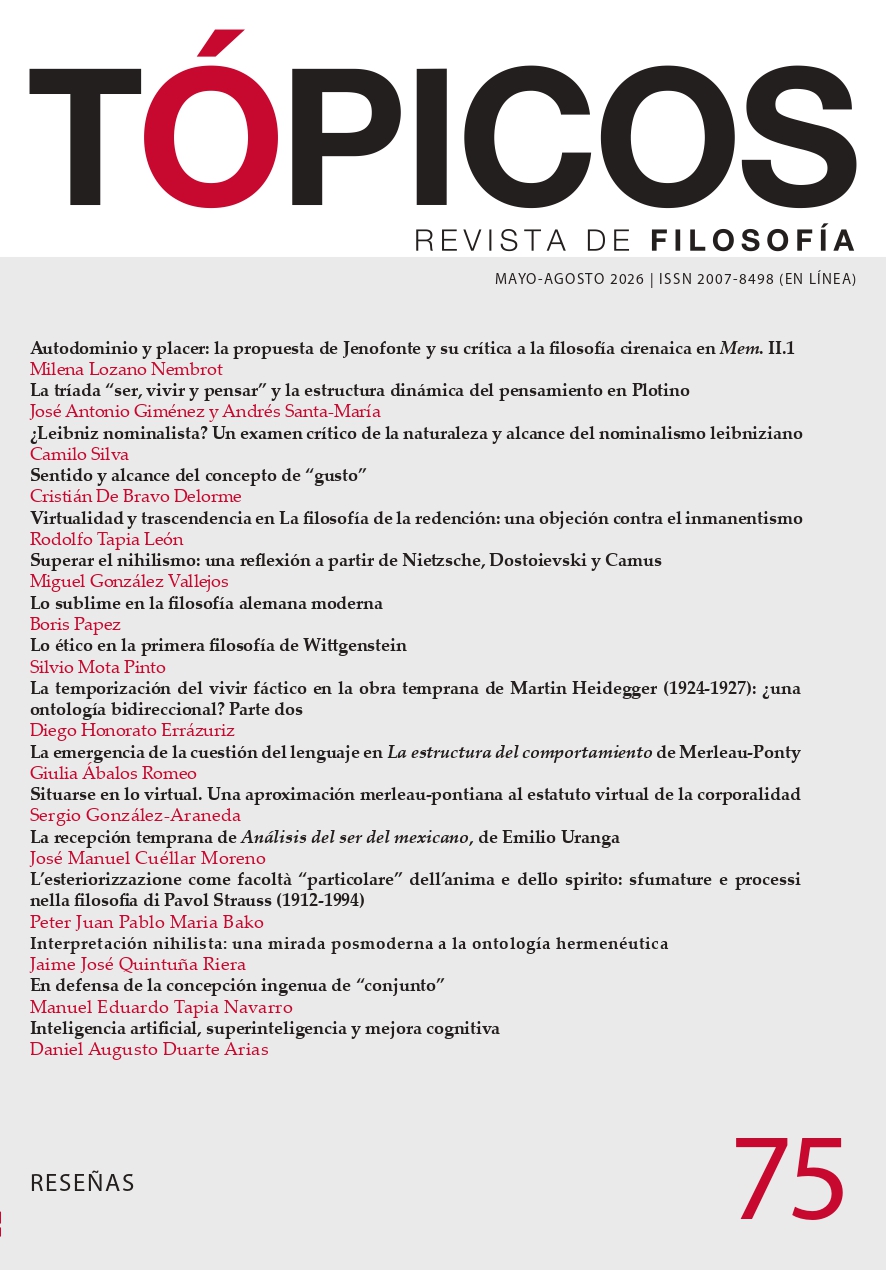
Was Leibniz a Nominalist? A Critical Survey of the Nature and Scope of Leibnizian Nominalism
Published 2026-01-31
How to Cite
Downloads
Copyright (c) 2026 Camilo Silva

This work is licensed under a Creative Commons Attribution-NonCommercial-ShareAlike 4.0 International License.
Abstract
In this article, I discuss the problem concerning the nature and scope of Leibniz’s nominalism. Considering several manuscripts from Leibniz’s youth to his later years, I provide textual evidence refuting the interpretation according to which he could be considered a nominalist. In contrast, following certain Leibniz’s scholars, I suggest that Leibniz’s ontology can be better understood as conceptualist. Thus, the main claim of this article is that even if—against Scholastics—Leibniz calls for the elimination or avoidance of abstract or universal terms in philosophical language, given some specific requirements of his ontology, he was pushed to reestablish them.
Keywords
- abstracts,
- conceptualism,
- concretes,
- Scholastics,
- Leibniz
- metaphysics,
- nominalism,
- realism,
- universals,
- truth ...More
References
- Angelelli, I. (1965). Leibniz’s Misundertanding on Nizzolius notion of “Multitudo”. Notre Dame Journal of formal logic, 6(4), 319-322. https://doi.org/10.1305/ndjfl/1093958340
- Angelelli, I. (2004). Leibniz et Nizzolius : réponse à Jean-Baptiste Rauzy. Les Cahiers philosophiques de Strasbourg, 18(2), 215-219.
- Antognazza, M. R. (2009). Leibniz: An Intellectual Biography. Cambridge University Press. https://doi.org/10.1017/CBO9781139012805
- Beeley, P. (1999). Mathematics and Nature in Leibniz’s Early Philosophy. En S. Brown (ed.), The Young Leibniz and his Philosophy (1646-76) (pp. 123-145). Springer. https://doi.org/10.1007/978-94-017-3507-0_7.
- Belaval, Y. (1976). Études leibniziennes. De Leibniz à Hegel. Gallimard.
- Berlioz, D. (1989). Tâche logique : le calcul des « coïncidents » et des inexistants. Les Études Philosophiques, 2(Leibniz), 187-200. Presses Universitaires de France.
- Berlioz, D. (2011). John Locke et la métaphysique. En M. de Gaudemar y P. Hamou (eds.), Locke et Leibniz : deux styles de rationalité (pp. 109-129). Georg Olms.
- Blank, A. (2007). Dalgarno, Wilkins, Leibniz and the Descriptive Nature of Metaphysical Concepts. En P. Phemister y S. Brown (eds.), Leibniz and the English-Speaking World (pp. 51-61). Springer. https://doi.org/10.1007/978-1-4020-5243-9_4.
- Broad, C. D. (1972). Leibniz’s Predicate-in-Notion Principle and Some of its Alleged Consequences. En H. Frankfurt (ed.), Leibniz: A Collection of Critical Essays (pp. 1-18). Anchor Books.
- Clatterbaugh, K. (1973). Leibniz’s Doctrine of Individual Accidents. Franz Steiner Verlag.
- Coombs, J. (2003). The Ontological Source of Logical Possibility in Catholic Second Scholasticism. En R. Friedman y L. Nielsen (eds.), The Medieval Heritage in Early Modern Metaphysics and Modal Theory (1400–1700) (pp. 191-229). Springer. https://doi.org/10.1007/978-94-017-0179-2_10
- Dascal, M. (1987). Leibniz. Language, Signs and Thought: A Collection of Essays. John Benjamins Publishing Company. https://doi.org/10.1075/fos.10
- Di Bella, S. (1998). L’astratto et il concreto. Hobbes, Leibniz et la riforma dell’ontologia. Rivista di Storia della Filosofia, 53(2), 235-266. https://www.jstor.org/stable/44023325
- Di Bella, S. y Schmaltz, T. (2017). The Problem of Universals in Early Modern Philosophy. Oxford University Press. https://doi.org/10.1093/acprof:oso/9780190608040.001.0001
- Drapeau-Contim, F. (2005). Des propositions aux termes : logique et réduction dans les recherches générales. En D. Berlioz y F. Nef (eds.), Leibniz et les puissances du langage (pp. 95-124). Vrin.
- Favaretti, M. (2017). Les formes de la pensée : logique et langage chez Leibniz. En M. Lærke, C. Leduc y D. Rabouin (dirs.), Leibniz: lectures et commentaires (pp. 233-253). Vrin.
- Fichant, M. (1993). Mécanisme et métaphysique : le rétablissement des formes substantielles (1679). Philosophie, 39, 27-59.
- Garber, D. (1995). Leibniz: Physics and Philosophy. En N. Jolley (ed.), The Cambridge Companion to Leibniz (pp. 270-352). Cambridge university press. https://doi.org/10.1017/CCOL0521365880.009
- Goodin, S. (1999). Locke and Leibniz and the Debate over Species. En R. Gennaro y C. Huenemann (eds.), New Essays on the Rationalists (pp. 163-176). Oxford University Press. https://doi.org/10.1093/0195165411.003.0007
- Jolley, N. (1984). Leibniz and Locke: A Study of the New Essays on Human Understanding. Clarendon Press.
- Jones, J.-E. (2006). Leibniz and Locke and the Debate over Species. En F. Duchesneau y J. Griard (dirs.), Leibniz selon les Nouveaux Essais sur l’entendement humain (pp. 141-152). Bellarmin-Vrin.
- Kneale, W. (1966). Leibniz and the picture theory of language. Revue internationale de philosophie, 76-77(2-3), pp. 204-215. https://www.jstor.org/stable/23940478
- Kulstad, M. (1977). Leibniz’s conception of expression. Studia Leibnitiana, 9 (1), pp. 55-76. https://www.jstor.org/stable/40693818
- Leduc, C. (2006a). Définition et substance dans les Nouveaux Essais. En F. Duchesneau y J. Griard (dirs.), Leibniz selon les Nouveaux essais sur l’entendement humain (pp. 179-188). Bellarmin-Vrin.
- Leduc, C. (2006b). Le commentaire leibnizien du “De veris principiis” de Nizolius. Studia Leibnitiana, 38-39(1), 89-108.
- Leduc, C. (2017). L’objection leibnizienne au conventionnalisme de Hobbes. En E. Parmentier y P. Rateau (dirs.), Leibniz lecteur critique de Hobbes (pp. 35-51). Les Presses Universitaires de l’Université de Montréal-Vrin. https://doi.org/10.1515/9782760638280-004
- Leibniz, G. W. (1923-2024). [A]. Sämtliche Schriften und Briefe, herausgegeben von der Berlin Branderburgischen Akademie der Wissenschaften und der Akademie der Wissenschaften in Göttingen. Walter de Gruyter Verlag.
- Leibniz, G. W. (1960-1961). [GP]. Die philosophischen Schriften von Gottfried Wilhelm Leibniz. C. I. Gerhardt (ed.). G. Olms.
- Leibniz, G. W. (1961). [C]. Opuscules et fragments inédits. L. Couturat (ed.). G. Olms.
- Leibniz, G. W. (1998). [G]. Textes inédits. G. Grua (ed.). Presses Universitaires de France.
- Levey, S. (2011). Logical Theory in Leibniz. En B. Look (ed.), The Bloomsbury companion to Leibniz (pp. 110-135). Bloomsbury.
- Lissy, A. (2016). Nature and Grace: On the Concept of Divine Economy in Leibniz’s Philosophy. Studia Leibnitiana, 48(2), 151-177. https://doi.org/10.25162/sl-2016-0008
- MacDonald Ross, G. (1988). The Demarcation between Metaphysics and Other Disciplines in the Thought of Leibniz. En R. Woolhouse (ed.), Metaphysics and Philosophy of Science in the Seventeenth and Eighteenth Centuries (pp. 133-163). Springer. https://doi.org/10.1007/978-94-009-2997-5_7
- Mates, B. (1979). The Lingua Philosophica. Studia Leibnitiana, Sonderheft 8 (Die intensionale Logik bei Leibniz und in der Gegenwart), 59-66.
- Mates, B. (1980). Nominalism and Evander’s Sword. Studia Leibnitiana, Supplementa, 21, 213-225.
- Mates, B. (1986). The Philosophy of Leibniz: Metaphysics and Language. Oxford University Press.
- Mercer, C. (2004). Leibniz and his Master: The Correspondence with Jokob Thomasius. En P. Lodge (ed.), Leibniz and his correspondents (pp. 10-46). Cambridge University Press. https://doi.org/10.1017/CBO9780511498237.002
- Møller-Nielsen, T. (2015). Was Leibniz a Generalist? Studia Leibnitiana, 47(1), 8-43. https://doi.org/10.25162/sl-2015-0002
- Mugnai, M. (1990). A Systematical Approach to Leibniz’s Theory of Relations and Relational Sentences. Topoi, 9, 61-81. https://doi.org/10.1007/BF00147628.
- Mugnai, M. (1992). Leibniz’ Theory of Relations. Franz Steiner Verlag.
- Mugnai, M. (2000). ‘Alia est rerum, alia terminorum divisio’: About an Unpublished Manuscript of Leibniz. En A. Lamarra y R. Palaia (eds.), Unità e molteplicità nel pensiero filosofico e scientifico di Leibniz (pp. 257-269). Leo S. Olschki Editore.
- Mugnai, M. (2005). Leibniz on Substance and Changing Properties. Dialectica, 59(4), 503-516. https://doi.org/10.1111/j.1746-8361.2005.01040.x
- Mugnai, M. (2012). Leibniz’s Ontology of Relations: A Last Word? En D. Garber y D. Rutherford (eds.), Oxford Studies in Early Modern Philosophy (pp. 171-208). Clarendon Press. https://doi.org/10.1093/acprof:oso/9780199659593.003.0006
- Nachtomy, O. (2006). Locke, Leibniz and Borges on Particulars and Universals in the Nouveaux Essais. En F. Duchesneau y J. Griard (dirs.), Leibniz selon les Nouveaux Essais sur l’entendement humain (pp. 167-178). Bellarmin-Vrin.
- Nef, F. (2000). Leibniz et le langage. Presses Universitaires de France. https://doi.org/10.3917/puf.neffr.2000.01
- Parkinson, G. H. R (1965). Logic and Reality in Leibniz’s Metaphysics. Clarendon Press.
- Parmentier, M. (2008). Leibniz-Locke : une intrigue philosophique. Presses de l’Université Paris-Sorbonne. https://doi.org/10.14375/NP.9782840506218
- Pelletier, A. (2013). Logica est scientia generalis : Leibniz et l’unité de la logique. Archives de Philosophie, 76(2), 271-294. https://doi.org/10.3917/aphi.762.0271
- Picon, M. (2003). Vers la doctrine de l’entendement en abrégé : éléments pour une généalogie des Meditationes de cognitione, veritate, et ideis. Studia Leibnitiana, 35(1), 102-132.
- Picon, M. (2005). L’expérience de la pensée : définitions, idées et caractères en 1675. En D. Berlioz y F. Nef (eds.), Leibniz et les puissances du langage (pp. 179-199). Vrin.
- Picon, M. (2009). On the Constitution of Leibnizian Formalism. En M. Kulstad, M. Lærke y D. Snyder (eds.), The Philosophy of the Young Leibniz (pp. 139-146). Franz Steiner Verlag.
- Picon, M. (2014). “The Summulists’ disputes de constantia subjecti”: The Young Leibniz and his Teachers on Eternal Truth and Existence. Intellectual History Review, 24(2), 135-151. https://doi.org/10.1080/17496977.2014.915471
- Picon, M. (2017). Théorie de la connaissance et méthode. En M. Lærke, C. Leduc y D. Rabouin (dirs.), Leibniz : lectures et commentaires (pp. 271-290). Vrin.
- Plaud, S. (2018). Expression et coordination : de Leibniz à Wittgenstein. Vrin.
- Rauzy, J.-B. (1993). Leibniz et les termes abstraits : un nominalisme par provision. Philosophie, 39, 108-128.
- Rauzy, J.-B. (2001). La doctrine leibnizienne de la vérité. Aspects logiques et ontologiques. Vrin.
- Rauzy, J.-B. (2004). An Attempt to Evaluate Leibniz’ Nominalism. Metaphysica, 5(1), 43-58.
- Rauzy, J.-B. (2005). L’inhérence conceptuelle, la raison suffisante et David Wiggins. En D. Berlioz y F. Nef (eds.), Leibniz et les puissances du langage (pp. 71-93). Vrin.
- Rodriguez-Pereyra, G. (2015). Nominalism in Metaphysics. En E. N. Zalta y U. Nodelman (eds.), The Stanford Encyclopedia of Philosophy. https://plato.stanford.edu/archives/spr2025/entries/nominalism-metaphysics/
- Rovira, R. (2000). Leibniz’s Twofold Distinction between Concrete and Abstract and Aristotle’s Fourfold Division of Entities. Studia Leibnitiana, 32(1), 68-85.
- Russell, B. (2005). A Critical Exposition of the Philosophy of Leibniz. Routledge.
- Rutherford, D. (1988). Truth, Predication and Complete Concept of an Individual Substance. Studia Leibnitiana, Sonderheft 15(Leibniz: questions de logique), 130-144.
- Rutherford, D. (1995a). Philosophy and Language in Leibniz. En N. Jolley (ed.), The Cambridge Companion to Leibniz (pp. 224-269). Cambridge University Press. https://doi.org/10.1017/CCOL0521365880.008
- Rutherford, D. (1995b). Leibniz and the Rational Order of Nature. Cambridge University Press. https://doi.org/10.1017/CBO9781139172776
- Silva, C. (2020a). Leibniz y el laberinto de la nada: la ontología en manos de un escolástico furtivo. Aporía, 19, 51-74. https://doi.org/10.7764/aporia.19.12626
- Silva, C. (2020b). Substance, vérité et métaphysique dans les Nouveaux essais : un échantillon de la perennis quaedam philosophia. Scripta philosophiae naturalis, 18, 27-60. https://scriptaphilosophiaenaturalis.wordpress.com/2020/07/16/camilo-silva-substance-verite-et-metaphysique-dans-les-nouveaux-essais-de-leibniz/
- Silva, C. (2021a). Essence, néant et existence : une lecture critique du concept de création divine chez Leibniz [Tesis doctoral, Escuela Normal Superior de París]. Theses.fr.
- Silva, C. (2021b). Leibniz lector de Locke: génesis y elaboración de los Nuevos ensayos sobre el entendimiento humano. Culturas científicas, 2(2), 70-91. https://doi.org/10.35588/cc.v2i2.5261
- Silva, C. (2025). Más allá del isomorfismo: Nominalismo, necesidad de la lógica y posibilidad de la metafísica en los jóvenes Leibniz y Wittgenstein. Logos. Anales del Seminario de Metafísica, 58(1), 53-72. https://doi.org/10.5209/asem.100295
- Silva, C. (2026). Leibniz y la pregunta “¿por qué hay algo más bien que nada?”: alcance universal, sentido onto-antrópico y naturaleza ficcional de la pregunta. Anales del Seminario de Historia de la Filosofía [manuscrito aceptado para publicación, en prensa].
- Swoyer, C. (1994). Leibniz’s Calculus of Real Addition. Studia Leibnitiana, 26(1), 1-30.
- Swoyer, C. (1995). Leibnizian Expression. Journal of the History of Philosophy, 33(1), 65-99. https://doi.org/10.1353/hph.1995.0009