
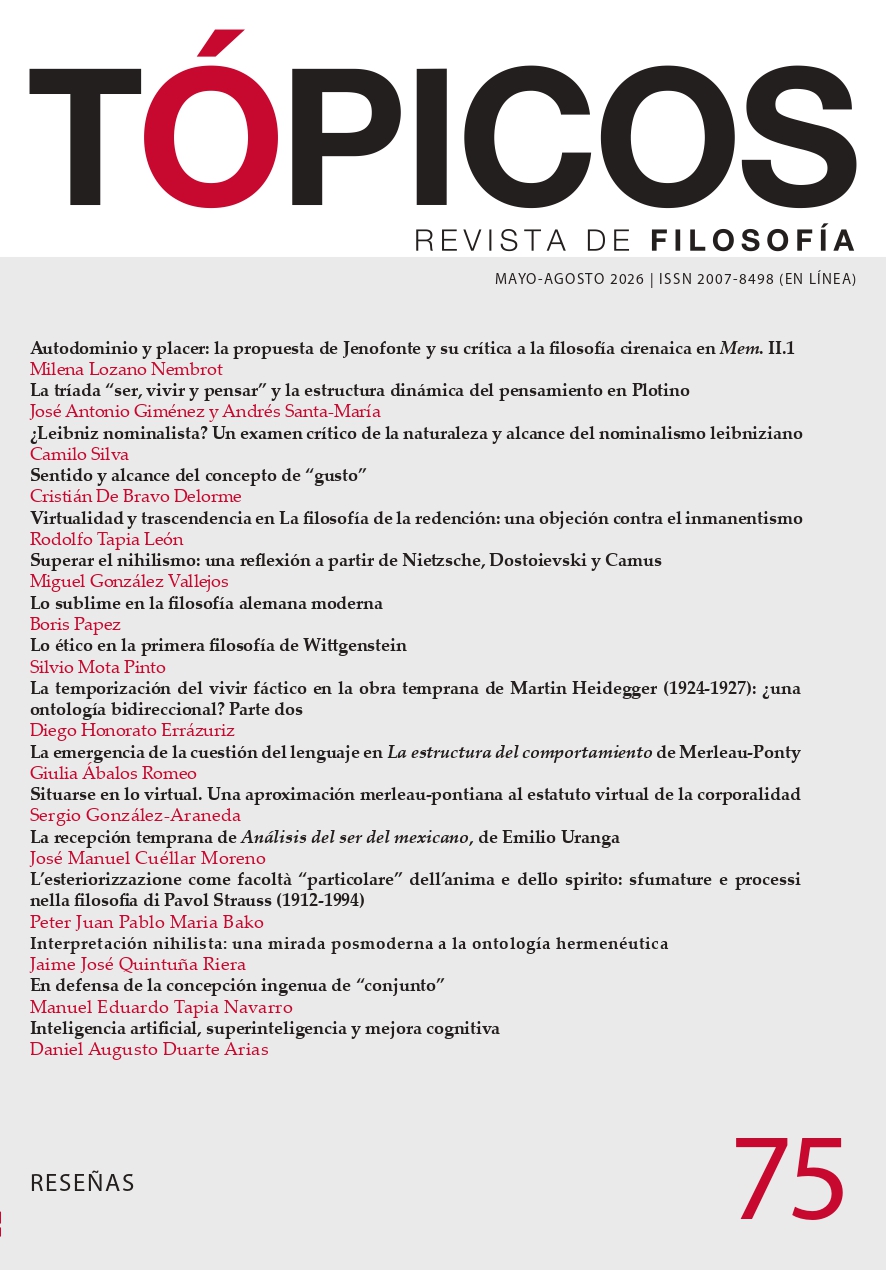
The Triad “Being, Living, and Thinking” and the Dynamic Structure of Thought in Plotinus
Published 2026-01-30
How to Cite
Downloads
Copyright (c) 2026 José Antonio Giménez, Andrés Santa-María

This work is licensed under a Creative Commons Attribution-NonCommercial-ShareAlike 4.0 International License.
Abstract
This article examines the dynamic character of the Plotinian conception of reality based on his particular appropriation of the identity of the notions of being, living, and thinking. It is argued that this proposal is characterized both by its adoption of classical sources (above all, Aristotelian epistemology) and by the extension of the triadic structure of the Intellect to reality as a whole. This extension allows Plotinus both to show the continuity between the different levels of reality (because of the origin of life in general from the Life of the Intellect) and to account for the necessity and possibility for the human soul to ascend to the Intellect. In this way, it is shown how the dynamic structure of the Intellect determines the contemplative, self-constitutive, and creative moments of each of the hypostases of Plotinus’s system.
Keywords
- Plotinus,
- Aristotle,
- being,
- living,
- thinking
- triadic structure of the Intellect,
- Plotinus’s epistemology,
- dynamism,
- analogy of life,
- emanation,
- reversion ...More
References
- Armstrong, A. H. (1971). Eternity, Life and Movement in Plotinus Account of noûs. En P. M. Schuhl y P. Hadot (eds.), Le Néoplatonisme. Royaumont 9-13 Juin 1969 (pp. 67-74). Éditions du Centre National de la Recherche Scientifique.
- Beierwaltes, W. (1991). Selbsterkenntnis und Erfahrung der Einheit. Plotins Enneade V 3. Vittorio Klostermann.
- Berman, B. (2016). Making the World Body Whole and Complete: Plato’s Timaeus, 32c5-33b1. The International Journal of the Platonic Tradition, 10, 168-192. https://doi.org/10.1163/18725473-12341347
- Boeri, M. D. (2006). Aristóteles contra Parménides: el problema del cambio y la posibilidad de una ciencia física. Tópicos, Revista de Filosofía, 30 bis, 45-68. https://doi.org/10.21555/top.v0i0.203
- Burnet, J. (1976). Platonis Opera. Oxford University Press.
- Bywater, I. (1986). Aristotelis Ethica Nicomachea. Clarendon Press. https://doi.org/10.1093/oseo/instance.00262063
- Charrue, J.-M. (1978). Plotin lecteur de Platon. Les Belles Lettres.
- Chiaradonna, R. (2006). Connaissance des intelligibles et degrés de la substance - Plotin et Aristote. Études Platoniciennes, 3, 57-102. https://doi.org/10.4000/etudesplatoniciennes.981
- Chiaradonna, R. (2008). Energeia et kinêsis chez Plotin et Aristote (Enn. VI, 1, [42], 16. 4-19). En M. Crubellier, A. Jaulin, D. Lefebvre y P.-M. Morel (eds.), Dunamis : autour de la puissance chez Aristote (pp. 471-491). Peeters.
- Cleary, J. (2010). Aristóteles acerca de los múltiples sentidos de prioridad. M. D. Boeri (trad.). Colihue.
- Cordero, N. L. (2007). Sofista. En Platón. Diálogos V (pp. 319-482). Gredos.
- Cordero, N. L. (2014). Cuando la realidad palpitaba. La concepción dinámica del ser en la filosofía griega. Editorial Biblos.
- Cornford, F. M. (1935). Plato’s Theory of Knowledge. The Theaetetus and the Sophist of Plato. Routledge.
- Dillon, J. (1983). Plotinus, Philo and Origen on the Grades of Virtue. En H.-D. Blume y F. Mann (eds.), Platonismus und Christentum. Festschrift für Heinrich Dörrie (pp. 92-105). Aschendorff.
- Emilsson, E. K. (1996). Cognition and Its Object. En L. Gerson (ed.), The Cambridge Companion to Plotinus (pp. 217-249). Cambridge University Press. https://doi.org/10.1017/CCOL0521470935.010
- Ferrari, F. (2020). Die „Seele“ des Seienden bei Platon: Sophistes 248e-249a und Timaios 30a-31c. En C. Helmig (ed.), World Soul – Anima Mundi: On the Origins and Fortunes of a Fundamental Idea (pp. 77-90). De Gruyter. https://doi.org/10.1515/9783110628609-004
- Fronterotta, F. (2008). La notion de dunamis dans le Sophiste de Platon : koinonia entre les forms et methexis du sensible à l’intelligible. En M. Crubellier, A. Jaulin, D. Levebvre y P.-M. Morel (eds.), Dunamis : autour de la puissance chez Aristote (pp. 187-224). Peeters.
- García Bazán, F. (1992). Plotino. Sobre la trascendencia divina: sentido y origen. Editorial de la Facultad de Filosofía y Letras de la Universidad Nacional de Cuyo.
- Gerson, L. (2005). Aristotle and Other Platonists. Cornell University Press. https://doi.org/10.7591/9781501716966
- Gerson, L. (2013). From Plato to Platonism. Cornell University Press. https://doi.org/10.7591/cornell/9780801452413.001.0001
- Gómez-Lobo, A. (1985). Parménides. Editorial Charcas.
- Hadot, P. (1960). Être, vie, pensée chez Plotin et avant Plotin. En E. R. Dodds, W. Theiler, P. Hadot, H. C. Puech H. Dörrie, V. Cilento, R. Harder, H. R. Schwyzer, A. H. Armstrong y P. Henry, Entretiens sur l’Antiquité classique. V. Les sources de Plotin (pp. 105-141). Fondation Hardt.
- Hadot, P. (1999). Plotin : Traité 38, VI 7. Les Écrits de Plotin publiés dans l’ordre chronologique. Éditions du Cerf.
- Henry, P. y Schwyzer, H.-R. (1964-1982). Plotini Opera. Tres volúmenes. [Editio minor]. Clarendon Press.
- Hermoso Félix, M. J. (2018). La percepción en Aristóteles y en Plotino: ¿realismo versus idealismo? Revista de Filosofía, 90(3), 42-59.
- Igal, J. (1971). La génesis de la inteligencia en un pasaje de las Enéadas de Plotino, V 1.7.4-35. Emerita, 39, 129-137.
- Igal, J. (1982). Porfirio: Vida de Plotino. Plotino: Enéadas I-II. Gredos.
- Igal, J. (1985). Plotino: Enéadas III-IV. Gredos.
- Igal, J. (1998). Plotino: Enéadas V-VI. Gredos.
- Jaeger W. (1957). Aristotelis Metaphysica. Oxford University Press.
- Kalligas, P. (2014). The Enneads of Plotinus. A Commentary. Volume 1. N. Koutras (trad.). Princeton University Press.
- Kalligas, P. (2023). The Enneads of Plotinus. A Commentary. Volume 2. E. K. Fowden y N. Pilavachi (trads.). Princeton University Press. https://doi.org/10.23943/princeton/9780691158266.001.0001
- Kosman, A. (1994). The Activity of Being in Aristotle’s Metaphysics. En T. Scaltsas, D. Charles y M. L. Gill (eds.), Unity, Identity, and Explanation in Aristotle’s Metaphysics (pp. 195-213). Oxford University Press. https://doi.org/10.1093/oso/9780198240679.003.0009
- Kühn, W. (2009). Quel savoir après le scepticisme ? Plotin et ses prédécesseurs sur la connaissance de soi. Vrin.
- Linguiti, A. (2012). Plotinus and Porphyry on the Contemplative Life. En T. Bénatouil y M. Bonazzi (eds.), Theoria, Praxis, and the Contemplative Life after Plato and Aristotle (pp. 183-197). Brill. https://doi.org/10.1163/9789004230040_011
- McGroarty, K. (2006). Plotinus on Eudaimonia: A Commentary on Ennead I.4. Oxford University Press. https://doi.org/10.1093/oso/9780199287123.001.0001
- Mesch, W. (2011). Die Bewegung des Seienden in Platons Sophistes. En A. Havlicek y F. Karfik (eds.), Plato’s Sophist. Proceedings of the Seventh Symposium Platonicum Pragense (pp. 96-119). Oikoymenh.
- Nyvlt, M. J. (2012). Aristotle and Plotinus on the Intellect, Monism and Dualism Revisited. Lexington Books. https://doi.org/10.5040/9781666985139
- O’Meara, D. (1996). The Hierarchical Ordering of Reality in Plotinus. En L. Gerson (ed.), The Cambridge Companion to Plotinus (pp. 66-81). Cambridge University Press. https://doi.org/10.1017/CCOL0521470935.004
- O’Meara, D. (2003). Platonopolis: Platonic Political Philosophy in Late Antiquity. Oxford University Press.
- Perl, E. D. (2022). Plato and Aristotle in the Enneads. En L. Gerson y J. Wilberding (eds.), The New Cambridge Companion to Plotinus (pp. 15-40). Cambridge University Press. https://doi.org/10.1017/9781108770255.002
- Rappe, S. (1996). Self-Knowledge and Subjectivity in the Enneads. En L. Gerson (ed.), The Cambridge Companion to Plotinus (pp. 205-274). Cambridge University Press. https://doi.org/10.1017/CCOL0521470935.011
- Remes, P. (2007). Plotinus on Self: The Philosophy of the ‘We’. Cambridge University Press. https://doi.org/10.1017/CBO9780511597411
- Ross W. D. (1951). Aristotelis Physica. Oxford University Press.
- Ross W. D. (1956). Aristotelis De Anima. Oxford University Press.
- Santa Cruz, M. I. (1997). L’exégèse plotinienne des mégista géne du Sophiste de Platon. En J. Cleary (ed.), The Perennial Tradition of Neoplatonism (pp. 105-118). Leuven University Press.
- Santa Cruz, M. I. (2000). La concepción plotiniana del filósofo. Kleos. Revista de Filosofía Antigua, 4, 9-30.
- Santa Cruz, M. I. (2006). Modos de conocimiento en Plotino. Classica, 19(1), 59-73. https://doi.org/10.24277/classica.v19i1.104
- Santa-María, A. (2013). Plotino, las Formas platónicas y el noûs aristotélico. Anales del Seminario de Historia de la Filosofía, 30(2), 311-330. https://doi.org/10.5209/rev_ASHF.2013.v30.n2.44050
- Sharples, R. W. (2008). Alexander Aphrodisiensis De anima libri mantissa. De Gruyter. https://doi.org/10.1515/9783110978995
- Szlezák, T. A. (1979). Platon und Aristoteles in der Nuslehre Plotins. Schwabe.
- Tornau, C. (2022). Plotinus on Knowledge. En L. Gerson y J. Wilberding (eds.), The New Cambridge Companion to Plotinus (pp. 193-215). Cambridge University Press. https://doi.org/10.1017/9781108770255.009
- Vigo, A. G. (2007). Aristóteles. Una introducción. Instituto de Estudios de la Sociedad.
- Wiitala, M. (2018). Argument against the Friends of the Forms Revisited. Apeiron, 51(2), 171-200. https://doi.org/10.1515/apeiron-2017-0013