
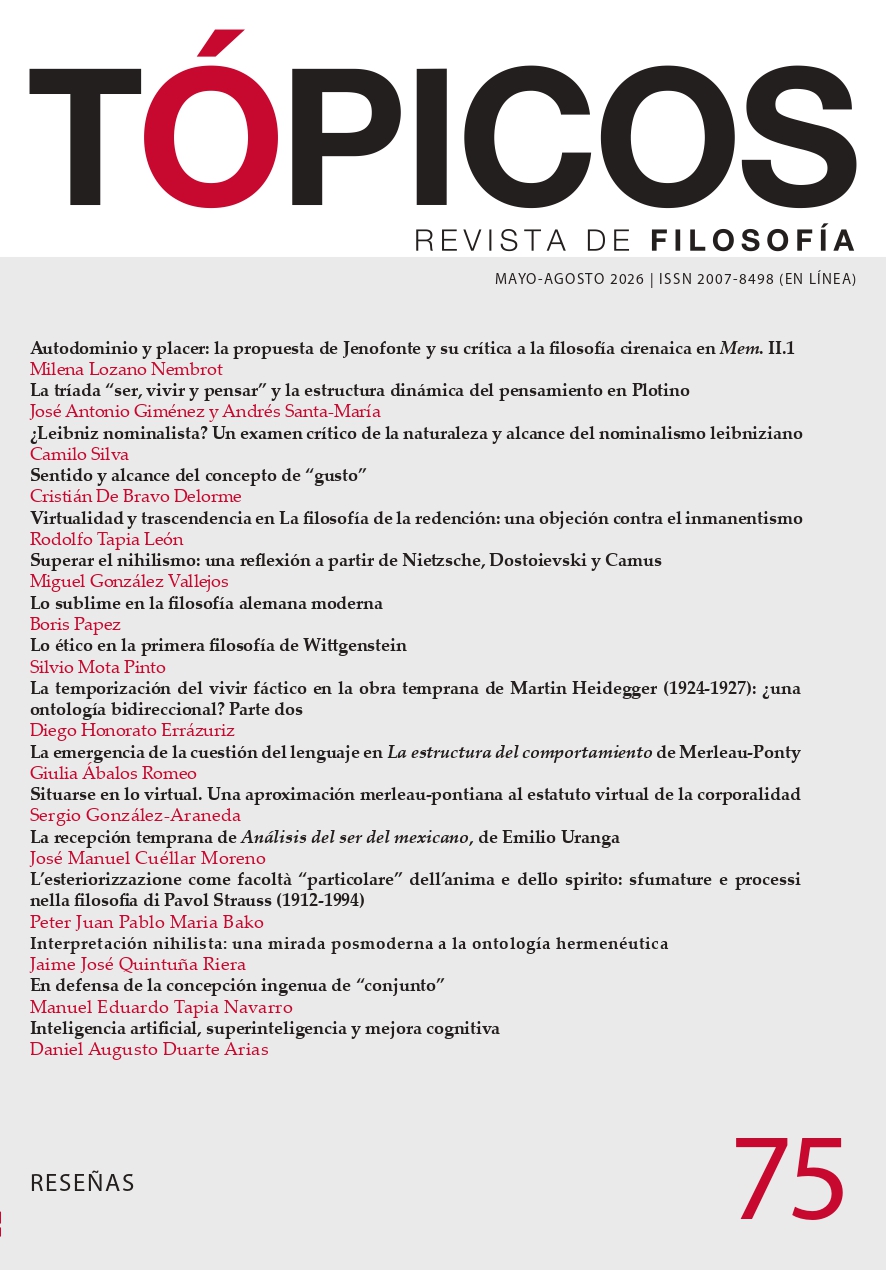
The Emergence of the Question of Language in Merleau-Ponty’s The Structure of Behavior
Published 2026-03-15
How to Cite
Downloads
Copyright (c) 2026 Giulia Ábalos Romeo

This work is licensed under a Creative Commons Attribution-NonCommercial-ShareAlike 4.0 International License.
Abstract
This article examines the emergence of the question of language in Maurice Merleau-Ponty’s The Structure of Behaviour, which precedes Phenomenology of Perception and yet has often been overlooked in studies of his philosophy of language. Contrary to the interpretation that places the beginning of this problem in a later work, it is argued that the foundations of his linguistic conception are already present in nuce in his first book. Through an analysis of his critiques of behaviourism and the dialogue with Kurt Goldstein’s organismic theory, two central themes are examined: the philosophical implications of aphasia and the notion of “linguistic consciousness.” It is shown how Merleau-Ponty understands language as an a priori material structure, inseparable from the body and intersubjectivity. Finally, the continuity between The Structure of Behaviour and Phenomenology of Perception is highlighted, as well as the relevance of the former for understanding the subsequent development of his thought.
Keywords
- Merleau-Ponty,
- Goldstein,
- language,
- verbal behaviour,
- aphasia
- behaviourism,
- Gestalt,
- linguistic consciousness,
- material a priori,
- intersubjectivity,
- phenomenology ...More
References
- Dillon, M. C. (2009). Apriority in Kant and Merleau-Ponty. Kant-Studien, 78(1-4), 403-423. https://doi.org/10.1515/kant.1987.78.1-4.403
- Escribano, X. (2004). Sujeto encarnado y expresión creadora: aproximación al pensamiento de Maurice Merleau-Ponty. Prohom.
- Firth, R. (1973). Symbols: Public and Private. Cornell University Press.
- Goldstein, K. (1995). The Organism, a Holistic Approach to Biology. O. Sacks (trad.). Zone Books.
- Husserl, E. (1997). Ideas relativas a una fenomenología pura y una filosofía fenomenológica. Libro segundo. Investigaciones fenomenológicas sobre la constitución. A. Zirión (trad.). Universidad Nacional Autónoma de México.
- Merleau-Ponty, M. (1953). La estructura del comportamiento. E. Alonso (trad.). Librería Hachette.
- Merleau-Ponty, M. (1967). La structure du comportement. Presses Universitaires de France.
- Merleau-Ponty, M. (1993). Fenomenología de la percepción. J. Cabanes (trad.). Planeta-De Agostini.
- Noble, S. A. (2014). Silence et langage. Genèse de la phénoménologie de Merleau-Ponty au seuil de l’ontologie. Brill. https://doi.org/10.1163/9789004266858
- Scheler, M. (2001). Ética. Nuevo ensayo de fundamentación de un personalismo ético. J. M. Palacios (ed.). H. Rodríguez Sanz (trad.). Caparrós Editores.
- Shinn, M. W. (1893-1899). Notes on the Development of a Child. Parts 1-4. Vol. 1. Berkeley: University of California.
- Von Uexküll, J. (2010). A Foray into the Worlds of Animals and Humans, with A Theory of Meaning. J. D. O’Neil (trad.). University of Minnesota Press.
- Watson, J. B. (1930). Behaviorism. Kegan Paul, Trench, Trubner & Co. https://archive.org/details/behaviorism032636mbp
- Weiszäcker, V. (1958). Le cycle de la structure. (Der Gestaltkreis). M. Foucault y D. Rocher (trads). Desclée de Brower.