
Virtuality and Transcendence in The Philosophy of Redemption: An Objection against Immanentism
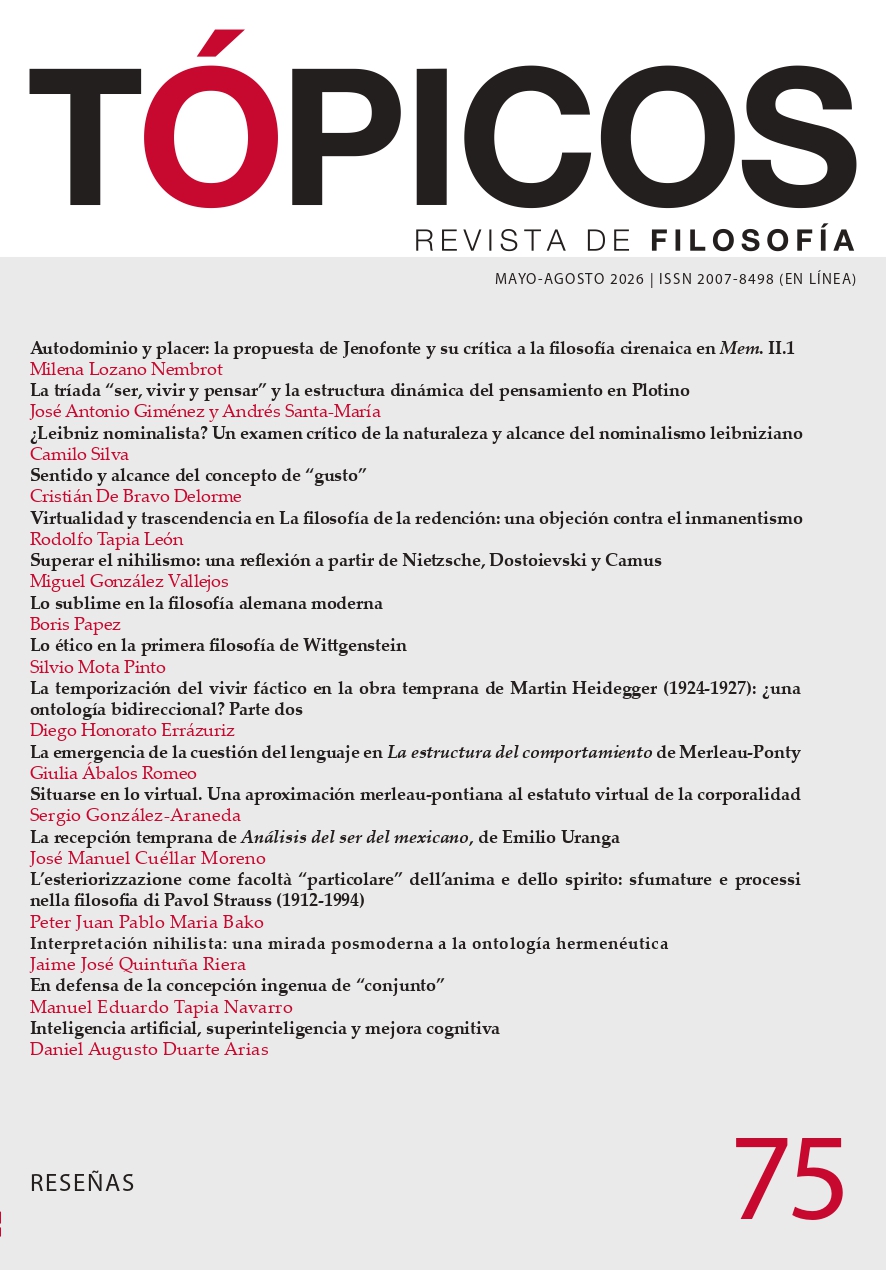
Published 2026-02-15
How to Cite
Downloads
Copyright (c) 2026 Rodolfo Tapia León

This work is licensed under a Creative Commons Attribution-NonCommercial-ShareAlike 4.0 International License.
Abstract
Mainländer wanted to develop a philosophical system that would defeat the pantheistic ideas represented, according to him, by Schopenhauer and Hegel. In this article, the relevance of Mainländer’s philosophical project is evaluated considering his immanentist claim. It is argued that the construction of his immanent system is hindered by the presence of realities over and above individuals: virtuality. This appears as both an actual and a dormant phenomenon, which cannot be accommodated by an immanentist philosophical system. It is concluded that a moderate perception of the disintegration of transcendence must be applied in the interpretation of his philosophy.
Keywords
- scientific atheism,
- self-awareness,
- disintegration,
- German idealism,
- immanence
- Mainländer,
- death of God,
- transcendence,
- will to die,
- virtuality ...More
References
- Baquedano Jer, S. (2021). Estudio preliminar. En P. Mainländer, La filosofía de la redención (pp. 15- 60). S. Baquedano Jer (trad.). Fondo de Cultura Económica.
- Berkeley, G. (2008). Philosophical Writings. D. Clarke (ed.). Cambridge University Press.
- Cohen, A. (2020). Kant on Evolution: A Re-evaluation. En J. Callanan y L. Allais (eds.), Kant and Animals (pp. 123-135). Oxford University Press. https://doi.org/10.1093/oso/9780198859918.003.0007
- Gajardo, P. (2020). Un sentido teleológico regulativo de la nada en el pensamiento de Mainländer. Contrastes. Revista Internacional de Filosofía, 25(2), 79-97. https://doi.org/10.24310/Contrastescontrastes.v25i2.7580
- Gajardo, P. (2023). Las repercusiones de la concepción del tiempo en el sistema mainländeriano. En F. Burgos, L. A. Gerena y S. Lomelí (eds.), Mainländeriana I (pp. 131-152). Universidad Autónoma del Estado de Morelos.
- Gardner, S. (1999). Schopenhauer, Will, and the Unconscious. En C. Janaway (ed.), The Cambridge Companion to Schopenhauer (pp. 375-421). Cambridge University Press. https://doi.org/10.1017/CCOL0521621062.013
- Hannan, B. (2009). The Riddle of the World: A Reconsideration of Schopenhauer’s Philosophy. Oxford University Press.
- Hassel, H. (2019). The Argument for Panpsychism from Experience of Causation. En W. Seager (ed.), The Routledge Handbook of Panpsychism (pp. 269-284). Routledge. https://doi.org/10.4324/9781315717708-23
- Janaway, C. (2006). Schopenhauer’s Pessimism. En C. Janaway (ed.), The Cambridge Companion to Schopenhauer (pp. 318-342). Cambridge University Press. https://doi.org/10.1017/CCOL0521621062.011
- Kant, I. (2015). Crítica del juicio. M. García Morente (trad.). Tecnos.
- Mainländer, P. (1925). Meine Soldatengeschichte. W. Rauschenberger (ed.). Georg Stilke.
- Mainländer, P. (2014). Filosofía de la redención. M. Pérez Cornejo (trad.). Ediciones Xorki.
- Mainländer, P. (2020). Apéndice. Vida de Philipp Mainländer. Datos tomados de la “autobiografía” manuscrita del filósofo por Fritz Sommerlad, 1898. En Filosofía de la redención (y otros textos). Antología. (pp. 405-443). M. Pérez Cornejo (trad.). Alianza.
- Mainländer, P. (2021). La filosofía de la redención. S. Baquedano Jer (trad.). Fondo de Cultura Económica.
- Mainländer P. (2024a). Ensayos sobre filosofía política. M. Pérez Cornejo (trad.). Alianza.
- Mainländer P. (2024b). Realismo e idealismo. Críticas a Kant y Schopenhauer. M. Pérez Cornejo (trad.). Alianza.
- Müller-Seyfarth, W. (2002). Was Philipp Mainländer ausmacht. En W. Müller-Seyfarth (ed.), Offenbacher Mainländer-Symposium 2001 (pp. 79-88). Königshausen & Neumann.
- Pérez Cornejo, M. (2014). Introducción. En P. Mainländer, Filosofía de la redención (pp. 9-41). M. Pérez Cornejo (trad.). Ediciones Xorki.
- Pfleiderer, E. (1877). [Reseña de Die Philosophie der Erlösung, de P. Mainländer]. Theologische Literaturzeitung, 11, 298-305.
- Plümacher, O. (1881). Zwei Individualisten der Schopenhauer‘schen Schule. L. Rosner. https://archive.org/details/bub_gb_YngOAAAAIAAJ
- Rauschenberger, W. (1931). Philipp Mainländer. Jahrbuch der Schopenhauer Gesellschaft, 18, 229-245.
- Schopenhauer, A. (2005). El mundo como voluntad y representación II. P. López de Santa María (trad.). Trotta.
- Schopenhauer, A. (2006). Sobre la voluntad en la naturaleza. M. de Unamuno (trad.). Alianza.
- Schopenhauer, A. (2016). El mundo como voluntad y representación I. P. López de Santa María (trad.). Trotta.
- Seiling, M. (1888). Mainländer, ein neuer Messias. Eine frohe Botschaft inmitten der herrschenden Geistesverwirrung. T. Ackermann. https://archive.org/details/bub_gb_aRsRAAAAYAAJ
- Soll, I. (2020). Schopenhauer on the Will as the Window to the World. En R. Wicks (ed.), The Oxford Handbook of Schopenhauer (pp. 127-143). Oxford University Press. https://doi.org/10.1093/oxfordhb/9780190660055.013.7
- Sommerlad, F. (1898). Aus dem Leben Philipp Mainländers. Mitteilungen aus der handschriftlichen Selbstbiographie des Philosophen. Zeitschrift für Philosophie und philosophische Kritik, 112, 74-101. https://babel.hathitrust.org/cgi/pt?id=mdp.39015068417461&seq=84