
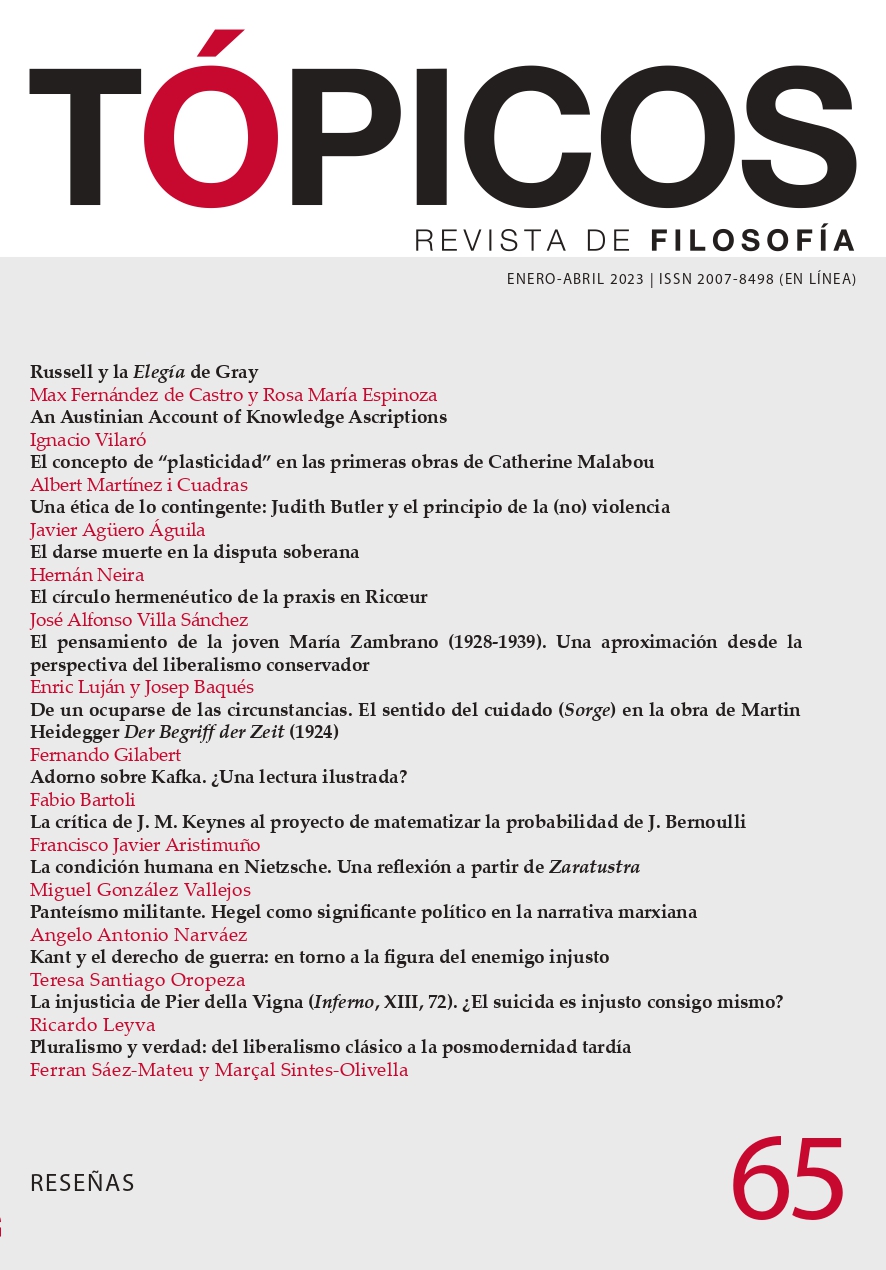
On Dealing with Circumstances: The Sense of Care (Sorge) in Martin Heidegger’s Der Begriff der Zeit (1924)
Published 2022-12-02
How to Cite
Downloads
Copyright (c) 2022 Fernando Gilabert

This work is licensed under a Creative Commons Attribution-NonCommercial-ShareAlike 4.0 International License.
Abstract
The existential of care (Sorge) is one of the most important elements in Martin Heidegger’s philosophical framework. In this article, I explore the relationship between this existential and three others that we consider fundamental: being-in-the-world (In-der-Welt-sein), being-with (Mit-sein) and the impersonal One (das Man). A propaedeutic overview of this relationship can be put forward with the help of Heidegger’s 1924 lecture delivered in Marburg: Der Begriff der Zeit, considered one of the key texts of those who pave the way to Sein und Zeit, often seen as his most important work
Keywords
- Heidegger,
- care (Sorge),
- being-in-the-world (Inder- Welt-sein),
- being-with (Mit-sein),
- the One (das Man)
References
- Escudero, J. A. (2009). El lenguaje de Heidegger. Diccionario filosófico 1912-1927. Herder.
- Gilabert, F. (2020). Propedéutica existenciaria de la vida en común a partir del pensamiento de Martin Heidegger. Condiciones de posibilidad de una política de mínimos. [Tesis doctoral]. Universidad de Sevilla. URL: https://hdl.handle.net/11441/93468.
- Heidegger, M. (1985). Gesamtausgabe. I. Abteilung: Veröffentlichte Schriften 1910–1976. Band 12. Unterwegs zur Sprache (1950–1959). Vittorio Klostermann.
- Heidegger, M. (1995a). Gesamtausgabe. II. Abteilung: Vorlesungen 1919–1944. Band 60 Phänomenologie des religiösen Lebens. Vittorio Klostermann.
- Heidegger, M. (1995b). Gesamtausgabe. II. Abteilung: Vorlesungen 1919–1944. Band 63. Ontologie. Hermeneutik der Faktizität. Vittorio Klostermann.
- Heidegger, M. (2004). Gesamtausgabe. III. Abteilung: Unveröffentlichte Abhandlungen. Vorträge – Gedachtes. Band 64. Der Begriff der Zeit. Vittorio Klostermann.
- Heidegger, M. (2006). Sein und Zeit. Niemeyer.
- Heidegger, M. (2009). Ser y tiempo. J. E. Rivera (trad.). Trotta.
- Heidegger, M. (2011). El concepto de tiempo. R. Gabás y J. Adrián (trads.). Trotta.
- Pöggeler, O. (1983). Der Denkweg Martin Heideggers. Neske.
- Real Academia Española. (2014). Estar. En Diccionario de lengua española. [DRAE]. Espasa.
- Safranski, R. (2007). Un maestro de Alemania. Martin Heidegger y su tiempo.
- R. Gabás Pallás (trad.). Tusquets.
- Sartre, J.-P. (1996). L’existentialisme est un humanisme. Gallimard.
- Schopenhauer, A. (1986). Die Welt als Wille und Vorstellung. Suhrkamp.