
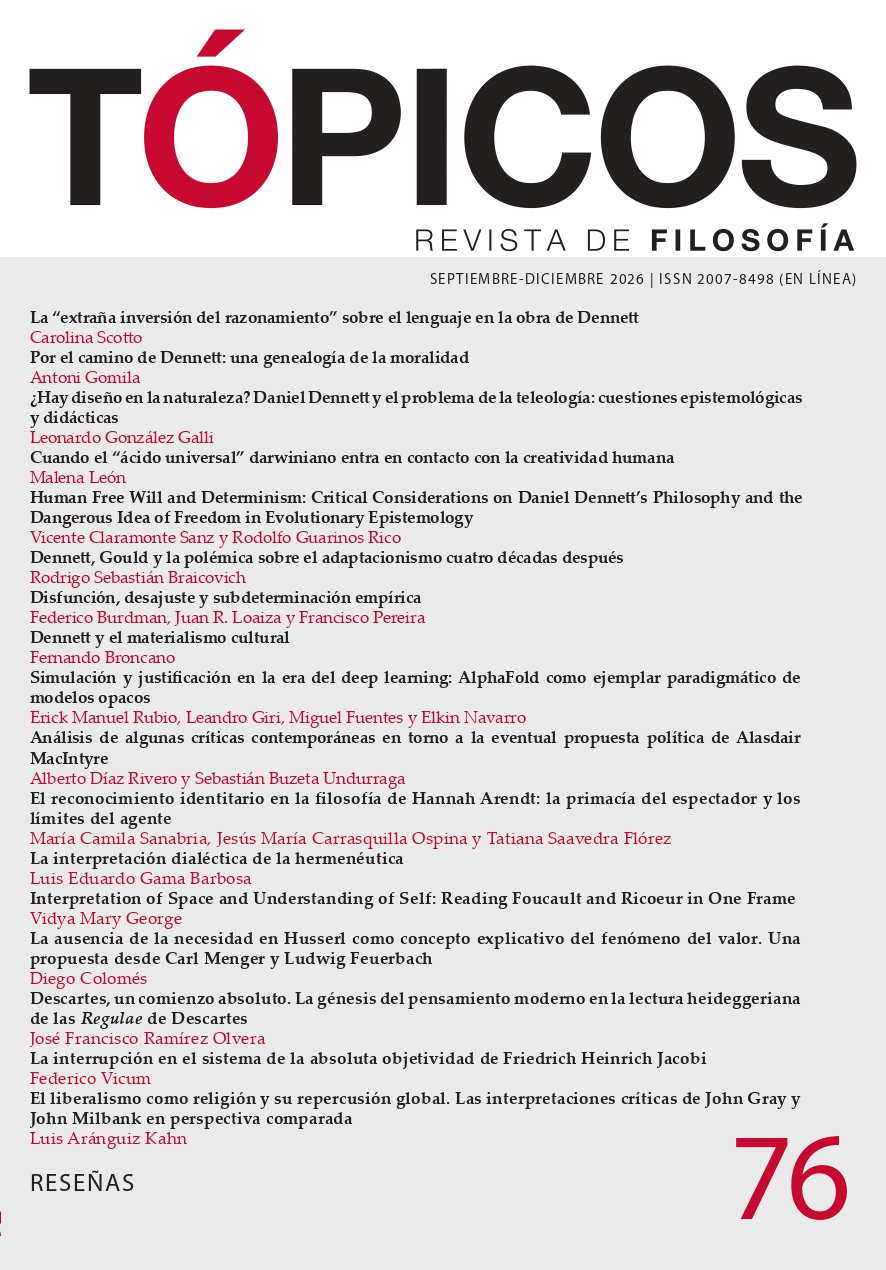
Simulación y justificación en la era del deep learning: AlphaFold como ejemplar paradigmático de modelos opacos
Publicado 2026-07-09
Cómo citar
Descargas
Derechos de autor 2026 Erick Manuel Rubio, Leandro Giri, Miguel Fuentes, Elkin Navarro

Esta obra está bajo una licencia internacional Creative Commons Atribución-NoComercial-CompartirIgual 4.0.
Resumen
Este artículo examina el estatuto epistémico de los modelos computacionales contemporáneos basados en deep learning a partir del caso de AlphaFold, con el objetivo de evaluar en qué medida estos sistemas pueden comprenderse dentro del marco tradicional de las simulaciones computacionales o si requieren categorías epistémicas diferenciadas. A partir del análisis del marco propuesto por Paul Humphreys —en particular, las nociones de “plantilla” y “modelo computacional”— se explora la posibilidad de una continuidad formal y epistémica entre las simulaciones clásicas y los sistemas de aprendizaje profundo, atendiendo críticamente a los problemas de opacidad, verificación y validación pragmática, y al papel constitutivo de la representación visual. Se muestra que, si bien las concepciones representacionalistas clásicas resultan insuficientes para dar cuenta del funcionamiento interno de modelos como AlphaFold, estos sistemas tampoco pueden reducirse sin más a meros dispositivos algorítmicos. En este sentido, el artículo argumenta que AlphaFold sitúa a la filosofía de la ciencia ante la necesidad de repensar los criterios de justificación epistémica y el alcance mismo de la noción de “simulación” en el contexto del deep learning.
Palabras clave
- simulaciones de deep learning epistémicamente opacas,
- aprendizaje profundo,
- opacidad epistémica,
- representación científica,
- validación
- verificación,
- justificación,
- simulación computacional,
- modelo computacional,
- plantilla computacional,
- deep learning ...Más
Referencias
- Barak, O. (2017). Recurrent Neural Networks as Versatile Tools of Neuroscience Research. Curr Opin Neurobiol, 46, 1-6. https://doi.org/10.1016/j.conb.2017.06.003
- Barberousse, A., Franceschelli, S. y Imbert, C. (2009). Computer Simulations as Experiments. Synthese, 169(3), 557-574. https://doi.org/10.1007/s11229-008-9430-7
- Chirimuuta, M. (2021). Prediction Versus Understanding in Computationally Enhanced Neuroscience. Synthesis, 199, 767-790. https://doi.org/10.1007/s11229-020-02713-0
- Daston, L. y Galison, P. (2007). Objectivity. Zone Books.
- Durán, J. M. (2017). Simulaciones computacionales. Principia, 21(1), 125-140. https://doi.org/10.5007/1808-1711.2017v21n1p125
- Frigg, R. y Reiss, J. (2009). The Philosophy of Simulation: Hot New Issues or Same Old Stew? Synthese, 169, 593-613. https://doi.org/10.1007/s11229-008-9438-z
- Galison, P. (1996). Computer Simulations and the Trading Zone. En P. Galison y D. J. Stump (eds.), The Disunity of Science: Boundaries, Context and Power (pp. 118-157). Stanford University Press.
- Gilmer, J., Schoenholz, S. S., Riley, P. F., Vinyals, O. y Dahl, G. E. (2017). Neural Message Passing for Quantum Chemistry. Proceedings of the 34th International Conference on Machine Learning, 70, 1263-1272. https://proceedings.mlr.press/v70/gilmer17a.html
- Gao, P. y Ganguli, S. (2015). On Simplicity and Complexity in the Brave New World of Large-Scale Neuroscience. Curr Opin Neurobiol, 32, 148-155. https://doi.org/10.1016/j.conb.2015.04.003
- Goh, G. B., Hodas, N. O., & Vishnu, A. (2017). Deep Learning for Computational Chemistry. Journal of Computational Chemistry, 38(16), 1291-1307 . https://doi.org/10.1002/jcc.24764
- Hughes, R. I. G. (1999). The Ising Model, Computer Simulation, and Universal Physics. En M. Morgan y M. Morrison (eds.), Models as Mediators: Perspectives on Natural and Social Science (pp. 97-145). Cambridge University Press. https://doi.org/10.1017/CBO9780511660108.006
- Humphreys, P. (2004). Extending Ourselves: Computational Science, Empiricism, and Scientific Method. Oxford University Press. https://doi.org/10.1093/0195158709.001.0001
- Humphreys, P. (2009). The Philosophical Novelty of Computer Simulation Methods. Synthese, 169, 615-626. https://doi.org/10.1007/s11229-008-9435-2
- Jensen, F. (2017). Introduction to Computational Chemistry. Wiley. https://doi.org/10.14293/S2199-1006.1.SOR-CHEM.CLYWQK5.v1
- Jumper, J., Evans, R., Pritzel, A., Green, T., Figurnov, M., Ronneberger, O., … y Hassabis, D. (2021). Highly Accurate Protein Structure Prediction with Alphafold. Nature, 596, 583-589. https://doi.org/10.1038/s41586-021-03819-2
- Lenhard, J. (2016). Computer Simulation. En P. Humphreys (ed.), The Oxford Handbook of Philosophy of Science (pp. 710-736). Oxford University Press. https://doi.org/10.1093/oxfordhb/9780199368815.013.42
- Morrison, M., (2012). Models, Measurement and Computer Simulation: The Changing Face of Experimentation. Philosophical Studies, 143, 33-57. https://doi.org/10.1007/s11098-008-9317-y
- Morrison, M. (2015a). Legitimating Simulation: Methodological Issues of Verification and Validation. En M. Morrison, Reconstructing Reality: Models, Mathematics, and Simulations (pp. 248- 286). Oxford University Press. https://doi.org/10.1093/acprof:oso/9780199380275.003.0008
- Morrison, M. (2015b). Without It There’s Nothing: The Necessity of Simulation in the Higgs Search. En M. Morrison, Reconstructing Reality: Models, Mathematics, and Simulations (pp. 287-316). Oxford University Press. https://doi.org/10.1093/acprof:oso/9780199380275.003.0009
- Norton, S. y Suppe, F. (2001). Why Atmospheric Modeling Is Good Science. En P. Edwards y C. Miller (eds.), Changing the Atmosphere (pp. 67-106). The MIT Press. https://doi.org/10.7551/mitpress/1789.003.0006
- Particle Physics & Astronomy Research Council (2005, 4 de junio). Millennium Simulation—The Largest Ever Model of the Universe.ScienceDaily. www.sciencedaily.com/releases/2005/06/050604061156.htm
- Rohrlich, F. (1990). Computer Simulation in the Physical Sciences. PSA: Proceedings of the Biennial Meeting of the Philosophy of Science Association, 2, 507-518. https://doi.org/10.1086/psaprocbienmeetp.1990.2.193094
- Rubio, E., Giri, L. y Ilcic, A. (2023). Desafíos epistemológicos en la era de las redes neuronales artificiales: abordando sistemas complejos desde una perspectiva computacional. Argumentos de Razón Técnica, 26, 145-178. https://doi.org/10.12795/Argumentos/2023.i26.06
- Sjölin Wirling, Y. y Grüne-Yanoff, T. (2021). The Epistemology of Modal Modeling Philosophy Compass, 16(10), e12775. https://doi.org/10.1111/phc3.12775
- Stokes, J. M., Yang, K., Swanson, K., Jin, W., Cubillos-Ruiz, A., Donghia, N. M., … y Collins, J. J. (2020). A Deep Learning Approach to Antibiotic Discovery. Cell, 180(4), 688-702.e13. https://doi.org/10.1016/j.cell.2020.01.021
- Vaswani, A., Shazeer, N., Parmar, N., Uszkoreit, J., Jones, L., Gomez, A. N., Kaiser, L. y Polosukhin, I. (2017). Attention Is All You Need. En U. von Luxburg, I. Guyon, S. Bengio, H. Wallach, R. Fergus (eds.), NIPS’17: Proceedings of the 31st International Conference on Neural Information Processing Systems (pp. 6000-6010). Curran Associates Inc. https://doi.org/10.48550/arXiv.1706.03762
- Vicsek, T. (2002). The Bigger Picture. Nature, 418(6894), 131. https://doi.org/10.1038/418131a
- Winsberg, E. (2001). Simulations, Models, and Theories: Complex Physical Systems and their Representations. Philosophy of Science, 68, S442-S454. https://doi.org/10.1086/392927
- Winsberg, E. (2010). Science in the Age of Computer Simulation. The University of Chicago Press. https://doi.org/10.7208/chicago/9780226902050.001.0001
- Winsberg, E. y Alvarado, R. (2022). Computer Simulations in Science. The Stanford Encyclopedia of Philosophy. E. N. Zalta y U. Nodelman (eds.). https://plato.stanford.edu/archives/spr2026/entries/simulations-science/
- Yang, K., Swanson, K., Jin, W., Coley, C., Eiden, P., Gao, H. Guzman-Perez, A., Hopper, T., Kelley, B., Mathea, M., Palmer, A., Settels, V., Jaakkola, T., Jensen, K. y Barzilay, R. (2019). Analyzing Learned Molecular Representations for Property Prediction. Journal of Chemical Information and Modeling, 59(8), 3370-3388. https://doi.org/10.1021/acs.jcim.9b00237