
Cyberbullying among university students in the post-pandemic period: aggresive behaviors and prevention
Ciberacoso entre estudiantes universitarios en la postpandemia: comportamientos agresivos y prevención
Cyberbullying among university students in the post-pandemic period: aggresive behaviors and prevention
Revista Panamericana de Pedagogía, no. 41, 2026, pp. 1 -20
Received: 29 July 2025
Accepted: 05 August 2025
Published: 19 September 2025
Abstract: A questionnaire administered to 863 university students in Mexico City examines the frequency of peer-aggressive behavior via digital media during the return to face-to-face classes in the context of COVID-19. Among the findings, it is evident that reading gossip about classmates online and sending offensive memes among classmates are the most frequent problems among university students. A predictive analysis was conducted using three variables: the probability of cyberbullying, the insinuation of cyberbullying, and the provocation of cyberbullying. The study shows that by controlling the insinuation of cyberbullying, the likelihood of doing it decreases by 11%. However, the probability of com- mitting cyberbullying could decrease twofold (21%) when its provocation is controlled.
Keywords: Bullying, Peer harassment, Peace education, Classroom environment, Higher education.
Resumen: Mediante un cuestionario aplicado a 863 estudiantes universitarios de la Ciudad de México se explora la frecuencia de comportamientos agresivos entre pares a través de medios digitales, durante el retorno a la presencialidad en el contexto del Covid-19. Entre los hallazgos se evidencia que la lectura de rumores en internet sobre compañeros de clase y el envío de memes ofensivos entre ellos aparecen como las problemáticas con mayor frecuencia entre los universitarios. Posteriormente, se realiza un análisis de predicción a partir de tres variables: probabilidad de ejercer ciberacoso, insinuación de ciberacoso y provocación de ciberacoso. El análisis muestra que al controlar la insinuación de hacer cy- berbullying, la probabilidad de ejercerlo disminuye 11%. Pero, la probabilidad de cometer ciberacoso podría disminuir al doble (21%) cuando se controla su provocación.
Palabras clave: Acoso escolar, Relaciones entre pares, Educación para la paz, Clima escolar, Bullying.
INTRODUCTION
The global impact of the COVID-19 pandemic brought about significant changes in the higher education landscape in Mexico, leading to a rapid transition to remote, virtual, hybrid, and/or blended learning modalities. This sudden transformation not only posed challenges and opportunities to educational practice and the teaching-learning process, but also brought about changes in the forms of socialization of young university students.
Among the opportunities that COVID-19 brought, the various approaches to educational modalities stand out. Concepts such as virtual education, hybrid education, and blended learning were added to the previously defined category of online or distance learning. They became part of the discourse among the main educational agents: directors, teachers, and academics.
Although there was a consensus among Higher Education Institutions (HEIs) before the pandemic to offer courses through distance education, through the term Online Distance Learning (ODL), whose main characteristic is to use asynchronous communication platforms such as Moodle o Blackboard (Falloon, 2011), during times of confinement, the proliferation of new forms of teaching and learning with synchronous virtual approaches was observed. This led to alternative approaches to preserving the right to education (Cardona-Londoño et al., 2020). This is the case of virtual education, which has opened the doors to thousands of students and teachers through Information and Communication Technologies (ICTs) and digital media, connected through the internet (Crisol-Moya et al., 2020). Virtual education, understood as “didactic or training processes mediated by technology” (Sanabria-Cárdenas, 2020, p. 3), has the virtue of bringing together online, distance, blended, and hybrid modalities, with asynchronous and synchronous components, and the presence of colleagues and teachers electronically.
During and after the COVID-19 pandemic, virtual education and the use of technology in higher education have become vehicles for expanding opportunities aligned with educational goals and objectives in Latin America (UNESCO, 2023). However, in addition to the paradigm shift, virtual education introduced new social dynamics and modes of socialization that also challenged the traditional structures of student coexistence. The sudden transition led university students to interact with their peers differently, moving their conversations and meetings to the virtual realm. Statistics reveal that, globally, in 2022, 71% of the population aged 15-24 used the internet daily, placing this age group first among users of this service (International Telecommunication Union, 2022).
In Mexico, data from the 2020 National Survey on the Availability of Information and Communication Technologies indicate that adolescents and young adults aged 15-23 reported spending 8.2 hours per day online. Of these, 97.1% reported using the internet to search for educational information, conduct research, and carry out other tasks, such as homework, and 78.7% indicated that it served as a means of taking courses (Gómez-Navarro & Martínez-Domínguez, 2022). In 2022, the National Institute of Statistics and Geography (INEGI) reported that 79.5% of the population aged 12 and over used the internet on any device (INEGI, 2022).
The access and daily use of ICTs by adolescents and young people has led to new challenges, such as violence and cyberbullying (Ortega-Barón et al., 2016; Sang-Ah-Park et al., 2024). Zhu et al. (2021) mention that the dark side of internet use by adolescents and young people is that they can harass or be victims of cyberbullying. 1 The data in Mexico are concerning. In 2024, 22.1% of men and 31.1% of women between the ages of 20 and 29 reported having been victims of cyberbullying (INEGI, 2025). Furthermore, among the population aged 12 and over who experienced this situation, 33.4% reported a higher level of education, a statistically significant increase from 31.2% in the previous year (INEGI, 2025).
In addition, some research has found a significant relationship between the COVID-19 pandemic and cyberbullying, as the increase in the number of cases of school bullying corresponds to the increase in the use of social networks (Mui-Hung-Kee et al., 2022). Specifically, Karmakar and Das (2020) report an upward trend in cyberbullying in the mid-2020s. Factors contributing to this increase include teenagers’ and young adults’ desire to remain connected following the implementation of distancing measures (Karmakar & Das, 2020; Nazir & Thabassum, 2021; Sela-Shayovitz et al., 2024).
In this regard, among the many forms of violence that exist in schools, there are aggressive behaviors that, taken together, allow us to link them to the definition of cyberbullying. For this study, the concept of aggression is understood as “a violent act or attack that goes against a person’s freedoms and has the firm intention of causing harm to the person it is directed at” (INEGI, 2021). Oteros (2006) has a broader view of what can be defined as aggressive behavior, noting that this behavior is socially reprehensible because it causes physical or psychological harm to another person, and leads to violent actions or behaviors, or to feelings, impulses, thoughts, and intentions against the other (Cid et al., 2008).
Cyberbullying is defined as a type of school violence perpetrated by someone in the educational community whose main characteristic is the use of information and communication technologies with the aim of intimidating, hurting, abusing, threatening, or revealing some personal issue in order to isolate a human being socially (Alismaiel, 2023). All these actions can be considered as part of a series of aggressive behaviors among peers.
Among the technologies most commonly used in cyberbullying are smartphones and computers, which are used to send text messages, images, audio recordings, emails, or posts about a member of the school community (Alismaiel, 2023; Alsawalqa, 2021). Romera et al. (2017) define it as an indirect form of traditional bullying that shares characteristics with traditional bullying, such as intentional, repeated aggressive acts by one or more perpetrators, often involving a power imbalance between perpetrators and victims, but differs in that it employs electronic technology.
Cyberbullying is a type of peer abuse that, like traditional face-to-face school bull- ying (Olweus, 1998), is an intentional and aggressive behavior that is frequently repeated against a victim who cannot easily defend themselves (Smith et al., 2008; Ortega-Barón et al., 2016). By particularizing its exercise through ICTs (Laorden-Gutiérrez et al., 2023), it exhibits characteristics of anonymity and concealment, as victims cannot readily identify the perpetrators. Cyberbullying perpetrators often perceive themselves as anonymous through the use of nicknames (Zhao & Yu, 2021; Romera et al., 2017).
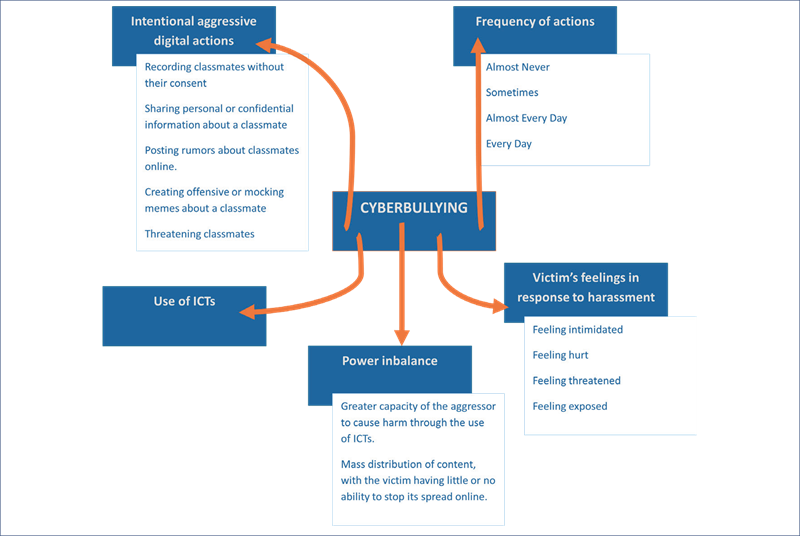
Taking these approaches into account, five criteria make up cyberbullying, which are used in the analysis of this study (Figure 1):
Intentional aggressive digital actions.
Frequency of actions.
Use of ICT.
Feelings of the victim regarding the harassment.
Imbalance of power.
Some of these criteria are subject to debate, for example, the duration of the violent acts. Cyberbullying is not limited by time or space (Zhao & Yu, 2021), as exposure to it occurs 24 hours a day, 7 days a week, thereby reaching a wider audience and potentially turning members into aggressors once they share and view aggressive content (Sela-Shayovitz et al., 2024). Because aggressors face no spatial or temporal constraints in virtual environments, new opportunities for cyberbullying arise without geographical or temporal limits (Zhu et al., 2021).
Regarding risk factors in cyberbullying, this phenomenon is considered a serious public health problem among adolescents, linked to personal factors such as age, gender, and place of origin; it is also associated with behavior, mental health, and the development of minors (Zhao & Yu, 2021; Zhu et al., 2021). Some of the negative effects of cyberbullying in the lives of young people include depression, anxiety, stress, low self-esteem, and various emotional problems. In the educational context, the following problems are observed: absenteeism and, at times, attrition, among others (Usuga-Jerez et al., 2023; Zhao & Yu, 2021). Its effects can be even more devastating than traditional or face-to-face bull- ying, since aggressors can act anonymously and at any time (Zhu et al., 2021).
There is evidence of the relationship between aggressive behaviors, self-esteem, and emotional and behavioral problems (Undheim & Sund, 2010). Some studies even refer to the problem of harassment as a predictor for emotional well-being or, on the contrary, effects on mental health and on the integral development of adolescents and young people (Kasimova et al, 2023; Rean et al, 2024).
This study has a dual purpose. First, it examines the frequency with which aggressive behaviors occurred among university students at a private institution in Mexico City through the use of ICTs during the return to in-person learning in the context of the COVID-19 pandemic, which can be encompassed by the concept of cyberbullying. This exploration, in turn, allows us to reflect on these behaviors. Secondly, based on the database generated with the results of the questionnaire on cyberbullying behaviors among students, a predictive analysis was carried out using a Logit model, based on the variables: 1) probability of engaging in cyberbullying, 2) insinuation of cyberbullying, and 3) provocation of cyberbullying, in order to identify the probabilities of its decrease.
It was decided to focus on the higher education population, given limited evidence on cyberbullying at this educational level and that much of the research on the subject focuses on educational stages prior to university (Laorden-Gutiérrez et al., 2023).
Development
Methodology
To contribute to the precision of measurement criteria for cyberbullying, a questionnaire was designed consisting of 54 questions grouped into three dimensions: 1) Coexistence and effects of social isolation among university students during virtual education; Aggressive behaviors through ICT among classmates during hybrid education; and 3) Aggressive behaviors through ICT among classmates upon returning to face-to-face learning.
For this article, we selected the third dimension, which measures the frequency of aggressive behaviors among university students via ICTs during the return to in-person learning during the COVID-19 pandemic. While we focus on aggressive digital actions and their frequency, which are two of the criteria that define cyberbullying, the items in the selected dimension also allude to the other three criteria (Figure 1).
Participants
The sample selection was purposeful (Creswell & Creswell, 2015), which was determined based on an inclusion criterion: that the higher education students had begun their university studies in 2019, a year before the global emergency was declared due to the COVID-19 pandemic; and that they had then returned to the in-person modality with health and social distancing measures. These students experienced two years of learning in hybrid and virtual environments due to the health crisis; they returned to in-person classes after the virus emergency was declared over. Finally, they completed their university cycle, approaching something “similar” to their first year of university.
Procedure
Data collection was conducted in January 2023, with a total sample of 863 students, which exceeded the 363 recommended by the sample size formula (Wakerly et al., 2008). The authorities of the Higher Education Institution’s common curriculum area were contacted, and the research objective was explained. They reviewed the permits and support for sending the questionnaire by email to all students in the common area.
Data collection instrument
Of the three dimensions covered by the aforementioned questionnaire, the dimension measuring the frequency of aggressive behaviors among university students via ICT during the return to in-person learning during the COVID-19 pandemic was selected. This dimension comprises nine items with a 5-point Likert-type response format, where 1 = Never and 5 = Every Day (Table 1).
| Every day | Almost every day | Occasionally | Almost never | Never |
|---|---|---|---|---|
| 5 | 4 | 3 | 2 | 1 |
| Ítems | ||||
| 1 | My classmates send me videos that I don't like. | |||
| 2 | My classmates send me videos that are violent. | |||
| 3 | My classmates send me offensive and mocking memes about other classmates. | |||
| 4 | My classmates have uploaded photos of me without my permission or distributed photos of me on social media. | |||
| 5 | I have received offensive, mocking, and/or even threatening messages from my colleagues through social media or phone applications. | |||
| 6 | I have seen messages or posts about comments or gossip from my colleagues. | |||
| 7 | My classmates have made confidential conversations public and shared my secrets on social media. | |||
| 8 | I have recorded my classmates without their permission. | |||
| 9 | My classmates have leaked compromising information about me on social media and the internet. | |||
The instrument was validated by three experts and reviewed by 27 higher-education students from a different institution from that in which the results are presented. Their feedback allowed for relevant adjustments to the wording of the items. To assess the reliability and internal consistency of these items, Cronbach’s alpha coefficient was calculated at 0.839794028. This value indicates a strong correlation among the nine questionnaire items.
Results
Descriptive results: frequencies of cyberbullying behaviors
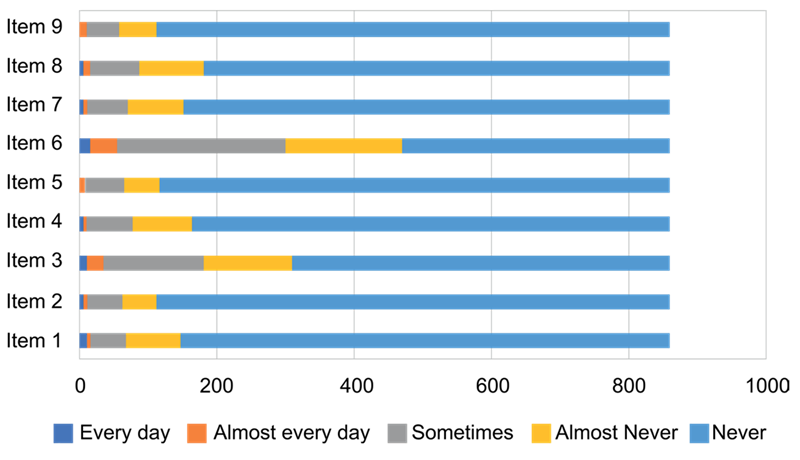
Through data analysis using descriptive statistics and the use of Pivot Tables in Excel, it was determined that the most frequent aggressive behaviors corresponded to items 6, 3, and 8, in that order: I have seen messages or posts about comments or gossip from my classmates; My classmates send me offensive and mocking memes about other classmates; and I have recorded my classmates without their authorization, respectively, as shown in Figure 2.
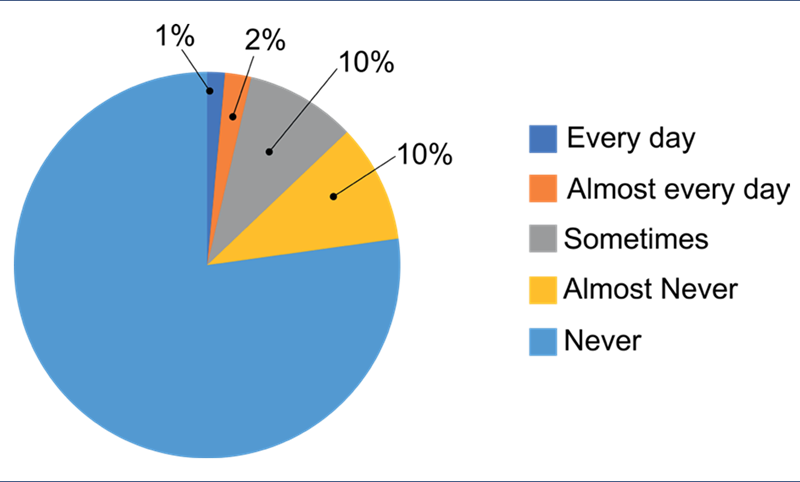
Subsequently, the mean of the 9 items was calculated to assess the frequency of aggressive behaviors associated with ICT use. This revealed a 23% frequency of such behaviors (Figure 3).
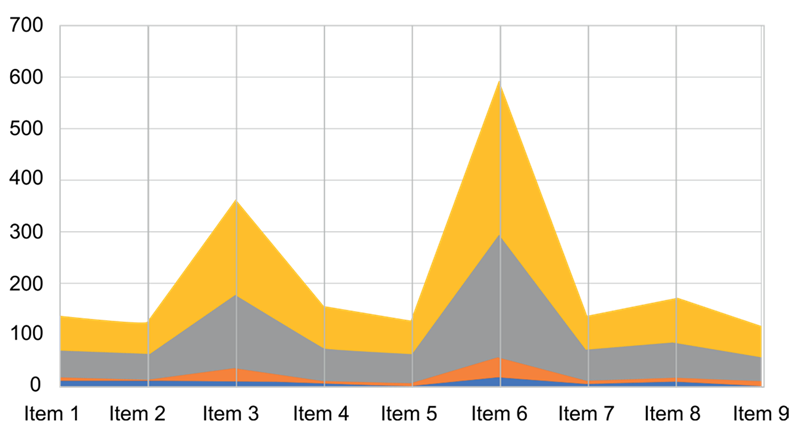
Again, items 6 and 3 showed the highest frequencies of responses of “Every day” and “Almost every day,” at 6.48% and 4.17%, respectively. However, when the response “Occasionally” is added to these two variables, the response percentage rises considerably to 34.76% for item 6 and 20.97% for item 3 ( Figure 4). This suggests that exposure to messages and posts about colleagues’ comments or gossip is common among respondents, with a majority reporting occasional exposure. With less exposure, receiving offensive and mocking memes is also among the most frequent cyberbullying experiences for a significant portion of respondents. Figure 4 shows the frequency per item considering the responses “Every day,” “Almost every day,” and “Occasionally.”
Analytical results: cyberbullying actions and prevention
The descriptive analysis of the database reveals a high prevalence of ICT use among students in relation to aggressive behaviors. This observation motivated a predictive analysis using a Logistic Regression model to estimate the probability of reducing cyberbullying among students when such behaviors are curbed. To this end, we proposed three variables: cyberbullying, cyberbullying insinuation, and cyberbullying provocation. Before defining these variables, we briefly explain the Logit model.
Gujarati and Porter (2010) comment that probability models seek the occurrence of an event in Y given some explanatory variables X1 , X2 , …, Xk , which Y can take the value of 1 or 0, for example
Y = 1 if cyberbullying occurs
Y = 0 if it does not occur
Linear probability models (LPMs) are known to be expressed as follows:

In our case, they estimate the probability of cyberbullying occurring. However, the estimates are not always bound between 0 and 1. To resolve this, we can use a Logit model that yields the probability when Y = 1, given,
 [ 1]
[ 1]Where. So,
So,  and
and  .
.
However, model (1) is not linear in the explanatory variables X1 , X2 , …, Xk . To make it linear, we start with expression (1): , to which we have applied logarithms. The- refore, we propose the following expression:
 [ 2]
[ 2]Model (2) is called the Logit (Gujarati & Porter, 2010). After these estimates, the marginal effects of the variables X1 , X2 , …, Xk on the probabilities can be obtained and will be shown later.
The definition of the three variables corresponds to the items that constitute the Scale on Aggressive Behaviors among university students using ICT (Table 1); in fact, they are defined by these items.
The variable of cyberbullying concerns the frequency with which aggressive digital actions occur: a high frequency, to the point of becoming routine, indicates the presence of cyberbullying; whereas a low frequency indicates that such aggressive actions are occasional behavior. Thus, cyberbullying includes items 4, 5, 7, and 9: “My classmates have uploaded photos of me without my permission or distributed photos of me on social media,” “I have received offensive, mocking, and/or even threatening messages from my classmates through social media or phone applications,” “My classmates have made confidential conversations public and revealed my secrets on social media,” and “My classmates have leaked compromising in- formation about me on social media and the internet.” While studies on cyberbullying report different levels of prevalence, a general prevalence range of victimization has been estimated between 10 and 40% (Kowalski et al., 2014, p. 1108; see Moreta-Herrera et al., 2018).
By “insinuation of cyberbullying,” we refer to aggressive online actions that convey a message that must be interpreted by the recipient. These actions are concentrated in items 1 and 2: “My classmates send me videos I don’t like” and “My classmates send me violent videos.” That is, it involves classmates sending violent and offensive material that alludes to other classmates who have already categorized the material as such. The recipients must interpret the sender’s motivations for sending this type of material (Ortega Ruíz et al., 2016).
Finally, the variable “provocation of cyberbullying” is understood as the action of inciting or stimulating someone, through ICTs, to carry out aggressive actions and offensive behavior against a classmate. This variable is made up of items 3, 6, and 8: “My classmates send me offensive and mocking memes about other classmates” “I have seen messages or posts about comments or gossip from my peers,” and “I recorded my classmates without their permission.” Provocation is related to impulsiveness. a variable that has been associated with bullying and cyberbullying. Some studies suggest that impulsiveness con- tributes to behaviors of bullying and cyberbullying, and research has suggested that, while impulsiveness is associated with both perpetration and victimization, its strongest link is with perpetration (Gámez-Guadix et al., 2014, p. 235).
The mathematical expression of the variables is:.
yi: cyberbullying
x1i: insinuation of cyberbullying
x2i: provocation of cyberbullying
Table 2 lists the items comprising the Scale of Aggressive Behaviors, with each item associated with one of the three variables.
| Items | Variable | |
|---|---|---|
| 1 | My classmates send me videos that I don’t like. | x1i |
| 2 | My classmates send me videos that are violent. | x1i |
| 3 | My classmates send me offensive and mocking memes about other classmates. | x2i |
| 4 | My classmates have uploaded photos of me without my permission or distributed photos of me on social media. | yi |
| 5 | I have received offensive, mocking, and/or even threatening messages from my colleagues through social media or phone applications. | yi |
| 6 | I have seen messages or posts about comments or gossip from my colleagues. | x2i |
| 7 | My classmates have made confidential conversations public and shared my secrets on social media. | yi |
| 8 | I have recorded my classmates without their permission. | x2i |
| 9 | My classmates have leaked compromising information about me on social media and the internet. | yi |
| Literal | Variable | Construction |
|---|---|---|
| Yp1 | Mean cyberbullying | |
| X1i | Mean cyberbullying insinuations | |
| X2i | Mean cyberbullying provocations |
We use the Logit probability model to measure whether cyberbullying occurs, whose qualitative variable to explain is:
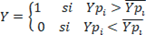
Where  is the average of the 863 interviewees who answered the items that made up the variable Ypromi
.
is the average of the 863 interviewees who answered the items that made up the variable Ypromi
.
Based on the constructed variables, the logit estimates provide the following information, as shown in Table 4.
| Y: probability of cyberbullying | Coef. Std. Err. z P>|z| [95% Confidence Interval |
| x1: insinuation cyberbullying | .9679521 .1677048 5.77 0.000 .6392568 1.296647 |
| x2 : provocation cyberbullying | 1.728159 .1669018 10.35 0.000 1.401037 2.05528 |
| _cons | -5.848717 .3798194 -15.40 0.000 -6.59315 -5.104285 |
The output data from Table 4 provide important information: both the insinuation of cyberbullying (X1i ) and the provocation of cyberbullying (X2i ) Furthermore, their effect is positive (see Pvalue ). This supports the claim that reducing the suggestion and provocation of cyberbullying has a significant effect on decreasing the likelihood of it occurring.
SHowever, since we are estimating probabilities, the coefficients we would expect to obtain should be less than 1. Thus, we estimate marginal effects using a logit model, as shown in Table 5.
| Likelihood of engaging in cyberbullying | Marginal effects | Pvalue | |
| Insinuation | 0.118 | 0.000 | |
| Provocation | 0.211 | 0.000 | |
| Marginal effects after logit | Pr(probability of acceptance) (predict)= 0.1431 |
||
| Evidence | Wald: p > 2 = 0.000 | Pseudo R2 = .304 |
Specificity and Sensitivity: 0.73 |
Regarding the significance tests, the most relevant finding is that both marginal effects (insinuation and provocation) on the probability of engaging in cyberbullying are significant (Pvalue lower than zero).
Then, based on Wald’s test, we can test the following hypothesis:
H0 : Both coefficients are equal to zero and the variables are not important to the model,
H1 : Both coefficients are different from zero and the variables are important for the model.
Our joint probability shows that, so we reject H0 . Thus, the variables together are significant for the model.
The specificity and sensitivity analysis yielded a value of 0.73, which falls within the parameters established by Hosmer and Lemeshow (2000), namely 0.6 and 0.8. This indicates that the model significantly discriminated against incorrect data that could have been mistaken for correct. The only test of weak significance is the Pseudo-Test, since a value close to 0 indicates a very weak fit for the estimated probabilities, and a value close to 1 indicates a very good fit. Since our value is 0.304, we could say it is a moderately good fit. However, based on the model, the obtained value is acceptable, as indicated by the individual significance (Pvalues ).
Once the Logit model is applied, the marginal effects allow us to infer a prediction of the probability of carrying out cyberbullying of 0.143 “by default”, which increases to 0.118 when there is an insinuation of carrying out cyberbullying (see table 5: row 2, column 2) and to 0.211 when there is a provocation to do it (see table 5: row 3, column 2).
DISCUSSION
Based on the five criteria that define cyberbullying (see Figure 1), we will discuss the data obtained from the scale administered to university students, as well as studies consistent with these data. Regarding the frequency or duration of incidents, 23% of students have experienced some form of cyberbullying at least once, and 10% of the surveyed population have participated in or experienced cyberbullying occasionally, almost every day, or every day.
Regarding the use of ICTs, aggressive actions are carried out via smartphones and computers, from which text messages, photographs, audio recordings, and screenshots of other classmates, among other materials, are posted on social networks and virtual educational platforms. These data are consistent with the results of the INEGI 2022 Cyberbullying Module, which reports that 20.8% of the population aged 12 and over who used the internet were victims of cyberbullying, compared with 21.7% in 2021 and 21% in 2020. This difference in percentages can be explained by the increased time spent online during the COVID-19 pandemic. Within the age range 20-29 years, which is closest to the population studied in this text, the data also indicate a trend of 23.7% for men and 29.3% for women (INEGI, 2022).
The study by Zhu et al. (2021), which consisted of a systematic review of the literature on the prevalence of cyberbullying, states that 11 studies from 6 countries, with analyses at the national level, indicated that the prevalence of cyberbullying victimization and cyberbullying perpetration ranged from 14.6% to 52.2% and from 6.3% to 32%, respectively. The ranges presented in Zhu’s study are also consistent with those found in this study.
Regarding the high frequency of reading online gossip, the data also align with the findings of Zhu et al. (2021), who state that cyber verbal violence is one of the most common forms of cyberbullying, including offensive verbal abuse such as defamation, insults, and mockery. According to the authors, the prevalence of victimization by cyber verbal violence ranges from 5% to 47.5%, while the prevalence of perpetration is between 3.2% and 26.1%.
Regarding intentionally aggressive digital actions, the most common ones are creating offensive, mocking memes about classmates, recording them, taking photos of them, and sending their personal information. A future direction stemming from this study is to analyze the content of aggressive memes and the processes by which they are disseminated. As some authors (Marina & Ricaurte, 2022; Marca-Tapia, 2018) have noted, the production and circulation of memes occur within a social context and maintain a communication circuit through a code of meanings shared by those who produce and circulate them, the audience, and the addressee. These meanings, framed within a power-status relationship, place the victim in a state of inferiority.
Delving a little deeper into the subject, which deserves a dedicated section of study, it is necessary to establish the distinction between an aggression meme and the meme, as has been proposed by Marina-Elizalde and Ricaurte-Quijano (2022, pp. 21, 28). The first “is characterized by the single issuance of a meme making use of “hate speech,”; while the second, which is a subtype of meme-aggression, is distinguished by the repetition of aggression towards a person due to physical, personality, sociodemographic, ideological, and gender-related factors.
In the context of power imbalances, we must consider the impact of ICTs on school bullying; their use is particularly problematic given their reach in the virtual world. In cyberbullying, aggression can be exponential, as the aggressor can have multiple personalities, names, avatars, or even be anonymous (Morales-Reynoso et al., 2023). In this regard, given that cyberbullies often operate anonymously and may be unidentifiable, we believe it is important to focus on working with the victim. Therefore, we consider it necessary to include the feelings the victim experiences after suffering cyberbullying.. In this situation, we believe that intentional violent actions must have an effect on the victim, making them vulnerable by damaging their psychosocial skills.
Ultimately, the goal of bullying is to socially isolate the person, separating them from peer support. This is precisely what happens when the victim is shamed. In the school context, shaming stigmatizes the student within their reference group, thereby marking them as undesirable for various reasons, as occurs in the configuration of stigma (Goffman, 2019, pp. 14-17).
Other negative impacts suffered by the victim include feeling intimidated, hurt, violated, and threatened. Items 2 through 7 reflect these feelings and received the highest average scores. This immediately suggests that more students feel attacked than those who attack.
Among the limitations of the study is the number of items used to define the category, given the broad spectrum of the virtual world. Based on previous research, other criteria for analyzing the phenomenon can be considered. In this sense, one variable not considered in this study, but which warrants attention in future research, is gender. Several studies (INEGI, 2022; Puma-Maque & Cárdenas-Zúñiga, 2024) have reported significant differences in the prevalence and frequency of cyberbullying across sociodemographic groups.
This article contributes to the existing literature on studies related to the frequency of cyberbullying and violence in the virtual world. The findings indicate that both exposure to messages or posts about comments or gossip from peers and the receipt of offensive memes are phenomena that occur with some frequency in the educational environment studied, with a higher prevalence of occasional exposure in both cases.
Our predictive analysis quantitatively demonstrates the effects of insinuation and provocation on the likelihood of cyberbullying. Furthermore, it shows that this problem can be prevented by reducing these two variables. Based on this, our analysis can serve as a starting point for further research and for the development of strategies to reduce the incidence of cyberbullying. If we know that a decrease in the sending of violent and unpleasant videos about third parties reduces the likelihood of cyberbullying, and that a decrease, for example, in the sending of offensive and mocking memes about classmates reduces the likelihood even further, educational communities could direct part of their efforts toward actions that contribute to this.
The above aligns with a study by Méndez et al. (2019), who analyzed differences among individuals who are victims, perpetrators, and observers of cyberbullying, based on sociodemographic variables (e.g., sex and age) and academic variables (e.g., level of education). The study population comprised undergraduate and master’s students at a Spanish university. The most prominent roles were observers, followed by aggressors and victims. The authors state that their study will enable the development of prevention and intervention programs for each cyberbullying role. They also propose that universities assume responsibility for addressing the issue, thereby promoting coexistence and wellbeing among university students. In this regard, Ross et al. (2022) provide strong evidence on the effectiveness of simple prevention strategies implemented in secondary schools and led by students, underscoring the need for the involvement of cyberbullying actors to reduce it.
CONCLUSIONS
Based on the application of a scale assessing aggressive behaviors among university students using ICT, in a population of 863 young people from a single institution. The frequency of these behaviors was determined among higher education institutions in Mexico City. Furthermore, based on the information generated, A prediction analysis was performed using a Logit model based on three variables: 1) probability of engaging in cyberbullying, 2) insinuation of cyberbullying, and 3) provocation of cyberbullying.
The results of the Logit model show that if students avoid accepting violent videos and/or unpleasant behavior towards third parties, they could decrease by 11% the likelihood of being themselves victims of cyberbullying. Likewise, if a student avoids being complicit in teasing and jokes directed at a classmate, the likelihood of being cyberbullied decreases by 21%. This latter result can be most clearly expressed in colloquial terms: “If you can’t take it, then don’t dish it out.” That is, every time a student receives offensive digital material about their classmates and participates in it by “liking” it or making an empathetic comment with the aggressor, they are creating a future role reversal for themselves as a victim of cyberbullying. Finally, if both insinuation and provocation are avoided, the- re would be a 4.3% decrease in the probability of cyberbullying for oneself.
While the variables constructed in response to cyberbullying could help refine the strategies that should be followed in schools, families, and other social settings to prevent it, we must consider other types of variables that we have not specified, and which also contribute to perpetrating or experiencing cyberbullying, such as sociodemographic aspects and individual characteristics that could make a person prone to it. This opens the possibility of making the scale used in this study more complex by incorporating new items that identify physical, behavioral, socioeconomic, and cultural aspects.
In conclusion, the instrument proposed in this article contributes to the development of diagnoses of the types and frequencies of aggressive digital behaviors experienced by university students, which may also apply to students at lower academic levels. The lo- git model analysis enables us to identify which aspects require attention when developing strategies to prevent and eradicate cyberbullying.
For future research, it is proposed to take into consideration variables that are related to the emotional and psychological well-being of students, as a consequence of school violence and, specifically, in cases of cyberbullying.
AUTHORS’ CONTRIBUTION
Cecilia Vallejos-Parás: Project management; Formal analysis; Conceptualization; Data curation; Writing - original draft; Writing - revision and editing; Research Methodology; Resources; Validation; Visualization.
Luis-Antonio Andrade-Rosas: Formal analysis; Data curation; Writing - original draft; Writing - revision and editing; Software; Monitoring; Validation.
Jaime Echeverría-García: Writing - review and editing; Validation; Visualization.
FUNDING
We thank La Salle University Mexico for the resources allocated to the project re- search entitled “The virtual world and its effects on school coexistence: towards web 3.0,” with code EDU-28-23.
CONFLICT OF INTEREST
The authors declare that there is no conflict of interest.
Referencias
Alismaiel, O. A. (2023). Digital media used in education: the influence on cyber behaviors among youth students. International Journey Environmental Research and Public Health, 20(2), 1370. https://doi.org/10.3390/ijerph20021370
Alsawalqa R. O. (2021). Cyberbullying, social stigma, and self-esteem: the impact of COVID-19 on students from East and Southeast Asia at the University of Jordan. Heliyon, 7(4) https://doi.org/10.1016/j.heliyon.2021.e06711
Cardona-Londoño, C. M., Ramírez-Sánchez, M., & Rivas-Trujillo, E. (2020). Educación superior en un mundo virtual, forzado por la pandemia del Covid-19. Revista Espacios, 41(35), 44-58. https://www.revistaespacios.com/a20v41n35/20413504.html
Cid P., Díaz, A., Pérez, M. V., Torruella, M., & Valderrama, M. (2008). Agresión y violencia en la escuela como factor de riesgo del aprendizaje escolar. Ciencia y enfermería, 14(2), 21-30. https://doi.org/10.4067/S0717-95532008000200004
Creswell, J. W. & Creswell, J. D. (2015). Research design: Qualitative, quantitative and mixed methods approaches. SAGE Publications.
Crisol-Moya, E., Herrera-Nieves, L., & Montes-Soldado, R. (2020). Educación virtual para todos: una revisión sistemática. Education in the Knowledge Society, 21, 1-15. https://doi.org/10.14201/eks.23448
Falloon, G. (2011). Exploring the virtual classroom: what students need to know. MERLOT. Journal of Online Learning and Teaching, 7(4), 439-451. https://jolt.merlot.org/vol7no4/falloon_1211.pdf
Gámez-Guadix, M., Villa-George, F., & Calvete, E. (2014). Psychometric properties of the Cyberbullying Questionnaire (CBQ) among Mexican adolescents. Violence and Victims, 29(2), 232-247. https://doi.org/10.1891/0886-6708.vv-d-12-00163r1
Goffman, E. (2019). Estigma: la identidad deteriorada. Amorrortu.
Gómez-Navarro, D. A., & Martínez-Domínguez, M. (2022). Usos del internet por jóvenes estudiantes durante la pandemia de la Covid-19 en México. Revista de Tecnología y Sociedad, 12(22). https://doi.org/10.32870/pk.a12n22.724
Gujarati, D., & Porter, D. (2010). Econometría. México: McGraw-Hill Interamericana.
Hosmer, D. W., & Lemeshow, S. (2000). Applied logistic regression. John Wiley & Sons. https://doi.org/10.1002/9781118548387
Kasimova, L., Svyatogor, M., Sychugov, E., & Zaitsev, O. (2023). Social, psychological and clinical factors of aggressive behavior in adolescents and young people. Psikhiatriya 21(2). https://doi.org/10.30629/2618-6667-2023-21-2-89-103
Kowalski, R. M., Giumetti, G. W., Schroeder, A. N., & Lattanner, M. R. (2014). Bullying in the digital age: A critical review and meta-analysis of cyberbullying research among youth. Psychological Bulletin, 140(4), 1073-1137. http://doi.org/10.1037/a0035618
Instituto Nacional de Estadística y Geografía. INEGI. (2020; 2021; 2022). Modulo sobre Ciberacoso. Principales resultados.
Instituto Nacional de Estadística y Geografía. INEGI. (2025). Módulo sobre Ciberacoso (MOCIBA) 2024.
Karmakar, S. & Das, S. (2020). Evaluating the impact of COVID-19 on cyberbullying through bayesian trend analysis. Proceedings of The European Interdisciplinary Cybersecurity Conference (EICC) collocated with European Cyber Week 2020. https://doi.org/10.1145/3424954.3424960
Laorden-Gutiérrez, C., Serrano-García, C., Royo-García, P., Giménez-Hernández, M., & Escribano- Barreno, C. (2023). La relación entre bullying y cyberbullying en el contexto universitario. Pulso. Revista de educación, 46, 127–145. https://doi.org/10.58265/pulso.5935
Marca-Tapia, I. L. (2018). Análisis de la frecuencia de uso de memes agresivos en estudiantes de secundaria y su relación con el cyberbullying [Tesis de Licenciatura en lingüística e idiomas mención castellano. Bolivia: Universidad Mayor de San Andrés].
Marina-Elizalde, N. & Ricaurte-Quijano, P. (2022). Meme agresión y meme-bullying: un modelo para analizar el uso de memes entre adolescentes. Observatorio (OBS*) Journal, 16(3), 18- 33. https://doi.org/10.15847/obsOBS16320222058
Méndez, I., Ruiz-Esteban, C., Martínez, J. P., & Cerezo, F. (2019). Ciberacoso según características sociodemográficas y académicas en estudiantes universitarios - Cyberbullying according to sociodemographic and academic characterisTIC among university students. Revista Española de Pedagogía, 77(273), 261-276. https://dialnet.unirioja.es/servlet/articulo?codigo=6941195
Morales-Reynoso, T., Mendoza-González, B., & Serrano-Barquín, C. (2023). College youth and cyberbullying: before and during the Covid 19 pandemic. Centro Sur, 7(4), 21-41. https://doi.org/10.37955/cs.v7i4.325
Moreta-Herrera, C. R., Poveda-Ríos, S. & Ramos-Noboa, I. (2018). Indicadores de violencia relacionados con el ciberbullying en adolescentes del Ecuador. Pensando Psicología, 14(24). https://doi.org/10.16925/pe.v14i24.1895
Mui-Hung-Kee, D., & Lutf-Al-Anesi, M. A., & Luft-Al-Anesi, S. A. (2022). Cyberbullying on social media under the influence of Covid-19. Global business and organizational excellence, 41(6). https://doi.org/10.1002/joe.22175
Ortega-Barón, J., Buelga-Vásquez, S. & Cava-Caballero, M. J. (2016). Influencia del clima escolar y familiar en adolescentes, víctimas de ciberacoso. Comunicar, XXIV(46), 57-65. https://doi.org/10.3916/c46-2016-06
Ortega-Ruíz, R., Del-Rey-Alamillo, R., & Casas, J. A. (2016). Evaluar el bullying y el cyberbullying validación española del EBIP-Q y del ECIP-Q. Psicología Educativa. Revista de los Psicólogos de la Educación, 22(1), 71-79. https://doi.org/10.1016/j.pse.2016.01.004
Olweus, D. (1998). Conductas de acoso y amenaza entre escolares. Ediciones Morata.
Puma-Maque, O. C., & Cárdenas-Zúñiga, M. (2024). Bullying y cyberbullying en el contexto peruano (2017-2021): una revisión sistemática. Revista Latinoamericana de Ciencias Sociales, Niñez y Juventud, 22(1). https://doi.org/10.11600/rlcsnj.22.1.6163
Rean, A., Shevchenko, A., Stavtsev, A., Konovalov, I., & Kuzmin, R. (2024). Aggressiveness traits as predictive factors for the components of the eellbeing of young people. National Psychological Journal. https://doi.org/10.11621/npj.2024.0408
Romera, E., Ortega-Ruiz, R., Del-Rey-Alamillo, R., Casas-Bolaños, J., Viejo-Almanzor, C., Gómez- Ortiz, O., Córdoba-Alcalde, F., Zych, I., García-Fernández, C., & Luque-González, R. (2017). Bullying, cyberbullying y dating violence. Fundación Centro de Estudios Andaluces. https://doi.org/10.54790/actualidad.0022
Ross, S. W., Lund, E., Collins, A., Schaper, A., & Sievers, N. J., (2022). Stand for courage: Student-led peer victimization prevention in high schools. The High School Journal, 106(2), 131-148. https://doi.org/10.1353/hsj.2022.a917573
Sanabria-Cárdenas, I. Z. (2020). Educación virtual: oportunidad para “Aprender a aprender”. Fundación Carolina, Serie: Formación Virtual. https://doi.org/10.33960/ac_42.2020
Sang-Ah-Park, M., Billieux, J., Raj, S., Chee-Lee, M., Shaneeta, D., & Nuyens, F. (2024). Function- al and dysfunctional impulsivity mediates the relationships between ‘Dark Triad’ traits and cyberbullying perpetration. Criminal Behavior Mental health, 34(1), 54-65. https://doi.org/10.1002/cbm.2321
Sela-Shayovitz, R., Levy, M., & Hasson, J. (2024). The role of self-control in cyberbullying bystander behavior. Social Sciences, 13, 64. https://doi.org/10.3390/socsci13010064
Smith, P. K., Mahdavi, J., Carvalho, M., Fisher, S., Russell, S. & Tippett, N. (2008). Cyberbullying: its nature and impact in secondary school pupils. Journal of Child Psychology and Psychiatry, 49, 376-385. https://doi.org/10.1111/j.1469-7610.2007.01846.x
UNESCO (2023). Global education monitoring report, 2023. Technology in education: a tool on whose terms? https://doi.org/10.54676/UZQV8501
Undheim, A. M., & Sund, A. M. (2010). Prevalence of bullying and aggressive behavior and their relationship to mental health problems among 12- to 15-year-old Norwegian adolescents. European Child & Adolescent Psychiatry, 19, 803-811. https://doi.org/10.1007/s00787-010-0131-7.
Unión Internacional de Telecomunicaciones (2022). Informe sobre la conectividad mundial de 2022. ITU Publications. Geneva. https://www.itu.int/itu-d/reports/statisTIC/global-connectivity-report-2022/
Usuga-Jerez, A. J., Lemos-Ramírez, N. V., Gómez-Camargo, M. F., & Adarme-López, E. M. (2023). Ciberbullying durante la pandemia por la Covid-19: un estudio en adolescentes de Santander, Colombia. Diversitas, 19(1). https://doi.org/10.15332/22563067.9169
Wackerly, D., Mendenhall, W., & Scheaffer, R. (2008). Estadística matemática con aplicaciones. Séptima Edición. Cengage Learning.
Zhao, L., & Yu, J. (2021). A meta-analytic review of moral disengagement and cyberbullying. Frontiers in Psychology, 12. https://doi.org/10.3389/fpsyg.2021.681299
Zhu C, Huang S, Evans R, & Zhang W. (2021). Cyberbullying among adolescents and children: A comprehensive review of the global situation, risk factors, and preventive measures. Frontiers in Public Health, 11(9), 634909. https://doi.org/10.3389/fpubh.2021.634909
Notes
1 There are various ways to refer to this form of violence. In this article, the term “cyberbullying” is used.
Author notes
acecilia.vallejos@lasalle.mxbluis.andrade@lasalle.mxcjaime.echeverria@lasalle.mx
Additional information
How to cite this article: Vallejos-Parás, C., Andrade-Rosas, L. A., & Echeverría-García, J. (2026). Cyberbullying among university students in the post-pandemic period: aggresive behaviors and prevention. Revista Panamericana de Pedagogía, 41, e3467. https://doi.org/10.21555/rpp.3467