
Revista Panamericana de Pedagogía, núm. 42, (2026). E-ISSN 2594-2190
Revista Panamericana de Pedagogía, núm. 42, (2026). E-ISSN 2594-2190
Social representations of Early Childhood Educators in Bogotá, Colombia. About their identity and profession
Representaciones sociales de los educadores infantiles en Bogotá, Colombia. Sobre su identidad y profesión
Received: 26 January 2026
Accepted: 14 March 2026
Published: 24 April 2026
Abstract: This paper presents the results of a doctoral research study aimed at understanding the social representations of Early Childhood Educators in Bogotá, Colombia, regarding their identity and profession. Using a hermeneutic-interpretive paradigm and both procedural and structural approaches informed by Moscovici (1979) and Jodelet (1989, 2011), qualitative research was conducted with a purposive sample of educators from two locations in the city. The findings reveal an ambivalent identity: an external hegemonic image linked to feminized caregiving versus an internal controversial image that claims the teacher as a specialized professional and researcher. The paper concludes by highlighting the need for collective action to dignify the profession within the regional context.
Keywords: Early Childhood Educator, Social representations, Information field, Representational and affective dimension.
Resumen: Este artículo presenta los resultados de la investigación doctoral que tuvo como objetivo comprender las representaciones sociales de los educadores infantiles en Bogotá, Colombia, sobre su identidad y profesión. Bajo un paradigma hermenéutico-interpretativo y los enfoques procesual y estructural de la teoría de Moscovici (1979) y Jodelet (1989, 2011), se realizó un estudio cualitativo con una muestra intencional de educadores de dos localidades. Los hallazgos revelan una identidad ambivalente: una imagen hegemónica externa vinculada al cuidado feminizado frente a una imagen polémica interna que lo reivindica como docente profesional especializado e investigador. El estudio concluye destacando la necesidad de acciones colectivas para la dignificación de la profesión en el contexto regional.
Palabras clave: Educador infantil, RS, Campo de información, Representacional y dimensión afectiva.
INTRODUCTION
In the past two decades, the study of social representations (hereafter SR) in Colombia has proliferated in disciplines such as health, politics, education, communication, and armed conflict, analyzing common-sense thinking and everyday practices (Aguirre-Dávila, 2023). Particularly in the field of education, research has explored how individuals interpret reality through this “practical knowledge” that guides action.
Previous research has explored identity processes of Early Childhood Educators (hereafter, ECEs) (González et al., 2021; Hernández-Prados and Ayala-de-la-Peña, 2019; Zapata and Ceballos, 2010) and SR constructed about educational objects by these professionals (Leão-Maia & Santos da Costa, 2019; Hernández-Cervantes & Pagés-Blanch, 2014; Silva et al., 2012; Sánchez, 2012). However, despite this academic boom, until 2024, in the construction of the literature review of the present study, no studies at the national level were found that specifically analyze the SR that ECEs construct about themselves and their professional identity.
In response to this gap, this article, derived from a doctoral thesis, has as its central objective to understand the social representations that ECEs in Bogotá construct about their identity and their profession. To this end, the research is structured around the following question: What social representations have a group of Early Childhood Educators constructed about themselves and their profession?
From the theoretical perspective of Moscovici (1979) and Jodelet (1989, 2011), social representations are defined as an organized body of knowledge through which individuals make their physical and social reality intelligible. Jodelet (2011) emphasizes their socially constructed and shared character with experiential roots. These act as an interpretive framework for reality and a practical guide for action, “especially in professional fields where they position actors in relation to norms, roles, and peers” (p. 134). This research adopts a three-dimensional analysis that integrates:
The information field (experiential knowledge and formative/political sources).
The representational field (figurative core and meanings).
The affective dimension (emotions and dispositions for action).
The novelty of this study lies in its procedural and structural approach to revealing an ambiguous identity, in which external hegemonic social representations (which associate the teacher with feminized caregiving) are challenged by the internal, controversial social representations of Early Childhood Educators, who position themselves as specialized professionals and researchers.
The educational relevance of this work is fundamental for teacher professionalization in Colombia, since it not only seeks to enhance pedagogical discussion but also to guide the structuring of regulations and public policies. By highlighting gender tensions, job insecurity, and the political resistance of educators, this research provides essential elements for dignifying the profession and improving the social recognition of a key player in the comprehensive development of childhood.
METHODOLOGY
Paradigm and design
This research was approached from the interpretive paradigm, which is characterized by the view of the subject as a producer of meaning, a feature in common with social representations framed within cognitive and cultural contexts (Sá, 1998; Jodelet, 1989). To study the symbolic productions constructed by the ECEs, the study adopts a procedural approach without neglecting the structural approach. The focus was on social representations (SR) as both a process and a product. Qualitative research enabled the identification of the meanings this group of professionals attributed to themselves, based on their experiences throughout their professional careers—that is, in the daily practice of their work, as materialized in interactions and communication processes (Jodelet, 1989; Moscovici, 1979). This selection was related to the study’s objectives, which sought to understand the participants’ construction of SRs during their professional development from the perspective of diverse knowledge, the affective dimension, and the orientation of their actions.
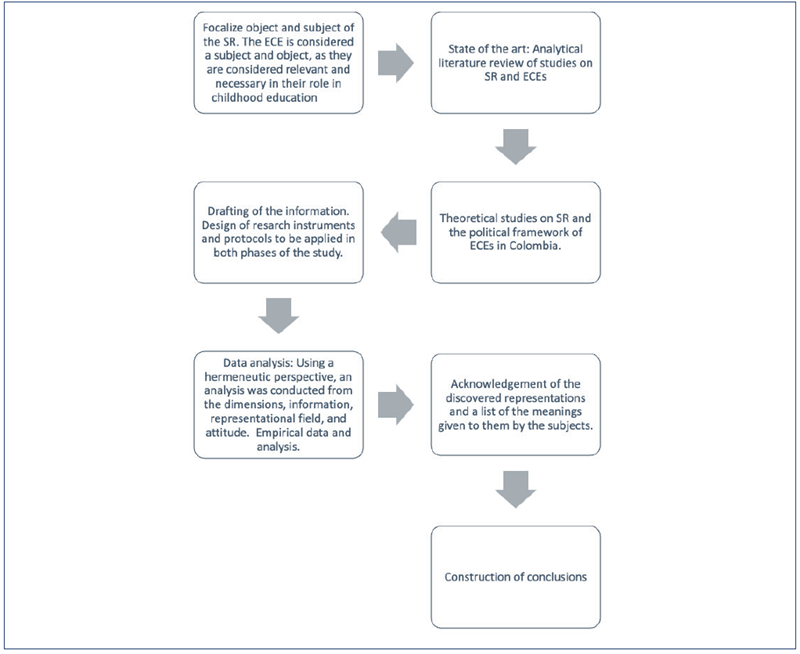
The study was structured in the following stages:
Research participants
The sample was purposive, which, according to Maxwell (1996), is a strategy in which people, settings, or events are deliberately selected to obtain relevant information that could not be obtained as effectively through other methods. Thus, a sample of 61 ECEs was established in the first phase and 20 in the second. Gender characteristics were taken into account (according to one of the gaps identified in the state of the art), as well as years of work experience (ECEs with less than 5 years, between 6 and 19 years, and more than 20 years in their job). The educational institutions that make up the study sample are located in the Bosa and Kennedy districts; these were selected based on the 2023 enrollment statistics from the Bogotá Education Secretariat, thereby identifying the districts with the highest presence of early childhood education professionals. Likewise, ECEs who did not work in school settings, but in foundations, projects, or non-governmental organizations (NGOs).
Another criterion for selecting participants was that they be graduates with a bachelor’s degree in early childhood education, preschool education, or pedagogy, given that, only from 2016 onwards, in Resolution 02041, Chapter 3, Article 2, all bachelor’s degrees were designated as early childhood education. This selection maximized the informational relevance of self-perceived SRs.
COLLECTION OF EMPIRICAL DATA
Collection techniques and instruments
Data collection techniques included a sociodemographic survey, free word association, life stories, discussion groups, and reflective interviews. These tools were validated by experts from the International Center for Social Representations of the Carlos Chagas Foundation in Brazil during an international internship in March and April of 2024.
The data collection was carried out in two stages, as presented in Table 1.
| Research phase | Data collection technique | Process | Number of ECEs |
|---|---|---|---|
| Phase 1 | Research ethics review process | Ethical considerations | 61 |
| Sociodemographic survey | ECEs complete a multiple-choice survey | ||
| Free word association | Free associations to the term Early Childhood Educator. Meaning is categorized according to importance range criteria. | ||
| Phase 2 | Discussion group | Opportunity to discuss and reflect on the meaning of being an ECE | 20 |
| Life history | Written life history about the participants' professional dimension. | ||
| Reflective interview | Meeting to delve into different aspects of fundamental information. |
RESULTS
The research employed a three-dimensional analysis based on the postulates of Moscovici (1979), categorizing the information into the information field, representational field, and affective dimensions, as evidenced in Table 2.
Social representations of the Early Childhood Educator about themselves and their profession: a three-dimensional analysis
| Representational field | Information field | Affectivity and tendencies towards action |
|---|---|---|
| Figurative core | What is known | Emotional burden |
| General meaning and relationships | Information sources for the construction of the SR | Positive or negative experiences and reviews |
| Guidelines for the actions of the subjects |
Information field: what is known and the sources of information
The ECEs construct their knowledge from an experiential, practical, and heterogeneous dimension, in which social integration and group membership mediate access to information (Mireles, 2021; Hernández, 2020). This field of information is structured on three levels: self-knowledge, social perception, and political framework.
Self-knowledge of the Early Childhood Educator: between training and practice
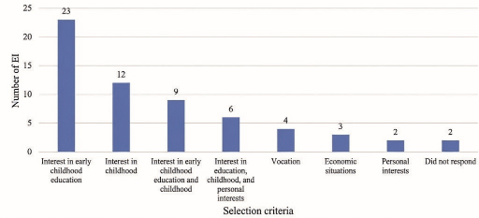
The academic knowledge of Early Childhood Educators originates primarily from vocation (45%), followed by family influence (25%) and job opportunities (20%) (see Figure 2). Although authors such as Devalle (2009) define training as a theoretical-practical space, the participants (P7, P3) express an SR that prioritizes practice over theory, which coincides with the findings of Dalmazo et al. (2012) and Santana (2017).
| Source of information: training | Well, for me, the teacher training college gave me the experience of being in context with children from the first semester, and that’s an advantage because, by being in contact with children, with what a school is like, in various environments—that is, they show us the private environment, they lead us to an observation practice, not of intervention, but observation of the private sector, the rural sector, the urban sector, both in the public and private spheres, so you get the whole picture of what it’s like to be a teacher there, in your own experience, and you can say, yes, I am made for this or not |
| Source of information: training | Luego ingrese a la universidad Monserrate donde realice mi formación que fue valiosa ya que se me dieron conocimientos de autores, políticos y didácticas, pero lo más importante fue luego de sexto semestre al realizar las prácticas en colegios que afianzaron mi interés por la educación preescolar, a pesar de que eran momentos difíciles |
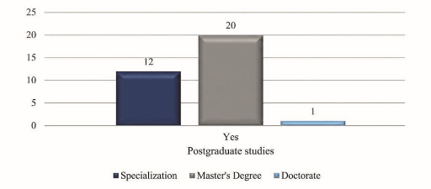
For ECEs, early exposure to diverse educational contexts (public, private, and nonschool-based) validates their professional identity. Regarding postgraduate training (Figure 3), a pragmatic motivation predominates: salary improvement and promotion in the teaching ranks.
Practical knowledge and tensions in their identity
The ECEs define their work as a “know-how” (Tardif, 2004) and face a constant tension with the hegemonic SR (Moscovici, 1979) of caregiving. In the discourses of the ECEs:
It is evident that there is a conscious effort to reposition the Early Childhood Educator as a leader in innovative pedagogical proposals, beyond mere caregiving, beyond being seen solely as “recreationists” or “caregivers” (P18). Regarding care, it is important to highlight the existing link between education and care (Dal Coleto, 2014), both of which are functions assigned to these professionals, as shown by Sousa’s (2019) research.
In addition, the association between early childhood education, motherhood, and domesticity (Pinzón, 2016; Dalli, 2002). This traditional view creates specific barriers for men, who report being stigmatized under suspicion of abuse (P5), reflecting a deeply entrenched sexual division of labor. The above is reflected in the following fragments:
| What is known: | Parents and society in general associate us with abuse; they think that because we are men, we are abusers. One day, a mother at a children’s home asked me who else the children would be with, if only me. |
| What is known: | We have always been associated with caring, entertaining, and recreation, but we must show that we are leaders in innovative and creative pedagogical proposals, and in enhancing learning and different aspects of the human being; we are the ones who face the greatest challenges; that is what we do, but what they don’t see. |
Social perception of Early Childhood Educators
The SRs held about male students are marked by social and cognitive undervaluation; the testimonies reveal prejudices that associate career choice with “low intellectual capacity” (P3, P19), as well as occupational segregation and prejudice against men (P5), which Moscovici (1979) identifies as conditioning factors of the information field of SRs. These culturally ingrained images act as barriers that condition self-perception and require strategies for professional visibility. Some of the testimonies of male students are presented below:
| What is known: | As the teacher said, well, she didn’t quite make it as a doctor, so she became a teacher, honey, because what else could she do? And it’s really sad, isn’t it? Really sad when you meet up with so many other colleagues, not just teachers, but also lawyers and doctors, and they talk about their jobs. And then you tell them, and it’s like, oh, poor thing, she has to take care of children. I mean, it’s a cultural thing, you know. At a cultural level, we are framed within that concept |
| What is known: | It was not so acceptable, and many thought it wasn’t for men. Furthermore, it was culturally and socially believed that people who did so—and they openly expressed this—were not suited for preschool education. Many teachers in teacher-training programs at other universities stated that anyone who entered preschool education did so because their brains weren’t capable of anything more. In other words, they were cognitively very weak, so to speak, or their cognitive capacity was very low compared to the rest of the population. |
| What is known: | Parents and society in general associate us with abuse; they think that because we are men, we are abusers. One day, a mother at a children’s home asked me who else the children would be with, if only me. |
Influence of policies on social representations
Regarding the political framework, ECEs acknowledge a surge in early childhood regulations, but they show an instrumentalization of their role: policies focus on the well-being of the child, making invisible the needs and profile of the professional who executes said policy (P3), highlighting a gap between the legal discourse and the operational reality (P13).
| Sources of information | I think there is indeed a surge in early childhood education policies, but these policies don’t specifically address Early Childhood Educators; rather, they focus more on children’s general education than on the professionals involved. |
| Sources of information | I believe there really is a link or a clash because, if we read the policies, the early childhood guidelines, the initial cycle—all of this is specified in documents; it’s very nice, well detailed—but if we look at reality, the context is quite different. |
Lack of information on studies
Finally, there is a shared epistemological gap: ECE professionals are unaware of previous studies on their own professional profile in Colombia. This lack of reference points was confirmed in the accounts of P5 and P10. The finding aligns with the state of the art in studies on the invisibility of their SR and underscores the relevance of this study in providing empirical data on their identity.
Emotions, feelings, and dispositions for action: an affective dimension in social representations
The affective dimension in SRs constitutes a structured field of “shared symbolic-emotional productions” (González, 2008, p. 236) that mediate professional practices. The study acknowledges a marked emotional ambivalence. On the one hand, passion and vocation predominate (“being in love with the career”); on the other, frustration and burnout arise due to job insecurity, low wages, and the social stigma of being seen as “caregivers.” In men, this is compounded by exhaustion from social prejudices linked to the risk of abuse, which shapes their social behaviors and daily action plans (Moscovici, 1979).
Emotional burden: passion and professional burnout
On the one hand, there is this affective charge, driven by pleasure, satisfaction, and professional passion, that goes beyond spontaneous reactions to affective information and is intended to be incorporated into their dialogues.
| Emotions and feelings | Feeling that love, that achievement of saying, well, I did it, I achieved it, here I am, and I am here to give my all to keep going, to keep innovating. |
| Emotions and feelings | Regarding positive emotions, like that feeling of being in love with the career, I think it’s like the state, or it’s one of my states regarding my teaching profession, that feeling of being in love with that profession, wanting what I do, that satisfaction of a duty well done, of doing things right as they should be done. |
On the other hand, their discourse expresses sadness, disillusionment, burnout, and frustration, resulting from social devaluation and poor working conditions. The educators’ testimonies show that being considered teachers “in a cartoon-covered smock” (P4) strips their work of intellectual rigor.
| Emotions and feelings | It is unpleasant for us teachers who work in the private sector that our contracts are not continuous and that the salaries are so low, because that undoubtedly does not provide a good quality of life for you as a teacher. |
| Emotions and feelings | Many colleagues, you see the caregiver side of them, how exhausting it is to work with so many children, and how they manage to cope with them. It seems extremely difficult, they say, they always mention that they couldn’t do it, that they don’t know how to handle it, they think it’s just another job of caregiving and having a lot of patience. I mean, it really is sad and frustrating. |
Likewise, men who practice this profession face social stigma, which affects their feelings and hinders their professional development.
| Emotions and feelings | So that social burden that exists regarding the stigma of the male teacher, and more when these things happen, yes, it’s difficult. Sometimes he vents to you and says things like, “Sometimes I don’t know how to handle that closeness, that affection from the children, that spontaneity.” Besides, he’s the physical education teacher, so when he gets to PE class, it’s a complete avalanche. |
| Emotions and feelings | That stigma of the macho man but also going to the extreme of the man who somehow abuses, because let’s say those are those prejudices and those stigmas that exist socially, and that somehow generates exhaustion. |
Similarly, there is a sense of anguish at the “dehumanization” of educational centers, seen by families as “garages or parking lots” (P14, P19), which generates a feeling of abandonment and melancholy.
| Emotions and feelings | Emotions and feelings. Oh no, sadness, melancholy, abandonment, let’s say the negative ones, seeing it as abandonment, not from the children, but from the parents, the lack of empathy; I feel disappointed in others that we only have |
| Emotions and feelings | Parents just want to bring them to school and have them there all day, rather like a parking garage. |
Experiences and assessments that structure their professional practice
Assessments of professional trajectory are shaped by a dialectic between rewarding experiences and formative tensions (Larrosa, 2006).
In reflective interviews, when inquiring about “a negative experience in their initial training and professional life,” narratives emerge that reveal formative tensions and work, integrating the affective dimension of SR (Moscovici, 1979).
Some of the answers are presented below.
| Positive experiences | Negative experiences |
|---|---|
| Fortunately, there are more positive experiences, memories, and lessons learned; there's also a sense of self-challenge, of reflecting and rethinking, because it's not just about teaching. Personal communication, reflective interview (P2) |
My colleagues throw me off balance, they really do. They don't do anything, they don't let others do anything, they try to create a bad atmosphere. When I say, well, we're all different personalities, we can't love each other, but we can follow a common path, come on, let's support each other. Personal communication, reflective interview (P19) |
| Working in the south of the city through these programs with comprehensive attention to children, from the coordination of educational projects, in the playroom where children attend freely, and at the same time, there is an intentionality. Personal communication, reflective interview (P16) |
At university, I couldn't do an internship in a kindergarten because the work was with very young children, so it was unpleasant at that moment. Personal communication, reflective interview (P8) |
| Returning to university, but this time as a teacher of Early Childhood Educators and guiding their training placements, has been one of the most positive and pleasant experiences on a professional level, because it has meant thinking about myself from a different perspective. Personal communication, life story (P7) |
When I started working in the private sector, suddenly, they aren't paid very well, or they are exploited all day. That never crossed my mind, because what always mattered to me was being with the students and thinking that from there I could do many things. Personal communication, reflective interview (P6) |
Trends towards action: visibility and professional reconstruction
Social representations not only interpret reality, but also guide dispositions to act (Moscovici, 1979). In the case of individuals, these predispositions are oriented towards the visibility and reconstruction of the role.
What is most frequently repeated in the actors’ discourse is the relevance and reconstruction of their role. There is a clear tendency to want to “redefine the teaching profession,” “make visible” their work, and “reconstruct and reconceptualize” it. They recognize the importance of “giving value to themselves” and not expecting others to do it.
Despite acknowledging historically low union participation (P11), a declared intention to organize and fight for decent working conditions emerges (P4). This tendency towards action translates into a willingness to move from invisible labor towards a politically situated and dignified pedagogical practice.
| Lines of action: | Regarding forming unions or something like that, there is little participation from preschool teachers. I’m also referring to what happens at my school; many of my co-workers don’t like it either, and secondly, few of them are taken into account. |
| Struggle | We have to organize, no matter what, because we have no other alternative but to fight for a decent preschool. And speaking of courage, to conclude, I would like to...to reflect on what we are facing with this district government |
Representational field: core and meanings of Early Childhood Educators
The representational field of the ECEs is organized around a figurative scheme (Moscovici, 1979) that gives meaning to its identity. This core is not a passive copy of reality, but a complex construction that integrates cognitive and affective elements (Jodelet, 2011). The figurative model was structured and interpreted according to the frequency, range of importance, sense, and meaning that the group of professionals assigns to each of the terms they use to associate, link, or identify ECEs. In addition to the above, interviews inquired about the meaning of being ECEs.
The SRs about ECEs of the subjects were ordered in the figurative scheme, based on heterogeneous representations, which are not simply a reflection of the outside world that is mechanically incorporated into the individual’s cognitive system as a mere passive reproduction of the external in the internal or an image in the usual concept of copy (Jodelet, 1986). The image in Social Representations Theory (SRT) is understood, according to Jodelet (1986), “...a series of features of a concrete character that bring into play the intervention specifically of the individual or social imaginary or of the imagination.” (p. 477).
The core of SR is structured under the concept of a “sensitive specialist teacher”.
Professional-intellectual dimension: The ECEs are defined as a leading subject and constructor of pedagogical proposals (Curriculum Guidelines, 2010). This is achieved through terms such as research, innovation, critical reflection, and technical capacity (P27, P32, P36), which are positioned as central axes in positioning the educator as a specialist capable of transforming children’s realities.
Ethical-affective dimension: Identity is nourished by sensitivity and empathetic pedagogical concepts such as love, passion, and accompaniment (P41, P50), which are not understood as mere emotions, but as professional skills that allow adapting practice to the rhythms and rights of children.
For educators, it is a recurring theme to recognize themselves as subjects who are constantly being trained and renewed in order to design and implement their pedagogical proposals that, in addition to weaving learning experiences, enable them to guarantee children’s rights and enhance different dimensions of the human being.
| “For me, being an early childhood educator is being everything; it is being a person who creates educational experiences for children based on various dimensions and themes.” |
| “A person trained to provide care according to their educational background” |
| “General leadership and creating innovative classroom strategies and activities” |
For educators working in universities and non-school settings, research is a related term that allows them to reflect on their professional practice, including the situations and needs that must be made visible.
| “That person who is always interested in staying informed about issues related to childhood and innovation, in order to implement new strategies in the classroom.” |
Similarly, support, love, and passion for their profession are frequent themes in representations of ECEs’ professional identity.
| “For me, it’s about guiding and supporting the processes of boys and girls.” |
| “Whoever inspires passion and a desire to work with children.” |
The central elements of the SR, organized around the figurative core, are embodied in a field of images that bring together the most prominent aspects expressed by the ECEs.
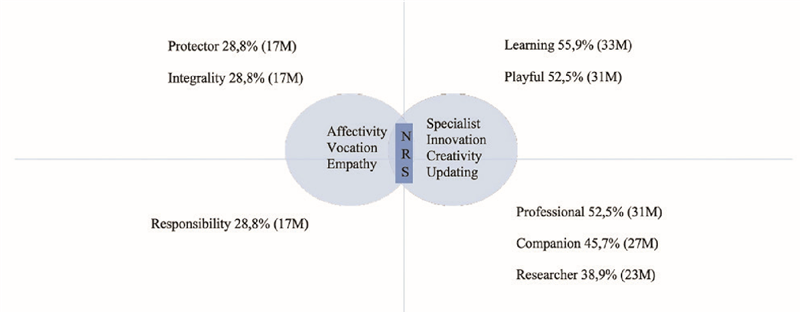
Image of the Early Childhood Educator: professional and sensitive
The image that is organized from the figurative core of the SR identifies the ECE as a dual compound: a specialized professional, reflective teacher with theoretical-practical knowledge, research ethics, and innovation, legitimized by Colombian regulations, and a sensitive individual defined by ethical love, pedagogical empathy, and relational passion with children, adapting practices to individual rhythms. The resulting image is that of a professional who reflects, specializes, and demonstrates ethics and empathy. The ability to investigate and the capacity to innovate are considered essential elements in the development of this professional’s practice.
In addition, a sensitive image is structured around love as a source of ethics and affectivity that gives meaning and identity to the profession, and is associated with concepts of dedication, passion, and relationship-building with children.
Empathy is established as a meaning of the practice, making it not only an emotion but also an essential pedagogical competence for understanding the other, appreciating the learning rhythms, and adapting the practice to the particularities of each child.
Regarding teaching, it is carried out by subjects who develop representations and identities of the early childhood education profession, which are created and recreated, but, above all, nourish professional practice, stimulate teaching activity, and, in many cases, are a source of commitment to generate learning in students (Buitrago-Bonilla & Cárdenas-Soler, 2017).
This complementary ambivalence (empathetic-professional caregiver) nurtures the professional identity and guides teaching action (Buitrago-Bonilla & Cárdenas-Soler, 2017), integrating subjective dimensions shaped by social realities (Mireles, 2011). Thus, SRs not only classify the profession but also creatively energize it. In conclusion, the representational field of Early Childhood Education in Bogotá is defined by the fusion of pedagogical rigor and ethical affectivity, breaking down the false dichotomy between “the one who knows” and “the one who cares,” to consolidate an identity of “sensitive specialist.”
DISCUSSION
The results confirm that SR in ECEs of Bogotá functions as a “practical knowledge” that organizes the behavior of professionals. This construction coincides with that proposed by Aguirre-Dávila (2023), who highlights the rise of studies on representations in Colombia to analyze common sense in education. The tension between professional identity and the stigma of caregiving reinforces the findings of González-Giraldo et al. (2021) on identity crises in early childhood education students.
Likewise, the prevalence of experiential knowledge over theoretical knowledge in this study is in dialogue with the research of Leão-Maia and Santos-da-Costa (2019) and Hernández-Prados and Ayala de-la-Peña (2021), who emphasize how biographical narratives and daily practices are the primary sources of the educator’s identity, without ignoring, as Tobío et al. (2021) state, that the early childhood education profession demands a broad and complex set of knowledge, aimed at guaranteeing the comprehensive care and attention of children.
The ambivalent affective dimension and the impact of gender observed in the Colombian capital are closely related to those reported by Sousa (2019) in Latin American contexts. The feminization of early childhood education continues to shape actors’ perceptions, as these professionals also serve functions assigned to them, where the male presence remains minimal due to cultural and social stigmas (Martín-Vidaña, 2021). This situation highlights an element to be addressed in future studies: How have gender inclusion policies in Colombia impacted, or not impacted, that hegemonic feminized social representation of care?
Finally, the recognition of the social representation of work beyond school, as well as the importance and versatility of their professional work, is disrupting the associations society commonly makes about caregivers and workers who are seen only in kindergartens.
CONCLUSIONS
The research allows us to conclude that the identity of the ECEs lies in a symbolic dispute between two types of representations. On the one hand, there is a hegemonic SR, external to the professional group, which associates early childhood education exclusively with maternal care and recreation. This view, shared by society and families, tends to naturalize the work as an extension of the domestic and private sphere, making its pedagogical complexity invisible.
In contrast, a controversial social representation emerges. This type of representation arises from the educators themselves as a form of resistance and a struggle for professional autonomy. The selected group of ECEs attempts to displace the stigma of the “caregiver” or “recreationist” to position a figurative core centered on the teacher as a specialized professional, researcher, and innovator. It is a conflicted representation that seeks to transform social perception through everyday practice.
The representational field of educators is organized around a figurative core in which the term “teacher” serves as the central axis, seeking to objectify an image of a specialized professional, researcher, and innovator. However, this core coexists in a dialectical tension with an external hegemonic representation that reduces their work to healthcare and maternal care. In addition, a symbolic struggle is identified to shift the image of the early childhood educator from that of a “recreationist” or caregiver “in a cartoon-covered smock” to that of a pedagogical professional. This resistance seeks to normalize professionalization in the face of a society that still associates early childhood education with the welfare sphere.
The attitude dimension reveals an ambivalent affective charge: one observes the phenomenon of “falling in love with the career” and passion that sustains the professional vocation. However, this same emotional charge generates sadness and frustration derived from precariousness. Workplace issues, low wages, and social devaluation are contributing factors. In men, this attitude is mediated by a “burnout” stemming from prejudice and social fear of abuse, which undermines their pedagogical spontaneity.
Social representations are not just knowledge, but guidelines for action. Sources indicate that the ECEs are moving beyond merely redefining their work as an organization and are struggling to demand decent conditions and real political recognition, which, according to the teachers, looks “nice in documents” but ignores the realities of the context.
The information possessed by the ECEs is primarily built from practical and experiential knowledge. The value placed on certain sources is noteworthy. While theoretical training is perceived as a conceptual foundation, it is practical training and work experience that give meaning and make professional reality intelligible. A relevant finding is the lack of information that the subjects have about research carried out on themselves in the Colombian context, which suggests that the Early Childhood Educator has historically been an “object” of study by others and not a “subject” of their own representation until recent research, such as this.
The SRs of the ECEs are profoundly mediated by gendered occupational segregation. The historical feminization of the teaching profession anchors its representation in caregiving stereotypes, which particularly affects male educators. For them, this representation is tinged with social fear and the stigma of abuse, leading to burnout that limits their pedagogical spontaneity and negatively impacts their emotional well-being in the classroom.
In summary, the dimension of the SR of Early Childhood Educators in Bogotá, Colombia, is marked by a duality: on the one hand, a social perception that often minimizes and feminizes their role, and on the other, the struggle of the professionals themselves to redefine their identity, demonstrate their high qualifications and defend the fundamental importance of their work; it is a struggle that does not cease and the effort to redefine and give visibility to this profession is essential.
NOTE
This article presents the final results of the doctoral thesis entitled “The subject and object of their social representations, presented at the Interinstitutional Doctorate in Education of the Francisco José de Caldas District University.
ETHICAL COMPLIANCE
Informed consent was obtained from each participant, during which the researcher introduced herself and explained the research intent, and participants signed to authorize the handling of information for analysis and the protection of their identity. According to Resolution 0008430 of 1993, this research is classified as research without any risk to the participant.
FINANCING
The research received no funding or financing.
OPEN SCIENCE OBJECTS
At the time of the thesis defense, the final document will be placed in the university repository.
References
Aguirre-Dávila, E. (2023). Teoría de las representaciones sociales: Su desarrollo en Colombia en los últimos veinte años. En M. E. Ortega & A. Novaes (Eds.), Recuentos históricos de la teoría de las representaciones sociales en América Latina (pp. 145–190). Fundação Carlos Chagas. https://www.researchgate.net/publication/370013320_Teoria_de_las_Representaciones_Sociales_Su_desarrollo_en_Colombia_en_los_ultimos_veinte_anos
Dalmazo, M., Sousa, M., & Ferrogut, L. (2012). Saberes docentes e representações sociais. En V. Placco, L. Villas Bôas, & C. L. de Sousa Prado (Eds.), Representações sociais: Diálogos com a educação. Fundação Carlos Chagas.
DeValle-de-Redondo, A. (2009). La formación docente. Según las representaciones de los futuros maestros. Buenos Aires: Editorial Lugar.
Buitrago-Bonilla, R. E., & Cárdenas-Soler, R. N. (2017). Emociones e identidad profesional docente: Relaciones e incidencia. Praxis & Saber, 8(17), 225–247. https://doi.org/10.19053/22160159.v8.n17.2018.7208
Dal Coleto, A. P. (2014). Percursos para a construção de indicadores da qualidade da educação infantil [Tesis de doctorado, Universidade Estadual de Campinas]. Repositorio Unicamp. https://doi.org/10.47749/T/UNICAMP.2014.927376
Dalli, C. (2002). Constructing identities: Being a “mother” and being a “teacher” during the experience of starting childcare. European Early Childhood Education Research Journal, 10(2), 85–101. https://doi.org/10.1080/13502930285208971
González-Giraldo, O. E., Castellanos-Sánchez, M. T., & Bolaños-Motta, J. I. (2021). Crisis en la identidad profesional docente en estudiantes de Licenciatura en Pedagogía Infantil: Estudio de caso en una universidad pública. Revista Virtual Universidad Católica del Norte, (64), 180–207. https://doi.org/10.35575/rvucn.n64a8
Hernández, E. (2020). Las representaciones sociales de maestros de educación básica secundaria y media de Bogotá sobre los jóvenes en condición escolar [Tesis de maestría, Universidad Nacional de Colombia]. Repositorio Unal. http://hdl.handle.net/11349/26012
Hernández-Cervantes, L., & Pagès Blanch, J. (2014). La enseñanza de las ciencias sociales en la educación infantil en México: Las representaciones sociales y la práctica docente de nueve estudiantes de maestra de educación infantil. Educação em Revista, 30(1), 65–94. https://doi.org/10.1590/S0102-46982014000100004
Hernández-Prados, M. Á., & Ayala de la Peña, A. (2021). La identidad del educador infantil desde las narrativas biográficas. Magis, Revista Internacional de Investigación en Educación, 14, 1–23. https://doi.org/10.11144/Javeriana.m14.iein
Jodelet, D. (Ed.). (1989). Les représentations sociales. Presses Universitaires de France.
Jodelet, D. (2011). Aportes del enfoque de las representaciones sociales al campo de la educación. Espacios en Blanco. Serie Indagaciones, 21(1), 133–154. http://www.scielo.org.ar/scielo. php?script=sci_arttext&pid=S1515-94852011000100006
Larrosa, J. (2006). Sobre la experiencia I. Revista Educación y Pedagogía, 18(44), 43–67. https://revistas.udea.edu.co/index.php/revistaeyp/article/view/19065
Leão-Maia, L. de S., & Santos da Costa, K. T. (2019). Práticas docentes e representações sociais: O ser professor na educação infantil. Revista Portuguesa de Pedagogia, 53(1), 39–61. https://doi.org/10.14195/1647-8614_53-1_3
Martín Vidaña, D. (2021). Masculinidades cuidadoras: La implicación de los hombres españoles en la provisión de los cuidados. Un estado de la cuestión. Revista Prisma Social, (33), 228–260. https://revistaprismasocial.es/article/view/4095
Maxwell, J. A. (1996). Diseño de investigación cualitativa: Un enfoque interactivo (A. I. Palermo, Trad.). Gedisa. (Obra original publicada en 1996). https://www.trabajosocial.unlp.edu.ar/uploads/docs/maxwell___qualitative_research_design__cap_1.pdf
Mireles, O. (2011). Representaciones sociales: Debates y atributos para el estudio de la educación. Sinéctica, (36), 1–11. https://sinectica.iteso.mx/index.php/SINECTICA/article/view/121
Moscovici, S. (1979). El psicoanálisis, su imagen y su público. Huemul.
Pinzón, L. (2016). Romper estereotipos de género en la identidad profesional docente: Una propuesta de paz. Educación y Ciudad, (31), 71-81. https://doi.org/10.36737/01230425.v.n31.2016.1610
Sá, C. P. (1998). A construção do objeto de pesquisa em representações sociais. EdUERJ.
Sánchez, M. L. (2012). Representaciones sociales de profesoras de educación preescolar entorno a su profesión [Tesis de doctorado, Universidad Nacional Autónoma de México]. Repositorio Institucional de la UNAM. http://www.ciencianueva.unam.mx/handle/123456789/137
Santana, L. C. (2017). Representaciones sociales de las experiencias formativas en estudiantes de la Facultad de Ciencias y Educación. Caso: Universidad Distrital Francisco José de Caldas, Bogotá-Colombia [Tesis de doctorado, Universidad Santo Tomás]. CRAI USTA. https://repository.usta.edu.co/handle/11634/4079
Silva, A., Sarmento, K., Santos, W., Rodrigues, F., & Votre, S. J. (2012). Representaciones sociales sobre la educación física en la educación infantil. Revista de Educação Física, 23(3), 443–455. https://doi.org/10.4025/reveducfis.v23i3.12684
Sousa, A. (2019). Representações sociais de relações de gênero de professoras/es da educação infantil [Tesis de doctorado, Universidad Federal de Pernambuco]. Repositorio UFPE. https://repositorio.ufpe.br/handle/123456789/34149
Tardif, M. (2004). Los saberes del docente y su desarrollo profesional. Narcea.
Tobío, C., Alcañiz, M., & Martín Palomo, M. T. (2021). La mirada de género en sociología. Síntesis.
Zapata, B. E., & Ceballos, L. (2010). Opinión sobre el rol y perfil del educador para la primera infancia. Revista Latinoamericana de Ciencias Sociales, Niñez y Juventud, 8(2), 1069–1082. https://doi.org/10.11600/rlcsnj.8.2.91